
Table of contents
- 1) At-a-glance
- 2) Real-life meaning (what “child-resistant” actually means)
- 3) How a push-and-slide kraft box works
- 4) Size & fit chart (typical pre-roll dimensions)
- 5) Fit math: a quick calculation example
- 6) Step-by-step: quick checks you can do at home
- 7) Troubleshooting: when the tray sticks or the lock won’t hold
- 8) Common myths
- 9) Safety & standards (how “child-resistant” is tested)
- 10) FAQ
At-a-glance
What it is
A child-resistant pre-roll box is designed to be significantly harder for young kids to open, while still being usable by most adults. It’s not the same thing as “child-proof.”
Many cannabis rules use “child-resistant” as a required packaging performance standard, not just a label.
What a push-and-slide box feels like
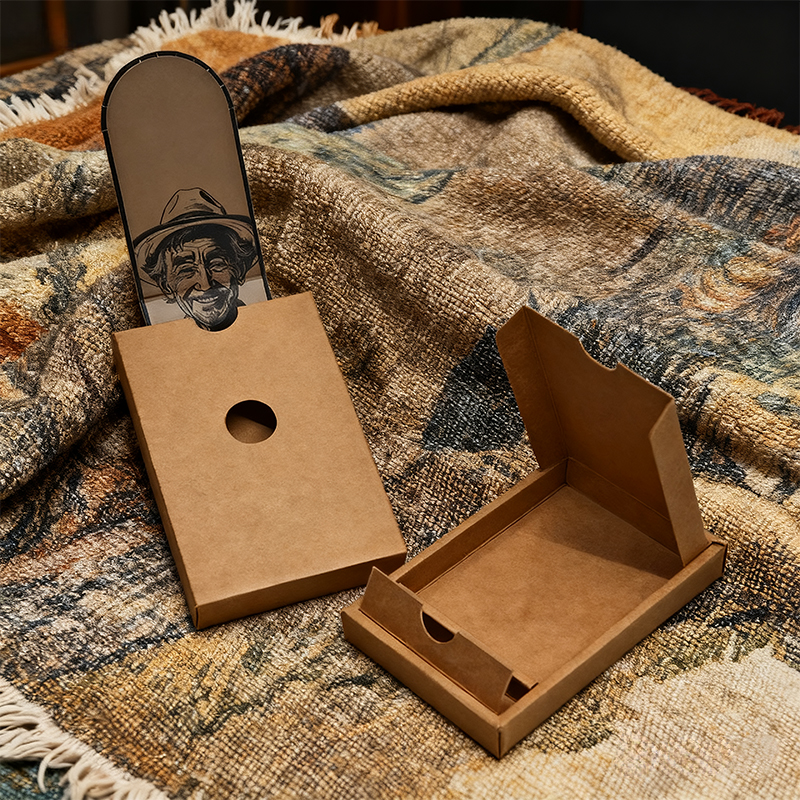
You usually need two actions at once: press a locking tab and slide an inner tray. If you try to slide without pressing, it should resist.
Example structure: outer sleeve + inner sliding tray + locking tab (kraft paperboard). Source
Safety note: Child-resistant packaging reduces risk, but it does not replace safe storage. If kids are in the home, treat cannabis like medication: locked, high, and out of sight.
Real-life meaning (what “child-resistant” actually means)
In plain language, child-resistant means the package is designed so most children under five can’t open it within a reasonable time—while most adults can. That “performance” idea is central in U.S. child-resistant packaging rules under the Poison Prevention Packaging Act (PPPA).
For many cannabis products, states often point to the same federal child-resistant framework in 16 CFR Part 1700. For example, Washington’s cannabis rules reference child-resistant packaging consistent with 16 CFR Part 1700, and California’s regulator explains that cannabis goods must be sold in child-resistant packaging. CA reference
Bottom line: the package should require an adult-like sequence (press + slide, squeeze + pull, push + turn, etc.). If it opens easily with one simple motion, it may not be functioning as intended.
How a push-and-slide kraft box works
A common paperboard “push-and-slide” design uses a locking tab to block the inner tray. To open, you press the tab (to clear the block) while sliding the tray out. In the kraft paperboard example box, the listing describes an outer sleeve with an inner sliding tray and locking tab, using a push-and-slide child-resistant mechanism. Example description
Quick “how to open” (gentle method)
-
Hold the outer sleeve in your non-dominant hand.
-
Find the locking spot (often a small tab area). Press it with your thumb.
-
While still pressing, use your other hand to slide the tray out slowly.
-
If it resists, stop—don’t force. Re-seat the tray fully closed, then try again with firmer tab pressure.
-
To close, slide the tray fully in until you feel/hear a soft “click” or see the tray sit flush.
Tip: If you’re opening it one-handed without thinking, it may be worn, damaged, or not actually locked.
Size & fit chart (typical pre-roll dimensions)
Pre-rolls and cones vary a lot. The most reliable approach is to measure your actual pre-roll length and thickness. Then make sure the inner tray has a little extra room so the tip doesn’t get crushed.
| Common pre-roll style | Typical length range (mm) | Typical diameter range (mm) | Recommended inner length = pre-roll length + headspace | Why headspace matters |
|---|---|---|---|---|
| “Mini” / short pre-rolls | ~70–85 | ~6–8 | Add 5–10 mm | Reduces tip damage and helps the tray close without pressure |
| “Standard” cones (varies by brand) | ~90–100 | ~7–9 | Add 5–10 mm | Prevents bending, especially if the tray is tight or humid |
| Longer / “king-style” cones | ~105–115 | ~7–9+ | Add 8–12 mm | Extra room helps avoid crushing the filter end or the cone tip |
If your box is a “custom size” style (many kraft paperboard pre-roll boxes are), confirm the inner tray dimensions from the spec sheet or by measuring the tray yourself. The example kraft push-and-slide box listing notes customizable sizing/capacity. Example listing
Fit math: a quick calculation example
Use this simple check: Minimum inner length = (your pre-roll length) + (headspace). Most people do well with 5–10 mm headspace; go higher if the cone is fragile or the box is snug.
Example
Your pre-roll measures 98 mm long. You choose 8 mm headspace.
Minimum inner length ≈ 98 + 8 = 106 mm.
If the inner tray is shorter than that, expect tip damage, bending, or a tray that won’t fully close (which can also weaken the lock over time).
Step-by-step: quick checks you can do at home
These checks don’t “certify” anything, but they can tell you if a push-and-slide box is behaving like a child-resistant closure should. (Official testing uses formal protocols—see the standards section below.)
-
Close check: Slide the tray fully in until it sits flush. If it won’t sit flush, the lock may never engage.
-
One-motion check: Try to slide the tray open without pressing the tab. It should resist.
-
Two-action check: Press the tab and slide. It should open smoothly without tearing paperboard.
-
Shake check (gentle): With the tray closed, lightly shake. Contents shouldn’t force the tray open.
-
Re-close consistency: Open/close 5 times. A working lock should feel consistent; “mushy” engagement can mean wear or swelling.
-
Fit check: With the pre-roll inside, the tray should close with no bulge and no scraping friction.
-
Label check: If your state requires warnings or symbols, confirm they’re present and readable on the package you received.
| What you notice | Most likely cause | What to do (safe, non-destructive) | When to stop using that closure |
|---|---|---|---|
| Tray won’t slide unless you force it | Paperboard swelling (humidity), tray misalignment, overfilled contents | Remove contents; re-seat tray fully closed; try again with the tab pressed. Store in a drier place. | If the sleeve tears, the tab creases permanently, or it requires excessive force |
| Tray slides open without pressing the tab | Locking tab not engaging, worn tab, damaged sleeve | Close fully until flush; check for crushed corners or a bent tab area. | If it repeatedly opens with one motion (lock no longer reliable) |
| “Click” feel is inconsistent | Tab edge wear, glue/debris in the track, box deformation | Inspect the track area; keep packaging clean and dry; avoid sitting on it or carrying loose in a pocket. | If it fails the close check after a few tries |
| Pre-roll comes out bent / tip crushed | Too little headspace, inner tray too short, tight diameter | Increase headspace target; choose a package with more inner length; don’t pack extras tightly against the cone. | If you can’t close without contact pressure on the pre-roll |
Troubleshooting: when the tray sticks or the lock won’t hold
Paperboard child-resistant closures are sensitive to crushing (pocket carry), humidity, and overfilling. If something feels off, fix the physical cause first—then re-check the lock behavior.
Fast troubleshooting checklist
-
Remove the contents and test the empty box first.
-
Check corners: crushed corners can pinch the tray track.
-
Check the tab area: if it’s creased flat, it may not “catch” anymore.
-
Check for bulging: too many items can bow the tray and defeat the lock.
-
Move to a dry spot for a few hours if the box feels soft/swollen (humidity can change friction).
-
Re-test the one-motion check (no tab press) and the close check (flush fit).
Common myths
-
Myth: “Child-resistant” means a child can’t open it. Reality: It means most kids under five can’t open it within the test windows, not that it’s impossible.
-
Myth: If it has a locking tab, it’s automatically compliant. Reality: The design still needs to meet performance testing requirements in many jurisdictions.
-
Myth: If adults struggle, that proves it’s safer. Reality: Standards also look at adult usability—packaging should be hard for kids but usable for adults.
-
Myth: A box that’s hard to open once will stay that way. Reality: Wear, moisture, and crushing can weaken paperboard locks.
Safety & standards (how “child-resistant” is tested)
In the U.S., the federal child-resistant packaging framework is tied to the PPPA. The Consumer Product Safety Commission (CPSC) summarizes the goal as packaging that is significantly difficult for children under five to open, but not difficult for normal adults to use properly. CPSC overview
The detailed testing procedure for “special packaging” is laid out in 16 CFR 1700.20. This is why you may see states point to “16 CFR Part 1700” when defining child-resistant packaging requirements for cannabis products. For instance, Washington’s cannabis packaging rule references child-resistant packaging consistent with 16 CFR Part 1700. Washington rule
Important nuance: CPSC notes in its business guidance that it does not approve, certify, or endorse specific packages, manufacturers, or testing firms. CPSC guidance
If you want something you can verify
Ask for documentation that names the standard/protocol used (often referencing 16 CFR 1700.20 for U.S. “special packaging” testing), and keep that with the product if you’re responsible for storage around kids.
FAQ
Is “child-resistant” the same as “child-proof”?
No. Child-resistant packaging is designed to reduce access by young children, not eliminate it. Safe storage still matters.
Why does my push-and-slide box feel harder to open on some days?
Paperboard can change friction with humidity, crushing, or debris in the track. Test the empty box and check for bulging contents.
How do I know the lock is actually engaged?
Close until the tray sits flush. Then try sliding it open without pressing the tab. It should resist.
Can a pre-roll be “too tight” for a box even if the length fits?
Yes. If the diameter is tight, it can scrape the tray, bend the cone, or keep the tray from closing fully (which can prevent the lock from working).
What measurements should I take to check fit?
Measure pre-roll length and the thickest diameter. Then confirm the inner tray length/width and add headspace so the tip isn’t compressed.
Why do some state rules mention “16 CFR Part 1700”?
Because many jurisdictions use the federal child-resistant framework and testing approach as their baseline for what counts as child-resistant packaging.
Does a child-resistant box need to be resealable?
Sometimes. Requirements can vary by product type and state. Some rules distinguish between single-use and reclosable packages.
What should I do if the box opens without using the locking tab?
Stop relying on it as a child-resistant closure. Move contents to a secure storage option and avoid leaving it accessible to children.