
Quick answer: A cannabis package may have been opened or altered if its heat seal is split or uneven, a shrink band is torn or missing, a security sticker is lifted or misaligned, an inner foil seal is punctured, a tear strip is already detached, or the closure does not match an unopened package of the same type. Do not rely on one clue alone. Compare the outer seal, inner seal, closure, label, batch information, and product condition. If anything is questionable, do not use the product; keep the package and receipt, photograph the issue, and contact the licensed retailer.
Last updated: August 2, 2026
Tamper-evident packaging is supposed to answer one narrow but important question: Can you tell whether someone gained access before you? It does not prove what happened, who handled the package, or whether the product is safe. It gives you visible evidence that deserves a closer look.
That distinction matters with cannabis because retail packages come in many forms—pouches, jars, tubes, cartons, blister packs, bottles, and combinations of an inner container plus an outer box. A “broken seal” does not look the same on all of them. This guide shows ordinary consumers how to inspect common formats without opening the product, damaging evidence, or confusing child resistance with tamper evidence.
Table of contents
- The 60-second inspection
- Tamper-evident vs. child-resistant
- Intact and suspicious signs by package type
- How common seals should behave
- Damage that is not proof of tampering
- What to do when something looks wrong
- Cross-check the seal with the label and batch
- Packaging option for brands
- Frequently asked questions
A 60-Second Inspection Before You Leave the Store
The best time to notice a problem is before the package leaves the licensed retailer. You can usually perform this check without breaking a seal or handling the product itself.
- Identify the intended first-opening feature. Look for a heat-sealed strip, shrink band, breakaway ring, security label, tear tape, or inner membrane. A zipper or screw cap alone may be reclosable without being tamper-evident.
- Follow the seal from end to end. The bond should be continuous where the design requires it. Look for gaps, lifting edges, double sealing, a second adhesive layer, or a tear that begins away from the intended notch.
- Check alignment. A sticker that bridges a lid seam should align across both surfaces. A cap ring should sit evenly. A shrink band should fit the neck or lid without a missing section.
- Check the closure without defeating it. Do not pull hard enough to open the package. A cap, drawer, or zipper should not already be loose beyond its normal closed position.
- Compare the label and batch information. Product name, lot number, net quantity, and date information should be present and readable. An added label should not hide required warnings or a damaged seal.
- Look at the whole package. Punctures, oil stains, leakage, unusual bulging, strong residue, missing pieces, or a carton that will not sit closed can point to lost package integrity even when the main seal looks intact.
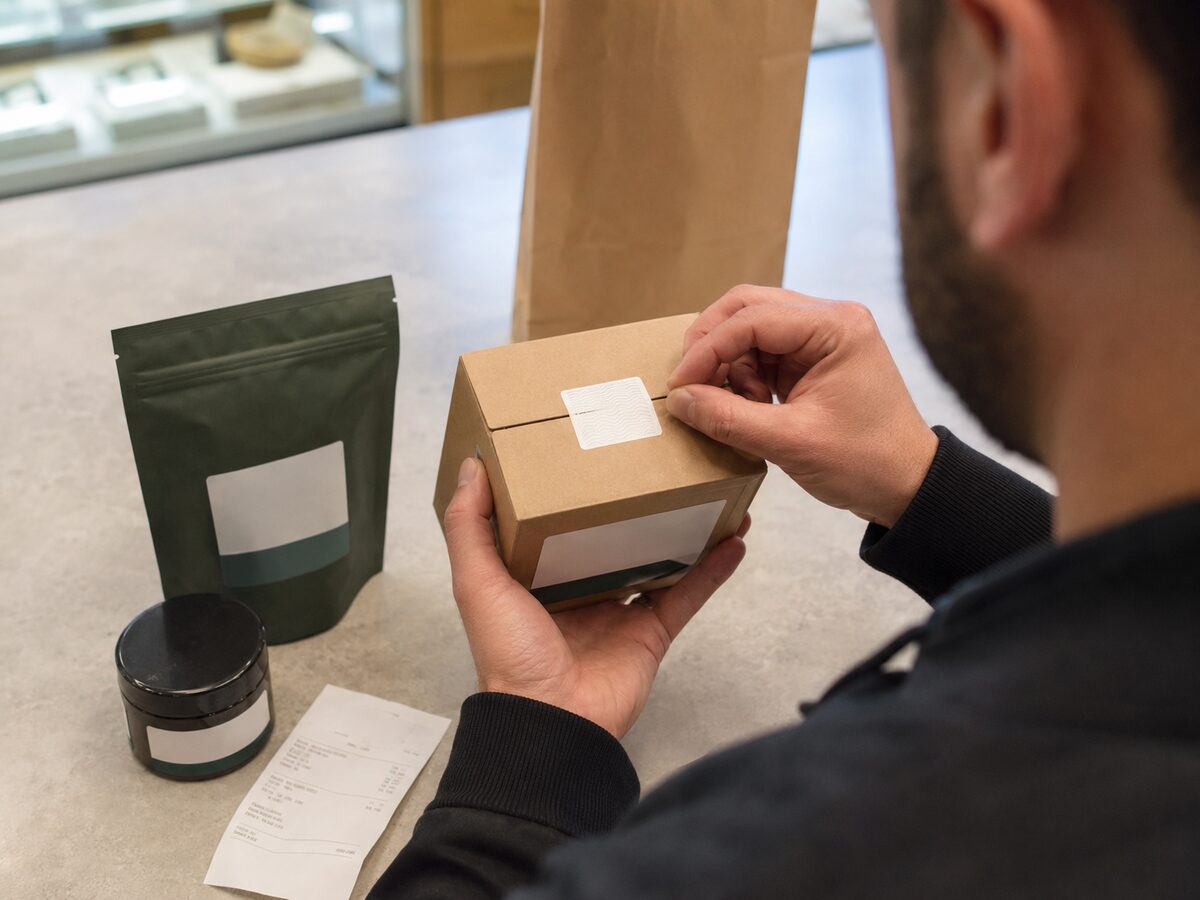
Practical rule: Stop when checking would require opening the package. Ask retail staff to compare it with another unopened unit instead.
Tamper-Evident, Child-Resistant, and Resealable Are Different Jobs
These terms are often grouped together, but they describe different functions. A package can perform one job and fail another.
| Feature | What it is meant to do | What consumers can check | What it does not prove |
|---|---|---|---|
| Tamper-evident | Makes prior opening or alteration readily detectable. | Broken seal, torn band, lifted label, popped button, separated tear strip. | That tampering never occurred or that the contents are safe. |
| Child-resistant | Makes access significantly difficult for young children while remaining usable by adults. | Closure is fully re-engaged and opening instructions match the mechanism. | That the package is childproof or can replace locked storage. |
| Resealable | Allows the package to close again after first use. | Zipper, cap, lid, or drawer returns to its intended closed position. | That the original first-opening seal is still intact. |
| Barrier protection | Limits exposure to moisture, oxygen, light, or odor transmission. | No punctures, open seams, leakage, or damaged closure surfaces. | Compliance, child resistance, or tamper evidence by itself. |
California’s Department of Cannabis Control describes tamper-evident cannabis packaging as a package sealed so a consumer can tell if it has been opened; its examples include a plastic seal, a sticker that rips across a lid, and a lid with an opening indicator. New York defines the concept around a seal, label, or marking that makes unauthorized access or tampering easily detectable. These examples help explain the function, but the exact rules still depend on the product and jurisdiction.
Sources: California Department of Cannabis Control and New York Office of Cannabis Management, Parts 128 and 129.
What Intact and Suspicious Packaging Looks Like
| Package format | Common first-opening evidence | Usually intact | Pause and ask the retailer |
|---|---|---|---|
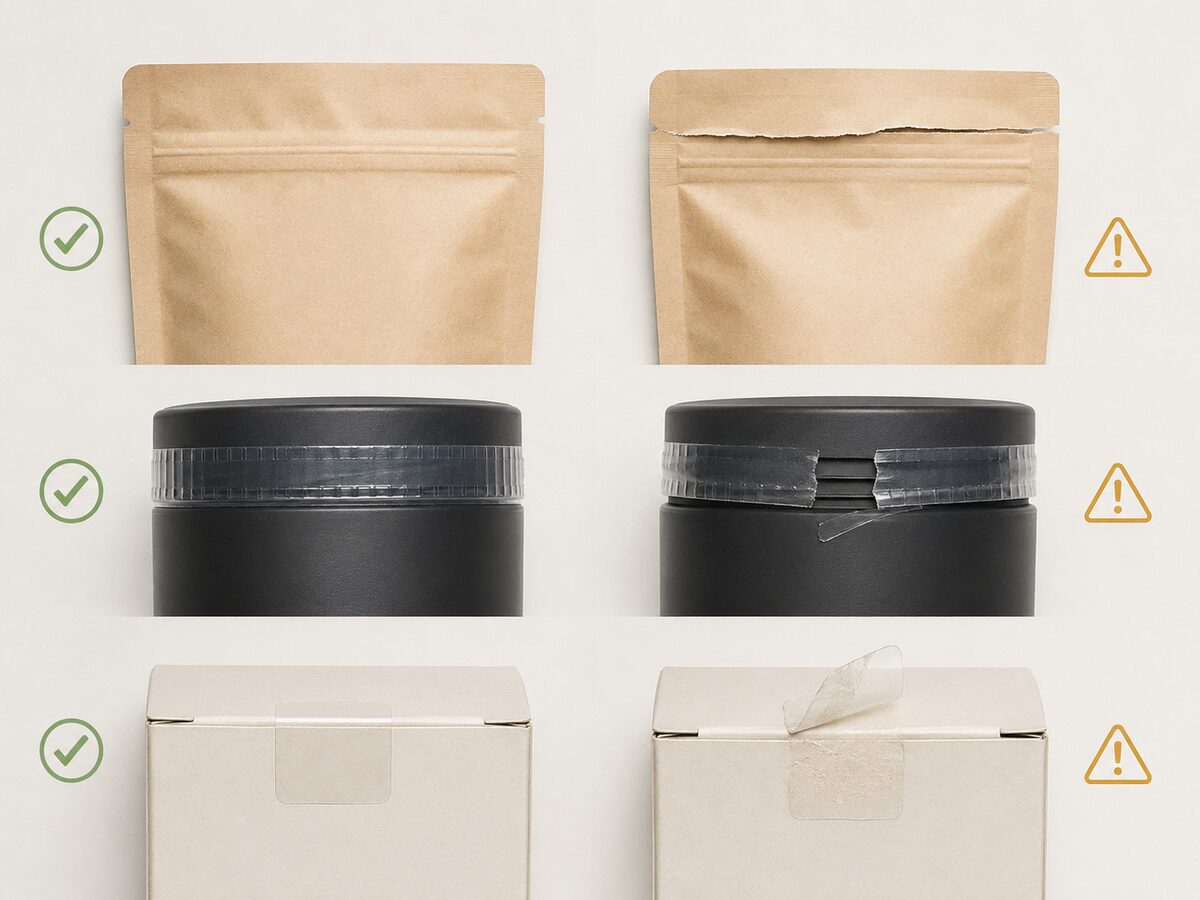
| Flexible pouch | Heat seal above zipper, tear strip, or tear notch | Top seam is continuous; zipper is inaccessible until the strip is removed | Gap through the seal, top already removed, uneven reseal, puncture, zipper accessible without tearing |
| Jar or bottle | Shrink band, breakaway ring, foil membrane, button lid | Band or ring is complete; inner membrane is uniformly bonded | Band split, ring detached, membrane punctured or partly lifted, lid button already raised |
| Paper carton | Security sticker, perforated flap, locked tear tab | Sticker bridges the seam; perforations are connected; flap sits flush | Lifted adhesive, paper fibers pulled away, double label, misaligned graphic across seam, torn perforation |
| Pre-roll tube | Shrink sleeve, security label, break feature | Sleeve fits continuously; label crosses cap/body seam | Cap can be removed without disturbing evidence; band has a cut or missing section |
| Blister or unit-dose pack | Foil or lidding film bonded around each cavity | Every cavity is sealed and shaped consistently | Pinholes, pushed cavity, peeled corner, mismatched lidding film, or one unit missing |
How Five Common Tamper-Evident Features Should Behave
1. Heat-Sealed Pouch Tops
A retail pouch may have a permanent seal above a reusable zipper. The top strip must be cut or torn away before the zipper can be reached. On an intact package, the seal line should run across the usable width without an open channel. Wrinkles near the seal are not automatically evidence of access, but a wrinkle that creates a path through the sealed area is different from a cosmetic crease.
2. Shrink Bands and Sleeves
A shrink band wraps a cap, jar neck, or tube seam and must tear before the closure can be removed. Check the whole circumference. A band can look complete from the front while being split at the back. Perforations are normal when they form the intended opening path; a jagged break away from that path is not.
3. Security Stickers Across a Seam
A sticker can bridge a carton flap, jar lid, or drawer edge. It should adhere to both sides of the opening. Suspicious signs include lifted corners with dust beneath them, adhesive residue beside the current label, paper fibers pulled from a carton, a sliced line through the sticker, or a second sticker covering the first. A decorative label placed entirely on one panel is not tamper evidence if the package can open without disturbing it.
4. Inner Foil or Film Membranes
Some jars and bottles have an inner seal beneath the cap. It should be bonded around the rim. A partly attached membrane may reflect poor sealing rather than deliberate tampering, but the practical consumer response is the same: do not use the product until the retailer or manufacturer resolves the issue. FDA guidance for certain over-the-counter products explains the core principle well—the seal should have to tear or break to reach the contents and should not be removable and replaceable without visible evidence. Cannabis rules are state-specific, but the physical inspection logic is useful.
Source: FDA tamper-resistant packaging guidance.
5. Breakaway Rings and Pop-Up Indicators
A breakaway ring on a cap should remain connected before first opening. A pop-up button or similar indicator changes position after the vacuum or closure is released. Do not press, twist, or manipulate an indicator just to test it; ask the retailer to compare the unit with another unopened package.
What Can Look Suspicious Without Proving Tampering?
Visible damage is a reason to stop—not a reason to accuse someone. Packaging problems can begin during sealing, packing, transport, stocking, or temperature changes. The correct question is whether package integrity can still be trusted.
| Observation | Possible non-tampering cause | Consumer response |
|---|---|---|
| Wrinkled pouch top | Film handling or heat-sealing variation | Check whether the wrinkle crosses the seal and creates an open channel. |
| Scuffed carton corners | Shipping or shelf contact | Distinguish surface rubbing from a flap, sticker, or perforation that has opened. |
| Shrink band slightly uneven | Normal shrink variation | Inspect the full circumference for a split, cut, or missing section. |
| Sticker off-center | Application tolerance | Check adhesion, residue, sliced edges, and whether it still bridges the opening. |
| Loose product movement | Headspace or imperfect internal fit | Do not shake aggressively; compare with a matching unopened package. |
A practical retailer comparison is often the fastest answer. If two units of the same product have clearly different first-opening features, ask staff which condition is intended and request a replacement when the seal cannot be verified.
What to Do if the Seal Looks Broken or Altered
- Do not consume, inhale, apply, or transfer the product. Do not taste or smell it closely to “test” it.
- Do not repair the package. Tape, glue, a new bag, or a reclosed zipper can erase useful evidence.
- Photograph before handling further. Take clear images of the full package, damaged feature, product label, batch or lot number, and receipt. Avoid posting personal information publicly.
- Keep the package and receipt together. Place the entire item in a separate secure container, locked away from children and pets.
- Contact the licensed retailer promptly. Explain what you observed without guessing at the cause. Ask about its return, quarantine, and incident-reporting procedure.
- Retain batch information. The retailer or manufacturer may need the lot number to check other units or identify a broader packaging issue.
- Check official recall or regulator channels when appropriate. Rules and reporting routes vary by state.
If a child may have consumed cannabis, or anyone has severe symptoms, treat it as a health emergency rather than a packaging complaint. The CDC advises contacting a healthcare provider, health department, or Poison Control at 1-800-222-1222, and calling 911 in an emergency. See the CDC cannabis poisoning guidance.
General FDA consumer guidance also recommends avoiding products whose packaging is open, torn, damaged, or unusual. Although that page addresses food tampering rather than cannabis regulation, the purchase-stage habit is sensible: do not take a questionable sealed product home when it can be inspected or replaced at the point of sale. Source: FDA food tampering consumer guidance.
Cross-Check the Seal With the Label and Batch
The seal is only one layer. A package can have an intact-looking sticker while other details suggest that the wrong label, wrong lot, or wrong outer package is present. Use the same batch-matching habits described in 420 Packaging’s cannabis label guide.
- Match the product name and form to what you ordered.
- Confirm net quantity and serving information where applicable.
- Record the batch or lot number before returning a questionable package.
- Check that package and expiration dates are readable and not covered.
- If a QR code links to a Certificate of Analysis, match its batch number to the physical package.
- Look for labels applied over torn seals, old labels, or required warnings.
For a broader explanation of how child resistance, tamper evidence, label space, and product protection work together, see the site’s medical marijuana packaging guide.
Product Bridge: Build First-Opening Evidence Into the Pouch
Personalized Logo on 3.5g Childproof Mylar Zipper Pouch

For brands choosing a flexible format, this official 420 Packaging product page lists a 3.5g capacity, childproof zipper, Mylar material, zipper closure, custom logo support, and a tamper-evident seal. The displayed price range is $0.10–$0.60 per piece; final pricing depends on the project.
| Capacity | 3.5g |
| Material structure | MOPP + VMPET + PE |
| Closure | Zipper top with childproof design; product page also lists a tamper-evident seal |
| Customization | Custom logo and gravure printing; custom orders accepted |
| Official source | View verified product page |
Important: A product page feature list is not a substitute for compliance review. The finished package, seal process, fill method, artwork, test documentation, and sales jurisdiction must all be checked for the exact project. Packaging only; no cannabis product is included.
Brands can also compare the broader weed bag selection and child-resistant packaging category. The best system is one in which the consumer can identify the intended first-opening feature immediately, without hiding warnings or confusing it with the reclosable mechanism.
A Better Seal Is One Consumers Can Understand
Technical performance matters, but visible logic matters too. A security feature fails its communication job if an ordinary adult cannot tell where to look, what should break, or how the package should look before first opening.
For brand and packaging teams, a useful prelaunch test is to place filled mockups—not just flat dielines—in front of people who have never seen the design. Ask them to point to the tamper-evident feature, explain what would change after opening, and reclose the package correctly. If they point to the zipper when the true evidence is a heat seal, or assume a decorative sticker is the security seal, the structure or instructions need work.
| Design question | Good evidence | Common failure |
|---|---|---|
| Can the package open without disturbing the feature? | Access requires obvious destruction or irreversible change. | Sticker sits near the opening but does not bridge it. |
| Is first opening different from reclosing? | Heat seal or tear strip provides evidence; zipper provides later reuse. | Zipper alone is described as tamper-evident. |
| Can damage be seen from normal viewing angles? | Band, seal, or indicator can be inspected around the closure. | Evidence is hidden under a flap or placed only on the rear edge. |
| Does opening remove required information? | Warnings, batch number, and directions remain readable. | Tear strip carries the only batch or warning text. |
Frequently Asked Questions
Does a torn seal always mean someone tampered with cannabis?
No. A torn or poorly bonded seal can result from packaging, shipping, stocking, or handling damage. It still means package integrity is questionable. Do not use the product until the licensed retailer or manufacturer resolves the issue.
Can a package be child-resistant but not tamper-evident?
Yes. A push-and-turn cap, squeeze zipper, or locking drawer may be difficult for a child to open but may not show whether an adult opened and reclosed it. The two functions should be evaluated separately.
Is a zipper on a cannabis pouch a tamper-evident seal?
Not by itself. A zipper is normally reclosable. A separate heat seal, tear strip, or other irreversible first-opening feature commonly provides tamper evidence.
Should a cannabis jar have an inner foil seal?
Not every jar uses an inner membrane. The intended feature may instead be a shrink band, security label, breakaway ring, or indicator lid. Compare the package with the manufacturer’s design or another matching unopened unit.
Is a loose cap proof that the product was opened?
No, but it is a reason not to use the product. A loose cap can come from closure torque or transport problems. Inspect any band, ring, membrane, or sticker and ask the retailer for a replacement.
What should I photograph if a seal is damaged?
Photograph the full package, the damaged feature from more than one angle, the label, batch or lot number, dates, and receipt. Keep personal information out of any image you share publicly.
Can I return a cannabis product with a broken seal?
Return policies and cannabis rules vary. Contact the licensed retailer promptly, keep the package and receipt, and follow its instructions. Do not transfer the contents into another container before the retailer reviews the issue.
What if the seal is intact but the product looks wrong?
Do not use it. Leakage, unusual discoloration, foreign material, unexpected odor escaping from a damaged package, or a mismatch between product and label can still justify a retailer or manufacturer review.
Can a tamper-evident seal be resealed?
A properly designed first-opening feature should leave visible evidence after access. The rest of the package may be resealable, but the original evidence should not return to its unopened condition.
Does tamper-evident packaging guarantee safety?
No. It is one layer of risk reduction and communication. It does not replace licensed sourcing, testing, correct labeling, child-resistant design, locked home storage, or common-sense inspection.
Final Takeaway
Do not ask only, “Is there a sticker?” Ask whether the package could have been opened without creating an obvious, irreversible change. Then cross-check that evidence against the closure, label, batch information, and overall condition.
If the answer is unclear, the safest and simplest move is to leave the package sealed, document what you see, and ask the licensed retailer to replace or investigate it.
Planning packaging that makes first opening obvious?
View child-resistant options · Browse packaging formats · Request a packaging guide or quote