
Last updated: August 4, 2026

Quick Answer
Accessible child-resistant cannabis packaging must balance two goals: it should be difficult for young children to open while remaining usable by intended adults, including older adults and people with limited grip strength, dexterity, vision, or coordination. Start with packaging supported by the documentation required for your market, then compare opening motions using representative finished samples. Test whether adults can locate the opening point, understand the motion, grip the package, apply the required action, access the product, and properly resecure it. Favor broad contact areas, stable grip surfaces, high-contrast cues, concise instructions, and forgiving alignment. Accessibility testing supports better selection, but it does not replace standardized child-resistant testing or state-specific compliance review.
Child-resistant packaging should not become patient-resistant packaging. That problem matters especially in medical cannabis, where some intended users may live with arthritis, tremor, neuropathy, low vision, temporary hand injuries, or reduced hand strength. A closure that technically opens for a strong, experienced employee may still fail in ordinary use.
The practical question is not “Which closure is easiest?” An easy opening can undermine child resistance, while a difficult opening can lead adults to leave the package unsecured, transfer the contents, use tools, or ask someone else for help. The better question is: Which documented child-resistant structure creates the clearest, most repeatable opening task for the adults who will actually use it?
What Accessible Child-Resistant Cannabis Packaging Means
In U.S. federal special-packaging guidance, child resistance and adult usability are paired concepts. The U.S. Consumer Product Safety Commission describes special packaging as significantly difficult for children under five to open but relatively easy for adults to open. Its current FAQ states that at least 90% of adults in the applicable test must be able to open the package within five minutes and, for a reclosable package, properly resecure a second package within one minute.
Those federal protocols do not automatically decide whether a particular cannabis package is lawful in a state program. Cannabis packaging requirements are mainly state-specific, and the responsible licensee must confirm the applicable package, label, and documentation rules. Still, the federal adult-friendly principle gives procurement teams an important lens: a child-resistant mechanism is supposed to protect children and remain usable by adults.
Review the current CPSC Special Packaging FAQ and the 16 CFR § 1700.20 testing procedure published by Cornell Legal Information Institute. Then compare those requirements with the cannabis regulator guidance for every state where the product will be sold.
Accessibility is more than opening force
An adult may fail before force is ever applied. Usability includes a chain of tasks:
- Recognize where the package opens.
- Understand whether to push, pinch, squeeze, slide, twist, or lift.
- Hold the package securely without slipping.
- Coordinate simultaneous actions.
- Apply enough force in the correct direction.
- Remove the product without dropping or damaging it.
- Close and re-engage the mechanism completely.
A design that improves only one link may not solve the real problem. A lighter button is not useful if the user cannot see it. A clear arrow is not enough if the package requires a painful pinch. A large grip area does not help if the inner tray binds after the carton is filled.
Why Child-Resistant Packages Become Hard to Open
Most accessibility failures fall into five categories. Identifying the category makes it easier to change the structure without guessing.
- Strength barrier: the button, pinch point, cap, or sleeve requires more force than the user can comfortably sustain.
- Dexterity barrier: two small contact points must be pressed at the same time, or a fingernail is needed to lift a tab.
- Coordination barrier: the user must push and slide in opposing directions while stabilizing a small package.
- Vision barrier: the release point blends into the artwork, lacks contrast, or is hidden on an unfamiliar surface.
- Cognitive barrier: the opening sequence is not intuitive, the instructions are vague, or multiple arrows compete for attention.
Manufacturing variation can add a sixth barrier. Board thickness, coating friction, glue placement, insert pressure, humidity, and cut tolerances can make a production lot harder to open than the approved prototype. Adult usability must therefore be checked on finished production-intent samples—not inferred from a dieline or 3D rendering.
Opening Motion Comparison for Older Adults
No mechanism is universally easier. The table below is a screening framework for selecting samples to test. It is not a compliance rating and should not replace evidence for the exact package configuration.
| Opening Motion | Potential Advantage | Likely Barrier | What to Measure |
|---|---|---|---|
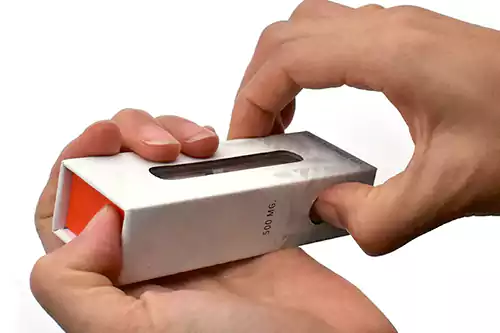
| Press and slide | Large sleeve can offer a stable grip and clear direction | Opposing hand actions; sleeve friction; small release area | Press force, slide force, thumb reach, opening time, false closures |
| Button and pull | Single release point can be easy to explain and mark | Concentrated fingertip pressure; button may be hard to locate | Button area, activation force, hold duration, tray resistance |
| Pinch and slide | Can create a compact, repeatable interlock | Requires pinch strength and simultaneous bilateral action | Pinch span, pinch force, slip rate, one-sided activation attempts |
| Push and turn | Familiar motion for many adults | Grip strength, wrist rotation, cap diameter, joint pain | Downward force, torque, grip diameter, reclosure confirmation |
| Flip-top with secondary lock | Familiar lid motion and broad package body | Lock location may be hidden; lid may need fingertip lift | Lock visibility, release sequence, lid lift force, re-lock feedback |
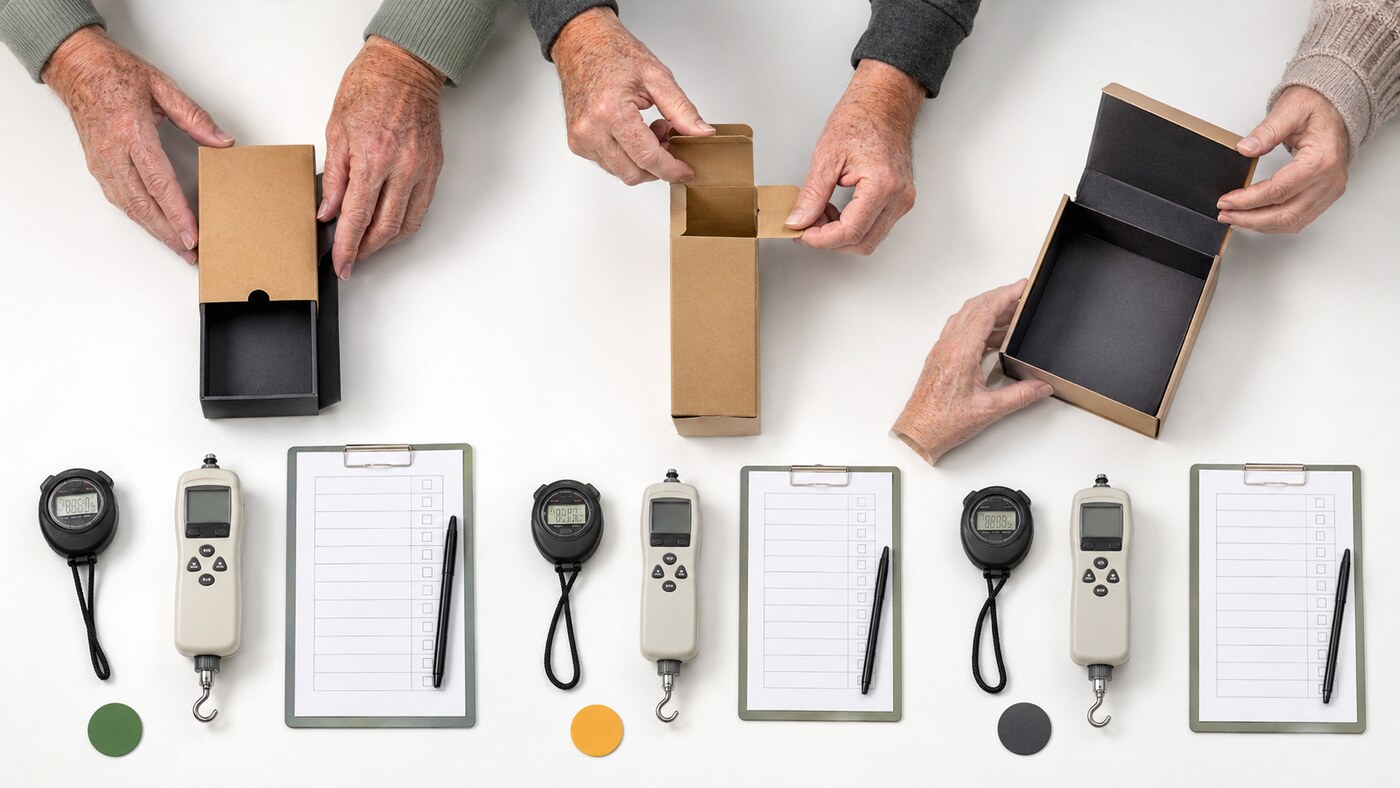
A Seven-Step Adult Usability Test
This internal test helps compare candidate structures and identify barriers before artwork and tooling are finalized. It does not replace the formal child and adult panel testing required for a certification or state rule.
1. Recruit people who reflect intended users
Do not test only with packaging engineers or employees who already know the mechanism. Include older adults and, where relevant, adults with varied grip strength, hand mobility, corrected vision, and prior familiarity. Participation should be voluntary, respectful, and safe. Do not ask users to push through pain.
2. Use finished, production-intent samples
Test the proposed board, coating, adhesive, insert, closure, print, label, and product weight. Fill the package with the legal product within licensed operations when appropriate, or use a safe representative substitute that matches size, weight, and handling behavior.
3. Start without coaching
Present the package as a customer would receive it. Ask the participant to open and properly close it. Observe where the participant first looks, which surface they grip, whether they find the release, and whether the package provides useful feedback. Coaching too early hides instruction and discoverability problems.
4. Record task-level outcomes
Use more than pass/fail. Record time to find the opening point, time to open, number of attempts, grip changes, slips, unintended tears, product drops, requests for help, reported discomfort, and whether the package was correctly resecured.
5. Repeat after a short interruption
A user may succeed immediately after learning the motion but forget it later. Repeat the task after another activity or on a second day. This reveals whether the opening sequence is memorable rather than merely teachable.
6. Test realistic conditions
Try normal indoor light, lower contrast, dry hands, and the way the package will actually be held. If the product is commonly used away from a table, include a standing test. Do not add unsafe conditions, and do not make one-handed opening a goal unless it is compatible with the required safety performance.
7. Define release criteria before testing
Decide what causes redesign. Useful stop signals include repeated inability to locate the release, pain or excessive effort, frequent tool use, damaged packages, product drops, incomplete reclosure, or a large performance gap between experienced and first-time users. Keep the recordings and approved sample with the project file.
Adult Usability Scorecard
- Opening point found without help: Yes / No
- Correct motion understood from package cues: Yes / No
- Opened without tools or pain: Yes / No
- Product removed without dropping or damage: Yes / No
- Package properly resecured: Yes / No
- Opening and reclosure repeated later: Yes / No
- Observed barrier: vision / strength / dexterity / coordination / comprehension / manufacturing
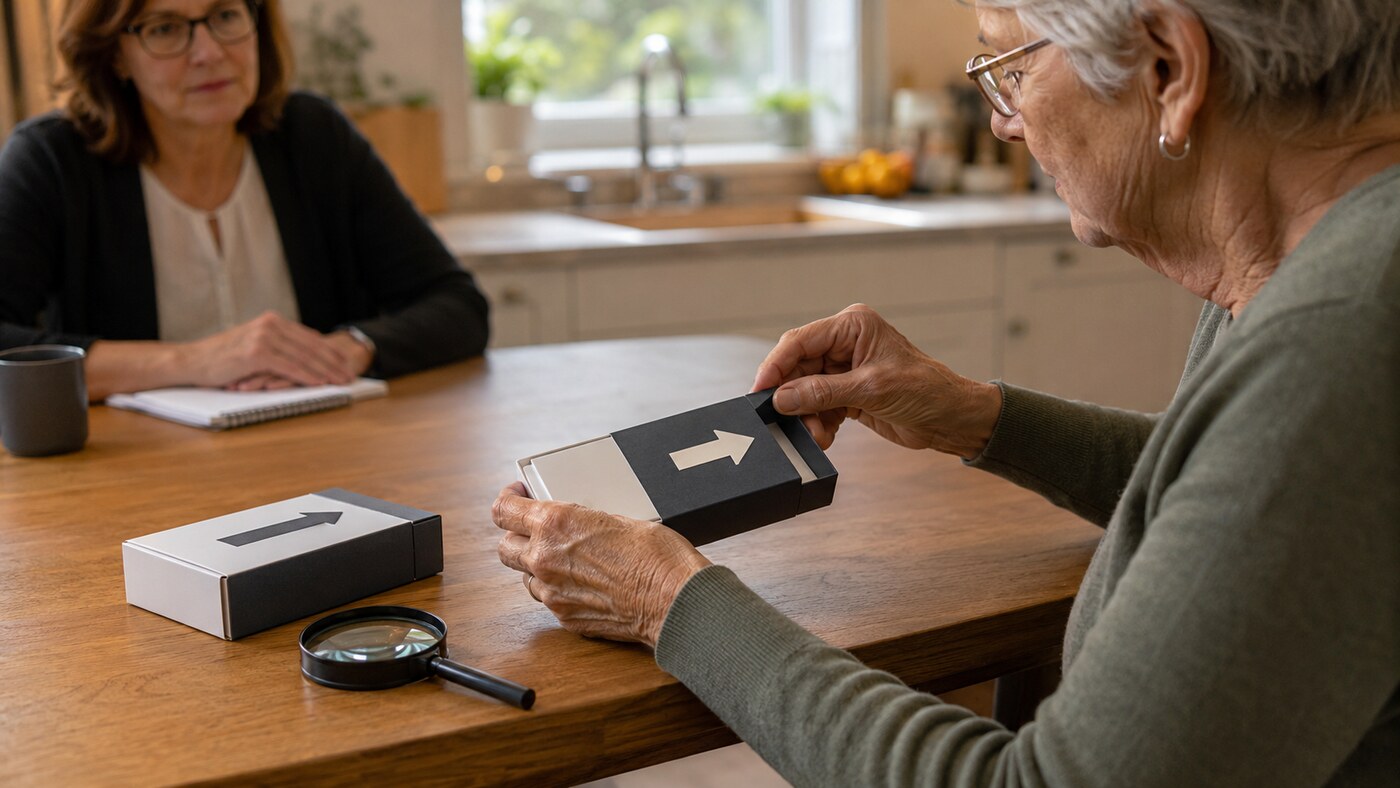
Improve Instructions and Visual Cues
Opening instructions should reduce uncertainty without revealing a mechanism in a way that conflicts with required testing or safety design. Coordinate instruction changes with the package supplier and compliance reviewer.
- Make the action specific: “Press here and slide tray” is clearer than “Open.”
- Show sequence: use numbered steps when two actions must occur in order.
- Use contrast: separate the activation zone from decorative graphics.
- Use redundant cues: combine shape, contrast, a short verb, and an arrow rather than relying only on color.
- Protect legibility: keep instructions away from folds, foil glare, seams, tamper labels, and variable-data stickers.
- Provide tactile location: a distinct surface, recess, raised area, or edge can help the user find the correct point by touch.
- Confirm reclosure: the package should provide visible, tactile, or audible feedback when the child-resistant feature is fully re-engaged.
Do not assume a QR-code tutorial solves the problem. A user may not have a phone available, may have low vision, or may need to open the package before accessing digital instructions. Put the essential opening instruction on the physical package when permitted and verify that all mandatory cannabis information still fits.
Recommended Packaging Options to Sample
These current 420 Packaging formats use different opening interactions and are useful for comparative sampling. Their official pages and images were checked on August 4, 2026. None should be selected from appearance alone: request the documentation applicable to the exact configuration and target market, then test finished samples with representative adults.
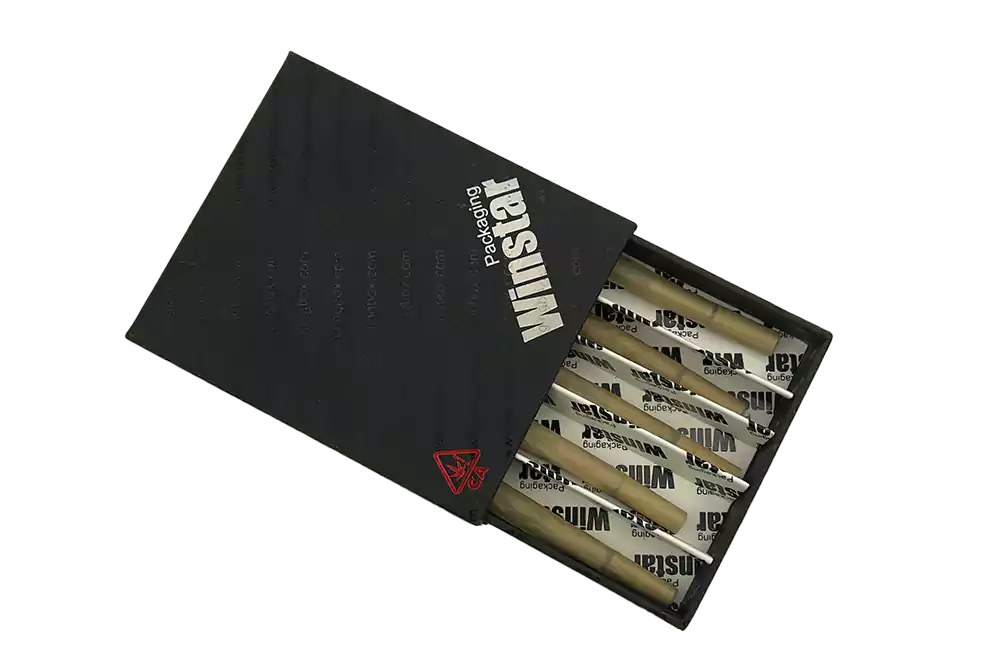
Raw Cones Packaging Box With Child-resistant Button
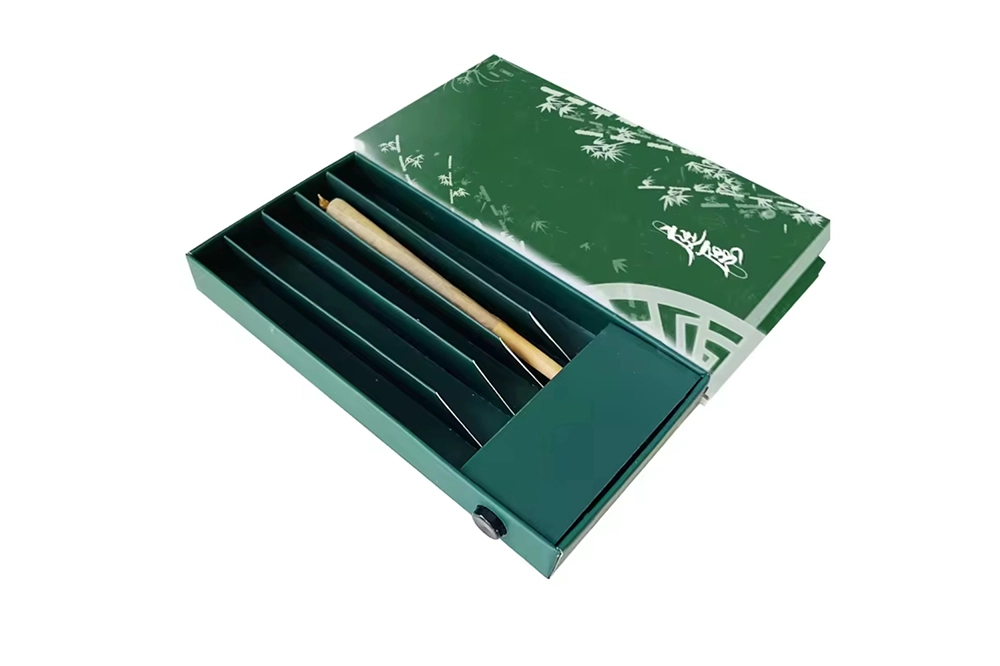
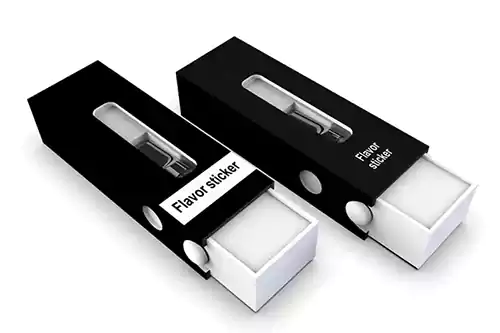
This high-quality paper package uses a child-resistant button and supports customized divider inserts. The single release location makes it suitable for studying button visibility, fingertip pressure, press-and-pull coordination, tray resistance, and whether the button remains usable after finishing.
Ask to test: activation force and contact area, contrast or tactile treatment around the button, whether the drawer binds when filled, and which documentation covers the exact size and structure.
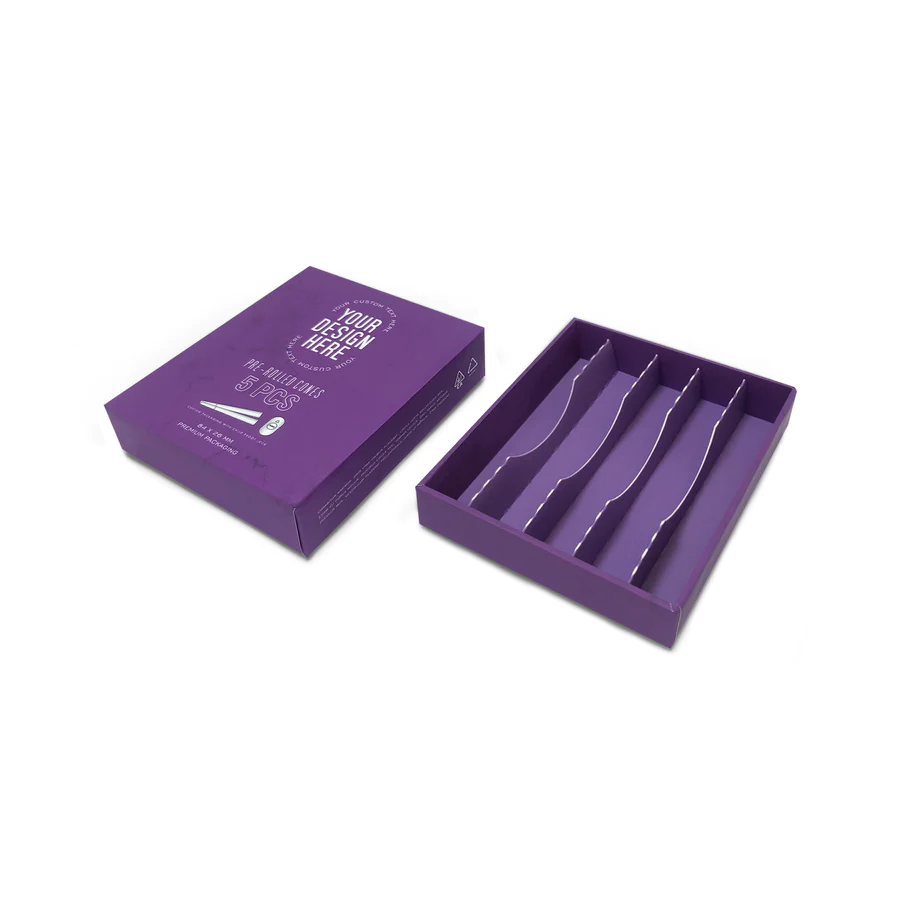
Child-Resistant Pre Roll Box 5 Pack
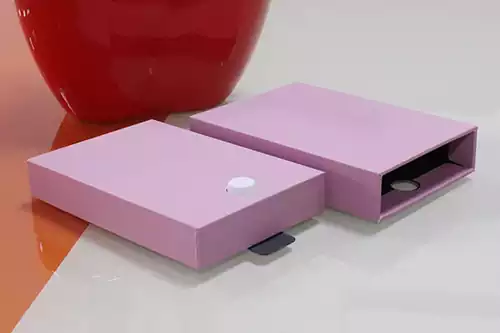
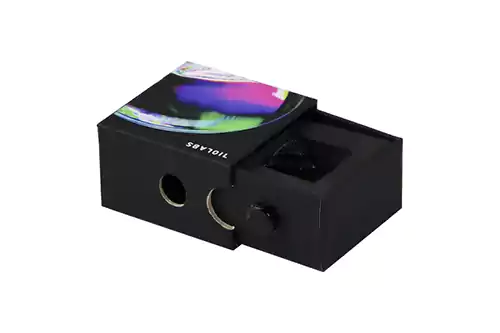
This paper drawer format holds up to five pre-rolls and places a child-resistant button on the back. The page lists custom sizes and shapes, optional dividers, 10pt–28pt paper-stock choices, and physical sampling on request. It is a useful candidate for testing whether the rear button is discoverable, whether users can stabilize the box while pressing it, and whether the tray opens smoothly without spilling the contents.
Ask to test: button location and force, full re-engagement after closing, dividers with the actual pre-roll size, coating friction, and performance across several production samples.
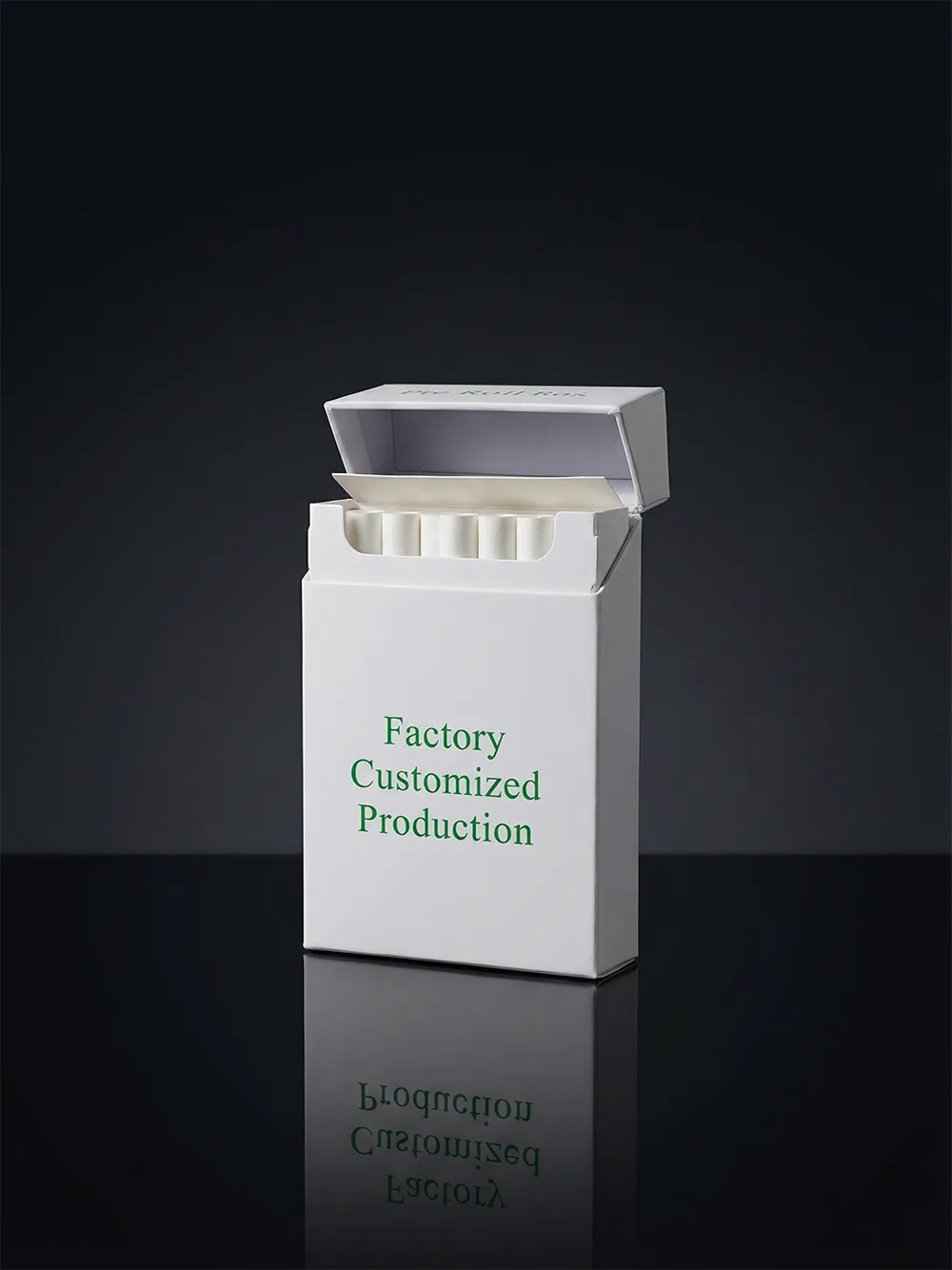
CR Flip-Top Box
The CR Flip-Top Box is a configurable pre-roll format with a flip-top opening, inner tray options, material and finish choices, and documentation options tied to the requested market. Its familiar lid form may reduce uncertainty, but the secondary lock, lid-lift action, and re-lock feedback still need direct user testing.
Ask to test: how users locate and release the lock, lid lift force, opening with reduced fingertip dexterity, tray access, reclosure confirmation, and the documentation set for the chosen size and pack count.
For a wider structural comparison, review the current Child Resistant Packaging collection. Treat category descriptions as a starting point; verify the specific product, evidence, and finished configuration before ordering.
Supplier Question Checklist
Send these questions before approving tooling or bulk production:
- Which child-resistant test report applies to this exact size, material, closure, and configuration?
- Does the supporting protocol include the applicable adult-use portion, and can we review the report scope?
- Which dimensions, materials, coatings, or structural changes would fall outside that scope?
- What are the measured release force, slide force, torque, pinch span, or other motion-specific specifications?
- Can the activation area be made broader, higher contrast, or tactile without changing validated performance?
- How will the package communicate that it is fully reclosed?
- Can we receive multiple production-intent samples with final print, coating, insert, and product weight?
- What in-process checks control cut position, glue, friction, button alignment, and closure performance?
- How will lot-to-lot changes be communicated and approved?
- Can the supplier support a pilot run and pre-shipment functional sampling?
Common Accessibility Mistakes
- Testing only employees: familiarity and packaging experience can hide discoverability problems.
- Equating low force with accessibility: reach, grip, vision, sequence, and reclosure also matter.
- Adding tiny arrows after tooling: instructions cannot compensate for an impractical physical motion.
- Using color alone: a low-vision or color-vision-deficient user may miss the cue.
- Ignoring pain: task completion is not a success if it causes discomfort or requires unsafe leverage.
- Testing an empty white sample: final weight, coating, labels, inserts, and artwork change handling.
- Forgetting reclosure: adults may open the package but fail to re-engage its safety feature.
- Changing the lock informally: an accessibility modification can affect the configuration covered by testing.
- Calling a package “senior-friendly” without evidence: describe the tested feature and result instead of making a broad unsupported claim.
Frequently Asked Questions
What is accessible child-resistant cannabis packaging?
It is packaging selected and designed to remain difficult for young children to open while reducing unnecessary vision, strength, dexterity, coordination, and comprehension barriers for intended adult users.
Is child-resistant the same as childproof?
No. Child-resistant packaging is designed to be significantly difficult for children to open under specified testing conditions; it is not impossible for every child to open. Store all cannabis securely and out of children’s sight and reach.
Does 16 CFR § 1700.20 include an adult test?
Yes. CPSC guidance explains that special packaging must satisfy applicable child and adult test requirements. The exact protocol and applicability should be reviewed for the package and regulatory context.
Which child-resistant closure is easiest for older adults?
There is no universal winner. Press-and-slide, button-release, pinch-and-slide, push-and-turn, and flip-top systems create different barriers. Compare finished samples with representative users and verify that any change remains within the supported safety configuration.
Can a cannabis brand test accessibility itself?
A brand can run formative usability studies to compare designs and identify barriers. Internal testing does not replace standardized child-resistant testing, required documentation, or state compliance review.
How many adults should participate in an internal usability test?
There is no single required number for an informal design study. Start with enough varied representative users to reveal recurring barriers, then conduct additional rounds after redesign. Do not present internal results as formal certification.
Should opening instructions be printed on the cannabis package?
Clear physical instructions can improve discoverability when permitted. Keep them concise, high contrast, and away from folds or required information. Confirm the wording and placement with the supplier and compliance reviewer.
Can I make the button larger without retesting?
Do not assume so. A larger or differently shaped activation area may change child-resistant performance or move the package outside the configuration covered by existing evidence. Ask the test laboratory or responsible compliance expert.
What should stop approval of a child-resistant package?
Stop when representative adults repeatedly cannot find or operate the mechanism, experience pain, resort to tools, drop the product, or fail to reclose it—or when the supplier cannot show that the proposed configuration is covered by the documentation required for the market.
Does accessible packaging guarantee cannabis compliance?
No. Accessibility is one design and usability consideration. The finished package and label must still meet all applicable child-resistance, tamper-evidence, opacity, warning, symbol, material, and other state requirements.
Get Packaging Guidance
When requesting samples, provide the product type, target state, package dimensions, pack count, intended users, preferred opening motion, required documentation, and any known vision or dexterity considerations. Request multiple finished samples so the decision can be based on real use rather than a rendering.