
Last updated: October 28, 2026
Cannabis brands selling into California should no longer treat “recyclable,” the chasing-arrows symbol, or directions telling consumers to recycle as generic artwork elements that can be added simply because a package contains paper, plastic, metal or another commonly recycled material. California SB 343 established criteria that products and packaging must satisfy before recyclability indicators are used. CalRecycle states that the law’s 18-month grace period ended October 4, 2026 for products and packaging manufactured after that date. However, as of this update, CalRecycle also states that a federal court issued a preliminary injunction on July 14, 2026 blocking enforcement of SB 343. That injunction does not erase the underlying recyclability framework or eliminate the need to review environmental claims. Cannabis brands should audit the exact finished package, identify every material and component, distinguish whole-package claims from component claims, document the evidence supporting the claim, and separately confirm cannabis-specific requirements such as child resistance, tamper evidence, resealability and opacity where applicable. Do not assume that a paper box, kraft package or “eco-friendly” material automatically qualifies for a California recyclability claim.
This article reflects publicly available California guidance as of October 28, 2026. CalRecycle states that SB 343 labeling restrictions are tied to packaging manufactured after the October 4, 2026 grace-period deadline, but also reports that a federal preliminary injunction currently blocks enforcement. The litigation status can change. Packaging teams should check the current official California guidance before releasing new artwork or making a legal determination.
For years, sustainability reviews for cannabis packaging often started with a simple material question:
“Is it paper or plastic?”
Then came an equally simple conclusion:
“Paper is recyclable, so put the recycling symbol on it.”
That workflow is no longer adequate for packaging intended for California.
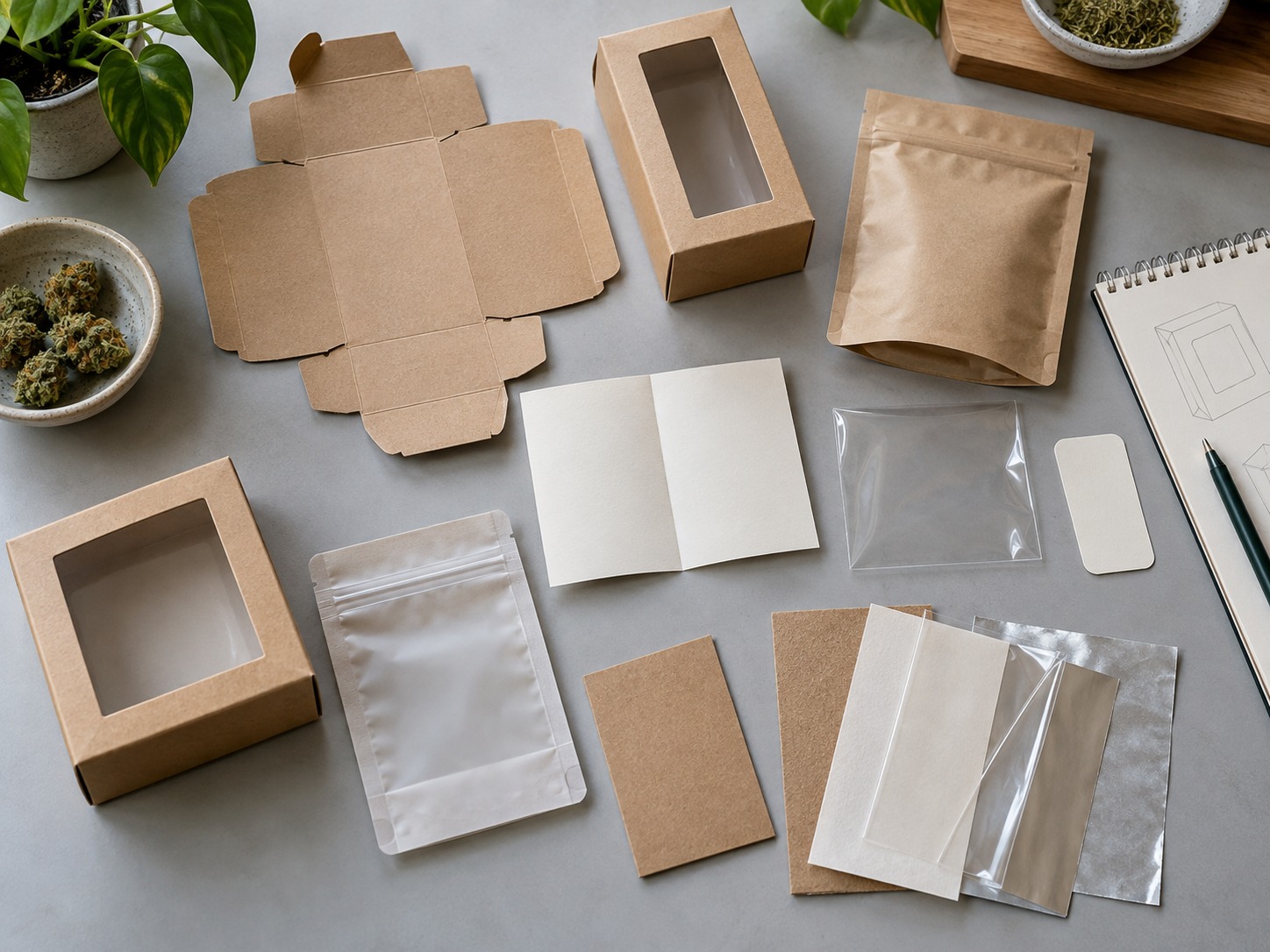
A child-resistant pre-roll box may be mostly paperboard but still contain a laminate, adhesive, locking component, insert, clear window or decorative finish. A rigid cannabis package may combine paper, foam, magnets and plastic. A pouch may look like one piece of material while actually being a multilayer laminate engineered for odor, oxygen and moisture barrier performance.
The consumer sees one package.
The recycling system may see several different materials joined together.
That distinction matters under California’s recycling-label rules.
For cannabis brands, there is an additional complication: environmental claims do not replace cannabis packaging requirements. A package still has to perform its regulatory and product-protection job.
The useful question is therefore no longer:
“Can we make the package look sustainable?”
It is:
“What exactly are we claiming about this exact finished package, and what evidence supports that claim in the market where it will be sold?”
Why SB 343 Matters Right Now
SB 343 is often called California’s “Truth in Recycling” or “Truth in Labeling” law.
The important issue for a packaging buyer is that it changes recyclability claims from a casual design choice into a claim that needs a documented basis.
CalRecycle’s current guidance states that the 18-month grace period following publication of its Final Findings Report ended on October 4, 2026.
The timing is based on when products and packaging are manufactured, not simply when a retailer sells the inventory.
View CalRecycle’s current SB 343 recycling-label guidance.
That makes the issue particularly relevant for cannabis brands placing new packaging orders now.
A carton printed in early 2026 and a new production run manufactured later in October 2026 may not sit in the same timing category.
Why cannabis brands should care
Cannabis packaging changes frequently because brands routinely update:
- strains;
- flavors;
- warning panels;
- state-specific artwork;
- product weights;
- child-resistant structures;
- seasonal graphics;
- materials and finishes.
That means cannabis brands often have more artwork revisions than a conventional consumer product with one package design used for several years.
If recycling language is embedded in the artwork template, an outdated environmental claim can be duplicated across many SKUs very quickly.
What Recycling Claims Does SB 343 Address?
CalRecycle’s SB 343 FAQ describes the law as covering more than the familiar three-arrow recycling symbol.
The scope includes indicators or statements that communicate recyclability or direct a consumer to recycle a product or package.
That means the artwork audit should look beyond one icon.
Examples worth reviewing include:
- the chasing-arrows recycling symbol;
- “Recyclable”;
- “100% Recyclable”;
- “Please Recycle”;
- “Recycle This Box”;
- “Recycle After Use”;
- a recycling icon beside disposal instructions;
- environmental graphics that clearly communicate a recyclability claim.
Whether a specific claim is lawful depends on the actual package and applicable criteria.
CalRecycle specifically states that it does not make product-by-product determinations about whether a particular recycling label is lawful.
The manufacturer remains responsible for evaluating its product and packaging.
Read the official CalRecycle SB 343 FAQ.
Search the complete packaging file for both symbols and words. Removing the chasing-arrows icon while leaving “Please Recycle” elsewhere on the carton does not remove the recycling claim from the artwork.
What Does the 2026 Injunction Change?
This is the part many older SB 343 articles now miss.
CalRecycle’s current implementation page states that a federal court issued a preliminary injunction on July 14, 2026 that blocks enforcement of SB 343.
At the same time, CalRecycle continues its statutory work and states that the material-characterization study will be updated again in 2027.
So what should a cannabis packaging buyer do?
Do not treat the injunction as permanent artwork approval
A preliminary injunction is a current litigation status, not a permanent guarantee that a recycling claim will remain unrestricted.
Packaging may remain in inventory for months or years.
A brand that prints hundreds of thousands of units using a claim solely because enforcement is temporarily blocked may create a future artwork and inventory problem if the legal situation changes.
Build the evidence now
A more durable workflow is to:
- identify the actual package materials;
- evaluate the California criteria;
- remove unsupported claims;
- retain the documentation;
- monitor official updates.
This is useful even outside California because it reduces vague environmental marketing claims and improves packaging specification control.
SB 343 is not the only law that can affect environmental marketing. A temporary enforcement block should not be interpreted as permission to make inaccurate sustainability claims. Legal review may be appropriate for high-risk or high-volume packaging programs.
Cannabis Packaging Rules Still Apply Separately
A package does not become compliant cannabis packaging merely because its recycling claim is accurate.
California Department of Cannabis Control guidance separately addresses cannabis package functionality.
Current DCC guidance includes requirements relating to:
- tamper evidence;
- child resistance;
- resealability for applicable multi-serving packages;
- opacity for edible products, subject to stated exceptions;
- protection against contamination and harmful substances;
- restrictions on packaging that imitates products typically marketed to children.
Review California DCC final-form packaging requirements.
This creates a design hierarchy
The package must first perform the functions required for the cannabis product.
Then the brand can reduce environmental impact within that functional system.
For example, removing a plastic locking component might simplify material composition, but not if the change invalidates the child-resistant configuration that the brand relies on.
Likewise, removing a barrier liner may reduce material complexity but create unacceptable odor, oxygen or moisture performance.
| Packaging Goal | Question | Do Not Assume |
|---|---|---|
| Child resistance | Does the finished structure meet the applicable requirement? | Paper automatically means compliant |
| Tamper evidence | Can initial opening be detected? | A recyclable carton automatically provides TE |
| Product protection | Does the pack control the needed light, oxygen, moisture and physical risks? | Sustainable material equals adequate barrier |
| Recycling claim | Does the exact package support the claim? | A material name alone proves recyclability |
| Branding | Does artwork remain accurate after material changes? | Old eco copy can be reused automatically |
What Does California Consider When Evaluating Recyclability?

CalRecycle’s FAQ summarizes several statutory criteria used in California’s recyclability framework.
Among them are whether a material type and form is accepted by recycling programs collectively serving a specified share of California’s population and whether it is sorted into defined streams by qualifying processing facilities.
CalRecycle also points to product- and packaging-specific composition and design limitations.
This is why the answer cannot simply be:
“Paper is recycled in California, so every paper package is recyclable.”
The evaluation is more specific than the broad material family.
Material Type & Form matters
CalRecycle uses the concept of a Material Type & Form.
The specific design of the finished package matters when determining the appropriate category.
CalRecycle does not assign the category for each individual commercial package.
Manufacturers are expected to evaluate their own product or package using available information.
For a cannabis package, consider:
- base substrate;
- coatings;
- lamination;
- films;
- closures;
- inserts;
- windows;
- magnets;
- metal components;
- adhesives;
- size and shape;
- whether components separate in normal disposal.
This is why the final production specification matters more than a marketing description such as “eco paper box.”
Start With a Component Map, Not a Material Buzzword
Before deciding whether a recycling claim belongs on cannabis packaging, create a simple component map.
Example: child-resistant pre-roll paper box
| Component | Possible Material | Question to Verify |
|---|---|---|
| Outer sleeve | Paperboard / kraft paperboard | Exact substrate and coatings? |
| Inner tray | Paperboard | Same material as sleeve? |
| Divider | Paperboard / molded material | Removable or permanently attached? |
| Locking feature | Paper structure or added component | Does it introduce another material? |
| Surface finish | Varnish, film, coating | Does it alter the package classification or recovery? |
| Label | Paper or film label | Permanent or removable? |
| Adhesive | Glue | Where and how much? |
Once every component is listed, the sustainability review becomes much more concrete.
Instead of asking:
“Is this eco-friendly?”
you can ask:
“What is the finished sleeve made of, what finish is on it, and what parts remain attached at disposal?”
Can a Paper Cannabis Box Say “Recyclable”?
Potentially—but the word paper is not enough by itself to make that determination.
A plain paperboard carton and a highly decorated rigid box can have very different constructions.
A relatively simple paperboard structure may include:
- paperboard;
- printing ink;
- a limited adhesive system;
- paperboard inserts.
A premium box may add:
- plastic lamination;
- EVA foam;
- PET windows;
- magnets;
- metallic components;
- textiles;
- complex multilayer inserts.
Both may be described commercially as “paper boxes.”
They should not automatically receive the same end-of-life claim.
Review the finished configuration
If California recyclability language is important to the brand, tell the packaging supplier during structural development rather than after production.
That allows the supplier to explore:
- paper-based inserts;
- reduced material count;
- simpler finishes;
- removable components;
- lower-plastic structures;
- right-sized packaging.
These design choices may make environmental goals easier to support, although they do not independently prove that a specific California recyclability claim is permitted.
Does Kraft Paper Automatically Qualify?
No.
Kraft is a material description, not an automatic California recycling-label authorization.
A kraft cannabis box could still include:
- film lamination;
- plastic windows;
- foam inserts;
- non-paper locks;
- decorative accessories.
Even a mostly paper structure should be evaluated in its actual finished form.
Instead of asking the supplier for “recyclable kraft packaging,” ask for the exact paperboard, coatings, inserts, closure components and finishes. Then evaluate the finished structure against the target-market requirements before deciding what environmental claim to print.
How Lamination and Coatings Complicate the Review
Premium cannabis packaging frequently uses surface finishes to improve:
- scuff resistance;
- color appearance;
- soft-touch feel;
- moisture resistance;
- premium shelf presentation.
These can include:
- matte film;
- gloss film;
- soft-touch film;
- aqueous coatings;
- varnishes;
- spot finishes.
From a recycling-claim perspective, the important point is that the final package is no longer simply an uncoated sheet of paperboard.
Ask these questions:
- Is the finish a film or a coating?
- What material is it made from?
- Does it cover the entire surface or only a small area?
- Does it remain attached during normal disposal?
- Does the exact configuration affect the relevant Material Type & Form?
- Is there evidence supporting the finished-package claim?
Do not make a recyclability claim based on the unprinted raw board if the consumer receives a laminated finished carton.
What About Clear Windows?
A product window is a perfect example of why component mapping matters.
Suppose a paperboard vape cartridge carton includes a clear PET window.
The consumer sees one package.
The package contains at least two visibly different material types.
Before printing a recycling instruction, determine:
- window material;
- window size;
- how it is attached;
- whether it is designed to separate;
- whether the intended claim applies to the carton only or the whole package;
- what the relevant California criteria say about the finished design.
Do not simply place a large recycling symbol beside the entire pack because the structural carton is paperboard.
Consider whether the window is actually necessary
For some cannabis products, a window supports:
- product visibility;
- retail merchandising;
- hardware identification.
For others, it may add material complexity without providing enough merchandising value to justify it.
A sustainability-focused redesign should ask whether every component earns its place in the package.
Inserts, Foam, Magnets and Mixed Materials
Secondary cannabis packaging often becomes complex because protection and premium presentation are added one component at a time.
A concentrate box might contain:
- paper-wrapped rigid board;
- EVA foam;
- a glass jar;
- a plastic liner;
- a magnetic closure;
- foil decoration.
Calling the outer structure a “paper package” does not describe the complete consumer disposal unit.
Three useful design questions
1. Can the number of materials be reduced?
A paperboard insert may be appropriate for some products that otherwise use foam.
2. Can components separate easily?
A removable insert and a permanently laminated component create different disposal scenarios.
3. Is the component functionally necessary?
If a magnet, window or decorative insert does not materially improve protection, usability or branding, removing it can simplify both production and end-of-life messaging.
Why Cannabis Pouches Need Their Own Review
Flexible cannabis pouches are often selected because they are:
- lightweight;
- compact;
- odor resistant;
- heat sealable;
- reclosable;
- high barrier.
But those properties are often achieved using multilayer structures.
A pouch described casually as “Mylar” may combine several layers engineered for:
- printing;
- oxygen barrier;
- moisture barrier;
- light barrier;
- heat sealing;
- puncture resistance.
That is why recyclability should not be inferred from the word “plastic,” “Mylar,” “PE,” or “eco pouch” alone.
Request the complete laminate
For example, ask for:
outer layer / barrier layer / sealant layer
rather than accepting:
“high-barrier recyclable bag.”
If the pouch includes:
- a zipper;
- a child-resistant closure;
- a clear window;
- a valve;
- metallic layers;
include those in the review.
Seven Recycling Claims to Audit Before Printing
| Artwork Claim | What to Ask Before Approval |
|---|---|
| Chasing-arrows symbol | Does the actual finished packaging meet the applicable California criteria? |
| “Recyclable” | What specific package or component does the statement describe? |
| “100% Recyclable” | Does every relevant part of the claimed package support that statement? |
| “Please Recycle” | Is this directing consumers to recycle a package that qualifies for the claim? |
| “Recycle This Box” | Is the box being claimed separately from the primary container? |
| “Eco-Friendly” | What measurable environmental attribute supports this broad claim? |
| “Sustainable Packaging” | Is the claim defined by recycled content, material reduction, recyclability, renewable material or another specific attribute? |
Specific language is usually easier to substantiate
Compare:
Broad: “100% eco-friendly packaging.”
with:
More specific: “Outer carton made with X% post-consumer recycled fiber.”
The second statement describes a measurable material attribute.
It does not automatically claim that the final package is recyclable.
Whole-Package vs. Component-Level Claims
This is particularly important for cannabis packaging because secondary cartons and primary containers often use different materials.
Example
A flower product could use:
- a flexible barrier pouch as the primary package;
- a paperboard carton as the secondary package.
If evidence supports a specific claim for the paper carton but not the pouch, the artwork should not casually imply that the entire finished package has the same end-of-life route.
A more precise disposal system could identify components separately where appropriate.
Another example
A concentrate product may include:
- glass jar;
- plastic lid;
- foam insert;
- rigid paper box.
One large recycling symbol on the outside of the rigid box may create a much broader consumer impression than the brand intended.
The environmental claim should be no broader than the evidence supporting it. If only one component has been evaluated, do not visually imply that the claim automatically covers every component in the retail package.
Recycled Content Is Not the Same as Recyclable
This distinction is essential.
Recycled content describes where some of the material came from.
Recyclable describes an end-of-life claim.
A package can contain recycled material without necessarily qualifying for a particular recyclability statement.
A package could also potentially support a recyclability claim while being made primarily from virgin material.
These are different attributes.
Do not merge them into one claim
| Claim | What It Describes |
|---|---|
| “30% PCR” | Material sourcing / recycled content |
| “Made with recycled paper” | Material sourcing |
| “Recyclable” | End-of-life recyclability claim |
| “Plastic-free” | Material composition claim |
| “Compostable” | Different end-of-life pathway requiring its own support |
Packaging artwork should keep these concepts separate.
How This Differs From “Sustainable Packaging”
420 Packaging already has broader guides explaining sustainable cannabis packaging and material options.
Those articles answer questions such as:
- Which materials can reduce plastic use?
- When can paperboard make sense?
- What are PCR, reusable and compostable options?
- How can brands right-size packaging?
This article answers a narrower and more time-sensitive question:
When can California-facing artwork communicate that a package is recyclable?
The difference matters for SEO and for packaging teams.
Read the broader Sustainable Cannabis Packaging Guide.
A 10-Step California Artwork Release Workflow
Step 1: Identify every California SKU
Do not assume national packaging automatically works for California.
Create a list of:
- California-only SKUs;
- national SKUs sold in California;
- shared packaging with state-specific labels.
Step 2: Search existing artwork for environmental claims
Search the file for:
- recycle;
- recyclable;
- recycling;
- eco;
- green;
- sustainable;
- compostable;
- biodegradable.
Also inspect icons and graphics.
Step 3: Freeze the actual packaging BOM
Create a bill of materials covering:
- substrate;
- coating;
- lamination;
- window;
- insert;
- closure;
- labels;
- adhesive;
- decorative components.
Step 4: Define exactly what the claim refers to
Is the artwork claiming that:
- the whole package is recyclable;
- only the paper carton is recyclable;
- one component should be separated;
- the package contains recycled material?
Do not continue until that scope is clear.
Step 5: Determine the relevant Material Type & Form
Use the finished design, not the supplier’s generic catalog description.
CalRecycle states that manufacturers should evaluate the specific product or package when determining the relevant Material Type & Form.
Step 6: Review the current California information
Use the current CalRecycle material-characterization findings and other information relevant to the statutory criteria.
Remember that CalRecycle does not make the final product-specific decision for your label.
Step 7: Review cannabis-specific requirements
Confirm that sustainability changes have not altered:
- child resistance;
- tamper evidence;
- opacity;
- resealability;
- product protection;
- required labeling space.
Step 8: Build a claim file
Retain:
- final packaging BOM;
- supplier material specifications;
- test or supporting data;
- artwork revision;
- internal review notes;
- applicable external references;
- approval date.
Step 9: Lock production against the approved structure
If the supplier changes:
- film;
- paperboard;
- lamination;
- window;
- insert;
- closure.
recheck the environmental claim before approving the substitution.
Step 10: Monitor official updates
CalRecycle says the material-characterization study is scheduled for another update in 2027.
Litigation surrounding SB 343 also remains relevant.
A claim approved in 2026 should therefore not be treated as a permanent, never-review-again decision.
A Practical Cannabis Packaging Example
Imagine a five-pack pre-roll box with:
- printed kraft paperboard outer sleeve;
- paperboard sliding tray;
- paper divider;
- matte surface finish;
- pressure-sensitive compliance label.
The design team wants to add:
“100% Recyclable Packaging”
on the back panel.
The wrong workflow
“It is a paper box, so approve the symbol.”
The better workflow
- Confirm the exact paperboard for sleeve, tray and divider.
- Identify the matte surface finish.
- Identify label face stock and adhesive.
- Confirm whether any non-paper CR component is present.
- Determine the actual finished Material Type & Form.
- Review current California recyclability criteria and data.
- Decide whether evidence supports a whole-package claim, a component claim or no recyclability statement.
- Keep that decision with the artwork revision.
The key difference is that the second workflow evaluates the package the consumer actually receives.
Another Example: Vape Cartridge Box With a Window
Now imagine:
- paperboard carton;
- clear PET window;
- paperboard insert;
- tamper-evident label.
The paperboard itself may appear straightforward.
The finished package is a mixed-material structure.
Before adding a claim to the entire carton, the brand should evaluate:
- whether the window remains attached;
- how large it is;
- how the package is categorized;
- whether component-level disposal instructions would be more accurate;
- whether removing the window is an acceptable redesign.
This is a much more useful sustainability conversation than simply switching the paper to kraft.
What to Request From Your Packaging Supplier
A supplier cannot make your California legal determination for you, but it should be able to provide the packaging facts needed for your review.
Request:
- exact paperboard or film structure;
- material thickness or weight;
- recycled-content percentage where claimed;
- coating type;
- lamination type;
- window material;
- insert material;
- closure material;
- adhesive information where relevant;
- whether any component is removable;
- material certifications where applicable;
- production-intent sample;
- confirmation that material substitutions require approval.
Avoid supplier descriptions that are too broad
“Eco-friendly paper” is not a technical specification.
“Recyclable material” is not enough evidence for a finished-package claim.
“Biodegradable” should not be treated as interchangeable with compostable or recyclable.
Ask for the actual structure.
420 Packaging Paperboard Formats to Evaluate
Child-Resistant Kraft Paper Pre-Roll Packaging Box
420 Packaging’s current kraft pre-roll box uses kraft paperboard with an outer sleeve, inner sliding tray and locking-tab structure. Capacity, printing and divider configuration can be customized, and optional surface finishes are available.
This makes it a useful starting point for brands trying to reduce material complexity while keeping a paper-based child-resistant structure.
For California-bound programs, however, the final recycling claim should be based on the actual production configuration, including:
- paperboard specification;
- divider;
- surface finish;
- labels;
- adhesive;
- any additional closure component.
Do not copy the word “recyclable” onto retail artwork solely because the base material is kraft paperboard.
Custom Pre-Roll Paper Boxes
420 Packaging offers multiple paper-based pre-roll structures, including sleeves, drawers, flip-top formats and divider configurations.
When recyclability is a project objective, ask the packaging team to compare structures by:
- number of material types;
- plastic content;
- insert design;
- surface finish;
- package size;
- child-resistant requirements.
The simplest-looking structure is not automatically the best package, but reducing unnecessary components can make both production and environmental-claim review easier.
Questions to Ask Before Choosing a “Greener” Cannabis Package
| Question | Why It Matters |
|---|---|
| Can we remove one material entirely? | Fewer material types can simplify the package |
| Can the insert be paper-based? | May reduce foam or plastic use where technically suitable |
| Is the window necessary? | A window may add another material and recycling consideration |
| Can the package be smaller? | Right-sizing reduces material and freight volume |
| Do we need film lamination? | Different finishes create different structures and performance |
| Can the CR feature remain paper-based? | May reduce added components, subject to performance/compliance needs |
| What claim do we actually want to print? | Material strategy should support the intended communication |
| Will this package also sell outside California? | National artwork may need broader state review |
Do Not Let SEO Copy Create a Packaging Compliance Problem
Environmental claims do not exist only on the physical package.
The same wording often gets copied across:
- product pages;
- Amazon or marketplace listings;
- sales PDFs;
- wholesale catalogs;
- social media;
- dispensary descriptions;
- packaging artwork.
This creates a version-control problem.
If the package changes, the marketing copy may remain unchanged.
Use one controlled claim source
For each packaging SKU, maintain a small claim sheet containing approved statements such as:
- material type;
- recycled-content claim;
- recyclability claim if supported;
- certifications;
- prohibited legacy wording.
Then use the same approved language across packaging, product pages and sales materials.
Legacy Sustainable Content Should Be Reviewed Too
Many older cannabis packaging articles—including content across the industry—were written before California completed the SB 343 material-characterization process.
Statements such as:
- “paper is always recyclable”;
- “just add a recycling symbol”;
- “Mylar can be recycled anywhere soft plastics are collected”;
- “biodegradable means environmentally safe.”
should not be carried forward without current verification.
This does not mean older sustainability content is useless.
It means material-selection advice and environmental claims should be separated.
Keep older sustainable-packaging pages focused on material reduction, right-sizing, recycled content and structural design. Link them to this SB 343 article whenever they discuss California recyclability claims. That creates a clear keyword hierarchy instead of having multiple pages compete for the same search intent.
California Cannabis Packaging Recycling-Claim Checklist
| Check | Approval Question |
|---|---|
| Market | Will this packaging be sold in California? |
| Manufacturing date | When is the packaging being manufactured? |
| Current status | Has the team checked the latest SB 343 litigation and CalRecycle guidance? |
| Artwork | Does the file contain recycling symbols or recycling instructions? |
| Claim scope | Does the claim apply to the entire package or one component? |
| BOM | Are all materials and components documented? |
| Material Type & Form | Has the finished package been evaluated rather than only the base substrate? |
| Current California data | Has the team reviewed the applicable CalRecycle information? |
| Paper coatings | Are varnish, coating and lamination included in the review? |
| Windows | Are clear-film windows and their attachment included? |
| Inserts | Are foam, molded, plastic or paper inserts documented? |
| CR structure | Has any sustainability redesign changed the child-resistant configuration? |
| Tamper evidence | Does the redesign preserve required package functionality? |
| Recycled content | Is a PCR/recycled-content claim being kept separate from recyclability? |
| Supplier changes | Do material substitutions require written approval? |
| Claim file | Is the evidence supporting the artwork retained with the SKU revision? |
| Future review | Is there a trigger to recheck California guidance and the 2027 study update? |
CalRecycle — Accurate Recycling Labels / SB 343
CalRecycle — SB 343 Frequently Asked Questions
California Department of Cannabis Control — Final-Form Cannabis Packaging Requirements
Build the environmental claim into the packaging specification before artwork is finalized. Send the target market, product type, required child-resistant configuration, paper or film structure, insert, surface finish and sustainability objective together. 420 Packaging can help develop lower-plastic and paper-based packaging structures, but the final brand should evaluate the exact finished configuration and current California requirements before printing recyclability claims.
View Pre-Roll Packaging Options
Frequently Asked Questions
1. Can cannabis packaging still say “recyclable” in California in 2026?
A recyclability claim should be evaluated against California’s applicable criteria for the exact finished package. CalRecycle states that SB 343’s 18-month grace period ended October 4, 2026, while a July 14, 2026 federal preliminary injunction currently blocks enforcement. Brands should check the latest official status before releasing artwork and should not assume the injunction permanently authorizes an otherwise unsupported claim.
2. Is SB 343 specifically a cannabis packaging law?
No. SB 343 is a California recycling-labeling law that applies more broadly to products and packaging. Cannabis businesses also have separate cannabis-specific packaging requirements, so both sets of considerations may need to be addressed.
3. Does SB 343 only apply to the chasing-arrows symbol?
No. CalRecycle’s FAQ describes the law as addressing symbols or statements indicating recyclability or directing consumers to recycle products or packaging. Packaging teams should therefore audit both icons and written recycling instructions.
4. Does the October 4, 2026 date depend on when the cannabis package is sold?
CalRecycle states that the end of the 18-month grace period is tied to when the product or packaging is manufactured rather than when it is sold.
5. Is kraft cannabis packaging automatically recyclable in California?
No automatic conclusion should be made from the word “kraft.” Review the exact finished configuration, including coatings, laminates, windows, inserts, locks, labels and other attached components, then evaluate the applicable California criteria.
6. Can I use a recycling symbol on a paper pre-roll box?
The decision should be based on the final production package rather than the base paperboard alone. CalRecycle does not make product-by-product labeling determinations, so manufacturers are responsible for evaluating the relevant criteria and supporting information.
7. Is recycled-content packaging the same as recyclable packaging?
No. Recycled content describes material sourcing, while recyclability is an end-of-life claim. A package containing PCR or recycled fiber does not automatically qualify for a recyclability statement.
8. Does a PET window make a paper cannabis box non-recyclable?
Do not make that conclusion without evaluating the exact package. A window introduces another material and attachment method that must be included in the finished-package review. The appropriate claim depends on the actual construction and applicable criteria.
9. Should existing cannabis packaging artwork be reviewed even if it was approved last year?
Yes, especially if it contains recyclability symbols or instructions and new production is being manufactured for California. Older artwork may have been created before the current SB 343 implementation timeline and material-characterization findings were available.
10. What documents should I request from a packaging supplier?
Request the exact material structure, substrate, coating or lamination, window, inserts, closures, recycled-content information where claimed and production-intent samples. Also require approval before meaningful material substitutions.
11. Can a child-resistant paper box also be designed with sustainability in mind?
Yes. Paper-based child-resistant structures, paperboard inserts, right-sizing and reduced material count can support sustainability goals. However, child resistance and other cannabis packaging functions should not be compromised, and any recyclability claim still needs its own review.
12. Will California’s recyclability rules change again?
They may. CalRecycle states that the material-characterization study is scheduled for revision in 2027 and every five years thereafter, and the current SB 343 enforcement injunction remains subject to litigation developments. Packaging teams should build periodic regulatory review into artwork change control.