
Cannabis Humidity Packs in Flower Packaging: 2026 Guide
Last updated: September 14, 2026
Quick Answer
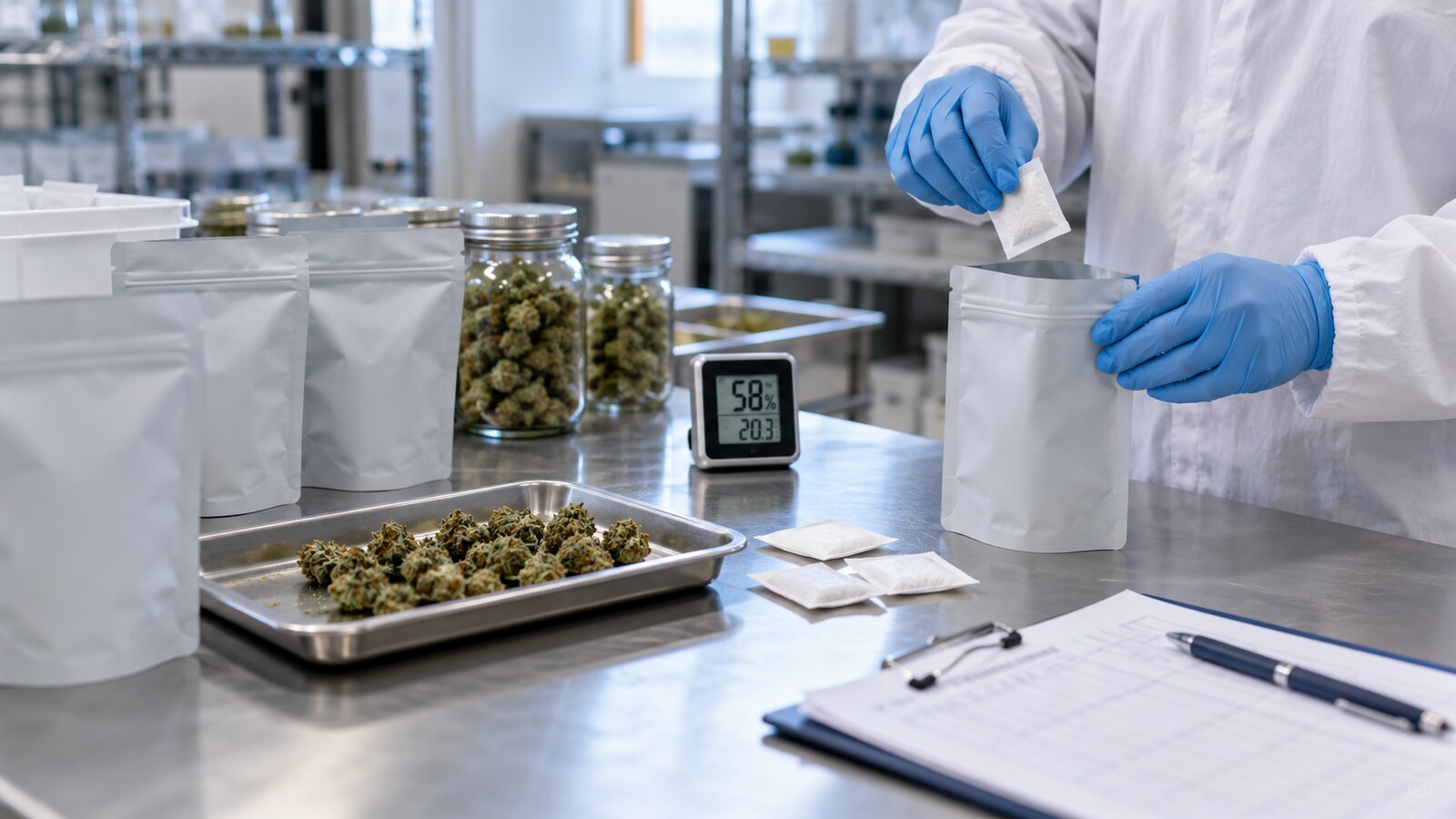
Cannabis humidity packs can help a sealed flower package move toward a specified relative-humidity range, but they are not a substitute for proper curing, water-activity testing, a suitable barrier package, sanitation, or state compliance review. Before adding one, confirm that the exact packet is permitted for the destination market and supported by food-contact documentation. Test it inside the final filled pouch or jar, at the intended product weight, through the planned shelf-life and distribution conditions. Record packet lot, package lot, flower lot, net weight, water activity, seal condition, odor, appearance, and any packet damage. A larger packet is not automatically better: it can crowd the closure, contact sharp stems, change pack-out geometry, or create an untested post-sampling input.
Humidity control is a packaging-system decision, not an accessory decision. Flower condition, headspace, package barrier, closure integrity, packet capacity, time, temperature, and opening frequency all interact. The practical goal is to prove that the chosen combination performs predictably without masking a drying, curing, storage, or sealing problem.
Check the Rules Before Adding a Packet
Do not assume a humidity packet is treated the same way in every state. Missouri's Division of Cannabis Regulation issued a variance on March 4, 2026 allowing qualifying humidity control packets after product sampling under stated conditions. Its guidance calls for packets made from FDA-approved food-contact substances, supporting documentation, and item-approval notation. It also warns that a packet added after mandatory sampling can introduce a contaminant that the original test did not evaluate. Read the current Missouri guidance rather than applying this example nationwide.
For each destination, have compliance staff document whether the packet is permitted, when it may be inserted, what records are required, and whether the final package remains child-resistant, tamper-evident, resealable, properly labeled, and within approved net-content tolerances. California, for example, places responsibility on licensees to use compliant final-form packaging; review the California final-form packaging guidance for that market.
What Humidity Packs Can and Cannot Do
A two-way humidity packet contains a controlled medium behind a permeable membrane. Inside a sufficiently closed package, it may absorb or release moisture as conditions move away from its designed range. That description does not establish how fast it will act, how long it will last, or whether it fits a particular flower weight and package.
- It can be evaluated as a buffer: compare changes in water activity, mass, aroma, texture, and package condition against a no-packet control.
- It cannot cure wet flower: packaging unsafe or unstable material and expecting a packet to correct it is poor process control.
- It cannot repair a leak: a channel seal, damaged zipper, loose lid, or high-transmission material can overwhelm the system.
- It does not prove microbial safety: use an approved sampling and testing program.
- It does not guarantee shelf life: stability depends on the complete product-package system.
ASTM D8450 addresses environmental conditions during cannabis and hemp flower packaging, including temperature and humidity around the operation. That is a useful reminder that controlling the room and stabilizing flower before filling are different from placing a packet inside the retail pack. Review the scope of ASTM D8450-22 and obtain the standard if it applies to your operation.
Select the Packet and Package Together
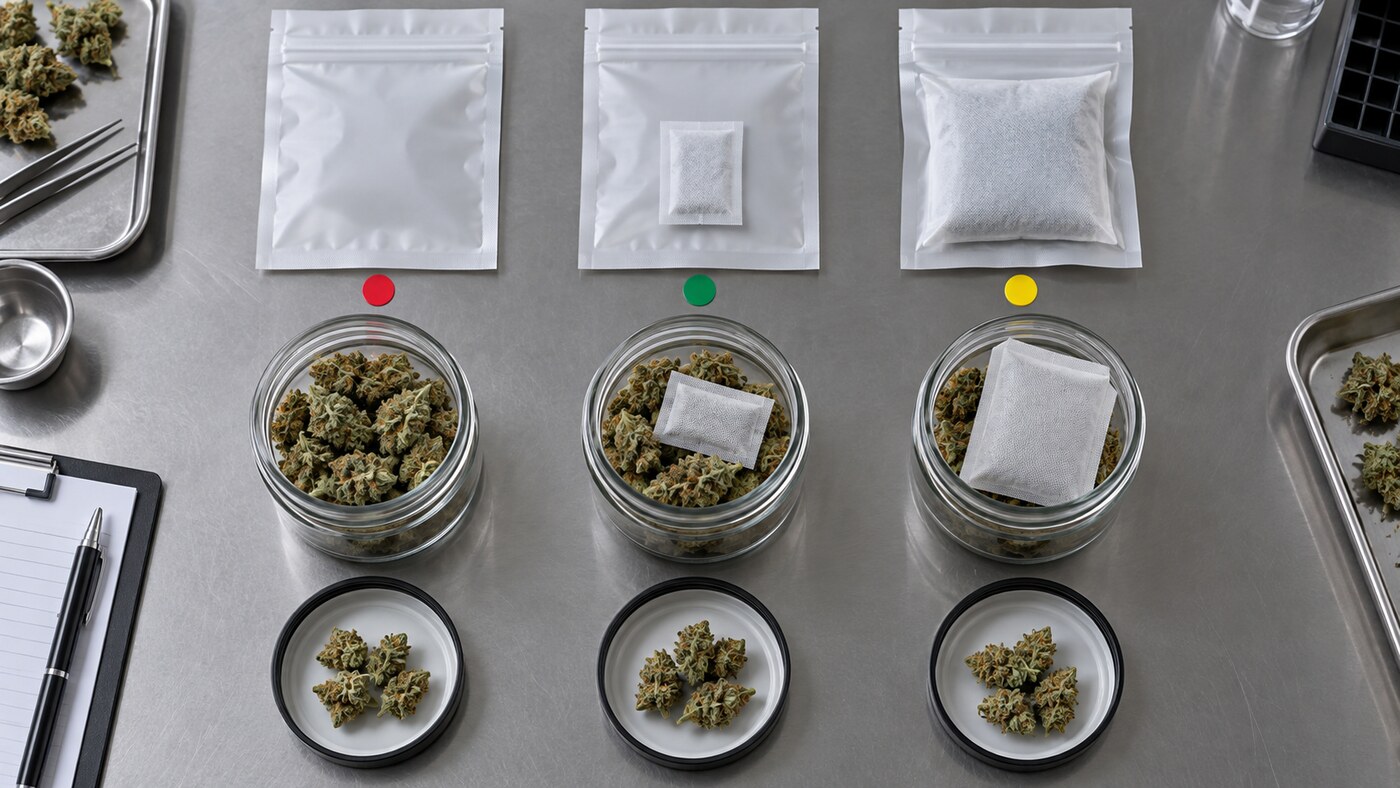
Start with the packet manufacturer's sizing instructions, but approve the result in the actual package. A packet that fits a one-ounce pouch may be awkward in a narrow eighth-ounce pouch. Check whether it lies flat, avoids the zipper and heat-seal land, resists puncture by stems, and remains easy to remove without spilling flower.
| Decision factor | What to verify | Common mistake |
|---|---|---|
| Flower mass and starting condition | Nominal and tolerance-limit fills; baseline water activity | Sizing only by pouch dimensions |
| Package barrier | Exact film or jar-and-lid construction | Treating “smell proof” as measured moisture-barrier data |
| Headspace and geometry | Packet stays clear of seal, zipper, lid threads, and sharp stems | Choosing the largest packet that physically fits |
| Consumer use | Repeated opening, reclosing, storage orientation, packet visibility | Testing unopened packages only |
| Documentation | Food-contact support, lot traceability, storage and replacement instructions | Accepting a generic marketing sheet |
Run a Filled-Package Humidity Test
- Write the protocol first. Define lots, sample count, package, packet, conditions, test intervals, acceptance limits, and decision owner.
- Measure the baseline. Record flower mass, water activity with a suitable calibrated instrument, visual condition, aroma assessment method, and package condition.
- Create meaningful groups. Include the proposed packet, a no-packet control, and only justified alternatives. Do not use one flower lot for one group and a different lot for another.
- Pack on the real process. Use production fill, packet placement, sealing, labeling, and case packing. Retain startup and steady-state samples.
- Check immediate fit. Inspect packet seams, puncture risk, zipper engagement, heat-seal clearance, lid seating, tamper evidence, and net weight.
- Store under documented conditions. Use normal conditions plus justified distribution challenges. Log actual temperature and humidity rather than relying on room settings.
- Test at planned intervals. Measure water activity and mass consistently. Photograph flower, packet, seal, label, and any condensation, staining, corrosion, or distortion.
- Add an in-use group. Open and reclose packages on a realistic schedule with controlled exposure time.
- Investigate outliers. Separate packet failure from package leakage, starting-product variation, measurement error, and storage hot spots.
- Approve the system, not the component. Lock the exact packet, flower range, package construction, process, and storage claim under change control.
Water activity and relative humidity are related but not interchangeable readings. Headspace relative humidity may help track package behavior, while water activity is measured on the product using a defined method. Use qualified instruments, allow equilibration, and follow your laboratory or quality procedure. Do not convert a casual hygrometer reading into a release specification.
Diagnose Results Before Release
| Observation | Investigate first | Do not assume |
|---|---|---|
| Packet dries or hardens unusually early | Package leak, incoming flower condition, packet storage, size, and lot | A larger packet alone fixes the root cause |
| Water activity varies widely within a group | Flower uniformity, equilibration, instrument method, seal consistency | All pouches have the same starting condition |
| Packet is torn or abraded | Sharp stems, fill method, packet placement, transport compression | Minor damage is harmless |
| Closure becomes difficult | Crowding, debris, zipper alignment, lid thread interference | Consumer force will solve it |
| Net weight trends downward | Barrier and seal, fill tolerance, product moisture migration, scale control | The packet caused every loss |
Packaging Options to Evaluate
These current 420 Packaging products are practical sample formats for a humidity-pack study. Confirm the exact construction, dimensions, closure, food-contact documentation, and child-resistant evidence for the version ordered. Product descriptions do not replace filled-package testing.

420 Smell Proof Bags with Zipper for Weed & Candy
The live page lists polyethylene construction, a resealable zipper, black color, 3 × 4.7-inch size, customization, MOQ of 1,000, and a listed 15–18 day lead time. Use the exact production bag to check packet clearance, zipper cycling, and small-fill geometry.
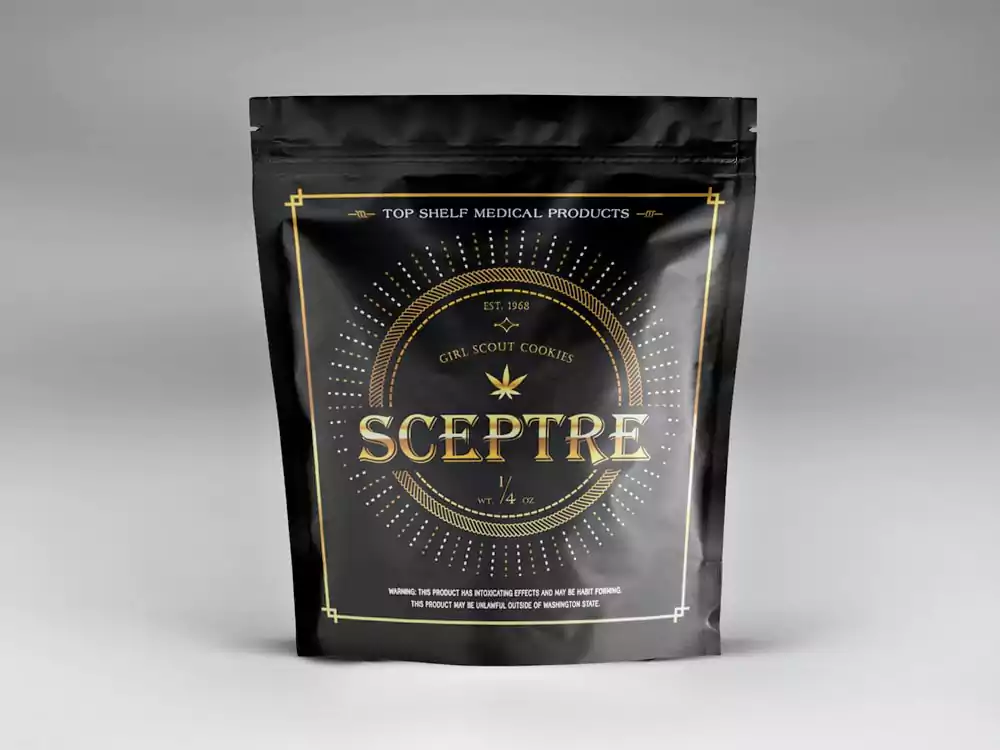
1lb Smell Proof + Moisture Proof Heavy Duty Weed Bags
The current page presents this as a large custom-printed flower bag and lists an MOQ of 1,000. For bulk flower, evaluate packet placement, fill density, seal integrity, case compression, and whether the selected packet capacity remains effective through the intended storage interval.
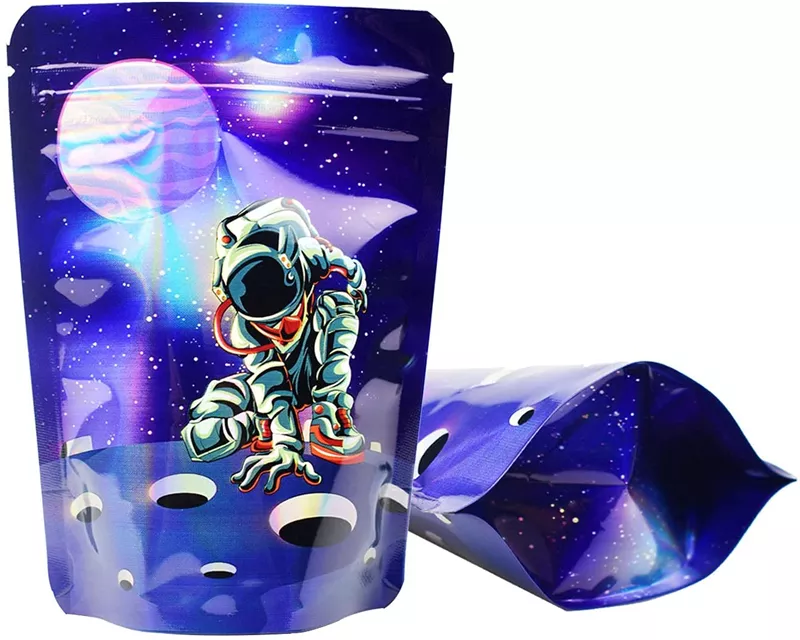
Double Printed & Holographic Mylar Pound Bags
The live product page lists multiple sizes, custom printing, a resealable zipper, heat-sealable top, and film-thickness options. Confirm the quoted laminate and size before comparing packet performance; visually similar pouches can have different barrier and sealing behavior.
Compare more formats in the Weed Bags collection. For a separate review of seal-land contamination and zipper fatigue, see the cannabis flower pouch seal test guide.
Production SOP and Records

- Receive packets in sealed supplier packaging and verify item, revision, lot, quantity, expiration or use-by information, and shipping condition.
- Quarantine wet, stained, torn, unsealed, incorrectly labeled, or otherwise damaged packets.
- Store unopened inventory within the supplier's stated conditions; control how long bulk packs remain open on the line.
- Issue packets by lot and reconcile quantities. Prevent dropped packets from returning to clean inventory.
- Verify one approved packet is placed in each package and remains outside the closure and seal land.
- Inspect the finished pack for packet damage, trapped product, closure function, tamper evidence, label condition, and net weight.
- Retain finished samples and record deviations, investigation, disposition, and any consumer complaints by lot.
A useful batch record connects the packet supplier and lot to the flower lot, packaging SKU and lot, line, operator, date, quantity, inspection result, and released market. This traceability matters if a packet material changes, a package leaks, or a contaminant investigation begins.
Questions for Packet and Packaging Suppliers
- What food-contact documentation applies to the complete packet, including membrane, ink, adhesive, and contents?
- What product weight and package-volume range supports each packet size?
- What target range, response limits, storage conditions, shelf life, and replacement guidance apply?
- How should opened bulk packet inventory be protected and how long may it remain exposed?
- Which lot code and change-notification records are provided?
- What defects require rejection, and what should be done if a packet tears or leaks?
- For the pouch or jar, what are the exact barrier, closure, dimensional, and sealing specifications?
- Can production-material samples be supplied for a filled-package stability study?
- Does child-resistant evidence cover the exact finished configuration and size?
- How are film, zipper, lid, liner, adhesive, ink, packet, and manufacturing-site changes communicated?
Frequently Asked Questions
What do cannabis humidity packs do?
They are designed to absorb or release moisture within a sufficiently closed package to move conditions toward a specified range. Actual performance depends on the flower, packet, package, temperature, time, and opening frequency.
Are humidity packs legal in cannabis flower packaging?
Rules vary by jurisdiction and product. Confirm current requirements for every destination. Missouri issued specific 2026 guidance and a variance with conditions; it should not be treated as a national rule.
Can a humidity pack fix flower that is too wet?
It should not replace controlled drying, curing, testing, and release procedures. Do not use a packet to mask material that fails an approved specification.
Does a humidity pack prevent mold?
No packet by itself guarantees microbial safety. Control incoming product, sanitation, water activity, packaging integrity, storage, testing, and applicable regulatory requirements.
How do I choose the correct packet size?
Follow the packet manufacturer's documented sizing guidance, then test it with the intended flower weight and final package. Confirm performance, physical fit, closure clearance, and puncture resistance.
Should I test water activity or relative humidity?
They answer different questions. Water activity is measured on the product with a defined method; headspace relative humidity can help characterize the package environment. Use qualified procedures and instruments.
Can a humidity packet replace a high-barrier pouch?
No. If moisture moves rapidly through the package or a closure leaks, the packet may be exhausted or unable to maintain the intended condition.
When should humidity-pack packaging be retested?
Review retesting after changes to flower condition, fill weight, packet, pouch or jar, closure, supplier, process, storage claim, route, or regulatory requirement.
What if a packet tears inside the package?
Quarantine the affected unit and follow the approved deviation and product-safety process. Do not release it based on appearance alone; investigate packet, stems, placement, filling, and transport pressure.
What records should a cannabis brand retain?
Keep regulatory review, food-contact support, specifications, supplier changes, packet and package lots, flower lot, test protocol, results, photographs, batch records, deviations, complaints, and release decisions.
Request Packaging Guidance
Choose the primary package and humidity packet as one tested system. Share your flower weight, package format, closure needs, market, artwork, quantity, and distribution conditions so production samples can be evaluated before a custom order.