
Last updated: November 12, 2026
Cannabis packaging sold in the United States should not be approved only on the basis of child resistance, appearance, food-contact status or a generic supplier statement that the material is “non-toxic.” Toxics-in-packaging laws adopted in 19 states restrict four heavy metals in packaging: lead, cadmium, mercury and hexavalent chromium. The traditional model prohibits intentional introduction of these metals and limits their incidental combined concentration to 100 parts per million by weight in a package or individual packaging component. The rule can reach far beyond the main box or pouch because packaging components may include inks, labels, dyes, pigments, adhesives, coatings, closures, cushioning and other additives. For cannabis brands, the practical workflow is to build a component-level packaging BOM, obtain a Certificate of Compliance or equivalent supplier declaration tied to the exact material grades being purchased, investigate higher-risk colored, metallic, recycled or imported components, and use appropriate screening or laboratory analysis when documentation is insufficient or verification is required.
Heavy-metal restrictions, PFAS restrictions and cannabis product-testing requirements are different compliance topics. A cannabis flower or concentrate laboratory COA does not prove that the package complies with toxics-in-packaging laws. Likewise, a PFAS non-use declaration does not establish compliance for lead, cadmium, mercury and hexavalent chromium. Keep separate evidence files for each requirement.
A cannabis brand approves a new pre-roll box.
The board is correct.
The child-resistant mechanism works.
The colors match the proof.
The box passes the shipping test.
So the packaging is ready, right?
Not necessarily.
Suppose the design uses:
- a bright red pigment;
- gold foil;
- a black plastic insert;
- a pressure-sensitive label;
- printed adhesive tape;
- a small metal component.
The packaging specification may contain several materials and additives that are almost invisible to the person approving the finished box.
That matters because U.S. toxics-in-packaging laws do not apply only to the largest structural material.
California’s Department of Toxic Substances Control, for example, specifically identifies packaging components such as:
- coatings;
- closures;
- inks;
- labels;
- dyes;
- pigments;
- adhesives;
- stabilizers;
- blocking and cushioning materials.
The correct question is therefore not:
“Is our paperboard lead-free?”
It is:
“Does every relevant packaging component in the final production configuration meet the toxics-in-packaging requirements for the states where we sell?”
What Are Toxics-in-Packaging Laws?
The original Model Toxics in Packaging Legislation was developed in 1989 to reduce toxic metals entering the municipal waste stream through packaging.
The Toxics in Packaging Clearinghouse, or TPCH, now helps coordinate implementation of state laws based on that model.
The original framework focuses on four metals:
- lead;
- mercury;
- cadmium;
- hexavalent chromium.
The laws generally address both:
- intentional addition of the restricted metals; and
- incidental presence above a defined combined concentration.
Toxics in Packaging Clearinghouse — Model Legislation
California has had its own Toxics in Packaging Prevention Act in effect since January 1, 2006.
California DTSC — Toxics in Packaging
Which Four Heavy Metals Are Restricted?

| Restricted Substance | Why Packaging Teams Should Recognize It | Potential Packaging-Relevant Sources to Investigate |
|---|---|---|
| Lead | Historically associated with some pigments, colorants, coatings and contaminated materials | Colored inks, pigments, recycled materials, certain imported components |
| Cadmium | Can be associated with certain pigments and stabilizer systems | Bright pigments, plastics and specialty colorants |
| Mercury | Restricted even though deliberate use in modern packaging is uncommon | Unexpected contamination or nonstandard specialty materials |
| Hexavalent chromium | Chromium compounds can be relevant to pigments and surface treatments | Colored coatings, pigments, some metal-finishing systems |
This table is a risk-screening tool, not a statement that every listed material contains a restricted metal.
Modern compliant packaging can use vivid colors, foil, plastics and recycled material without violating the law.
The purpose of the review is to identify where documentation matters most.
What Does the 100 ppm Limit Actually Mean?
This is one of the most commonly misunderstood parts of toxics-in-packaging compliance.
The traditional rule does not mean:
“Each metal may be present at 100 ppm.”
The limit applies to the sum of the four incidentally present metals.
In simplified form:
Lead + Cadmium + Mercury + Hexavalent Chromium ≤ 100 ppm by weight
for the relevant package or packaging component, subject to the applicable state law and exemptions.
Illustrative example
| Metal | Example Result |
|---|---|
| Lead | 45 ppm |
| Cadmium | 20 ppm |
| Mercury | 5 ppm |
| Hexavalent chromium | 10 ppm |
| Combined | 80 ppm |
The combined result in this example is below 100 ppm.
But that does not address whether any restricted metal was intentionally introduced.
The two requirements need to be evaluated separately.
A low analytical result does not automatically prove that a restricted metal was never intentionally used. Likewise, a supplier declaration stating “no intentional addition” does not quantify incidental contamination. A useful compliance program understands what each piece of evidence actually proves.
How Many U.S. States Have These Laws?
TPCH currently states that legislation based on the Model Toxics in Packaging Legislation has been adopted by 19 states:
- California;
- Connecticut;
- Florida;
- Georgia;
- Illinois;
- Iowa;
- Maine;
- Maryland;
- Minnesota;
- Missouri;
- New Hampshire;
- New Jersey;
- New York;
- Pennsylvania;
- Rhode Island;
- Vermont;
- Virginia;
- Washington;
- Wisconsin.
TPCH — Toxics in Packaging Fact Sheet
The basic four-metal requirements are broadly similar across these laws, but exemptions, documentation, administration and enforcement can differ.
State law—not the model text—controls in the actual market.
Why multi-state cannabis brands should care
Cannabis companies frequently use one physical package across several states while changing only:
- compliance labels;
- universal symbols;
- potency stickers;
- batch information.
That makes a state-by-state packaging chemical review more efficient than building unrelated packaging for every state.
Start by qualifying the base packaging construction to the requirements of the intended markets, then manage state-specific label differences separately.
Why Cannabis Brands Should Pay Attention

Cannabis packaging tends to use many decorative and functional components in a very small area.
A premium pre-roll box might contain:
- printed paperboard;
- colored ink;
- foil stamping;
- lamination;
- adhesive;
- plastic insert;
- metal or magnetic parts;
- a tamper label.
A flower pouch might contain:
- multiple film layers;
- printing inks;
- adhesive between laminate layers;
- zipper material;
- compliance label;
- tamper feature.
A concentrate package might contain:
- glass jar;
- plastic lid;
- liner;
- paperboard carton;
- foam or paper insert;
- foil decoration.
A single statement about the “main material” therefore does not describe the finished packaging system.
California DTSC specifically notes that toxics-in-packaging rules cover packaging components and additives—not only the container body.
What Counts as a Packaging Component?
California’s toxics-in-packaging guidance uses a broad definition.
A packaging component can include individual assembled parts and materials such as:
| Component | Cannabis Packaging Example | Why It Belongs in the BOM |
|---|---|---|
| Ink | CMYK or Pantone print on pre-roll carton | Pigments and colorants are part of the package |
| Label | Batch or compliance sticker | Face stock, ink and adhesive may differ from the base box |
| Coating | Varnish or protective coating | It remains part of the finished package |
| Adhesive | Carton glue or lamination adhesive | Chemical composition comes from a different supplier stream |
| Closure | Zipper, cap, locking tab or hardware | Can use different resin or metal from the container |
| Cushioning | EVA or foam insert | Separate material requiring its own supplier information |
| Window | PET or PVC display window | Different polymer and colorant system |
| Foil / decorative layer | Gold foil brand mark | Separate converted material from printed board |
This is why a useful packaging BOM should be component-based.
Paperboard Cannabis Boxes
Paperboard is one of the largest product categories on 420 Packaging, especially for pre-rolls, vape cartridges, concentrates and edibles.
Plain paperboard is only the beginning of the specification.
A finished box may also include:
- white or kraft board;
- greyboard;
- coated art paper;
- CMYK inks;
- Pantone inks;
- foil;
- lamination;
- UV coating;
- glue;
- insert materials.
Ask for the converted package, not just the paper certificate
A mill certificate for the base board is useful.
It does not automatically cover:
- printing ink;
- foil;
- adhesive;
- plastic window;
- insert.
If the finished cannabis box uses several suppliers, the packaging converter should maintain compliance information across the relevant components.
Printing Inks, Dyes and Pigments
Inks and pigments deserve particular attention because color is one of the biggest reasons cannabis brands customize packaging.
California DTSC specifically lists inks, dyes and pigments among packaging components relevant to its toxics-in-packaging law.
Higher-risk situations worth checking carefully include:
- very bright specialty colors;
- unusual fluorescent pigments;
- unknown imported ink systems;
- supplier changes between print runs;
- very low-cost unverified promotional packaging;
- legacy inks with incomplete compliance documentation.
Do not assume Pantone matching proves chemical compliance
A Pantone reference tells the printer the visual target.
It does not define the pigment chemistry.
Two printers can match the same color using different ink systems.
For repeat cannabis packaging, lock both:
- the approved visual color;
- the approved ink or supplier-compliance system.
For print-color consistency itself, use the separate Cannabis Packaging Color Consistency Guide.
That article answers whether two runs look the same.
This article answers whether relevant packaging materials satisfy heavy-metal restrictions.
Foil, Metallic Finishes and Decorative Effects
Foil stamping is common on premium cannabis packaging because it creates strong shelf contrast without changing the structural box.
But “gold foil” is a visual description, not a complete material specification.
Different foils can contain:
- carrier films;
- release layers;
- metalized layers;
- colored coatings;
- adhesive layers.
What to request
- foil supplier or material identification;
- applicable heavy-metal compliance statement;
- confirmation for the exact foil color or grade;
- notification if the foil supplier changes.
The same logic applies to:
- metallic inks;
- holographic finishes;
- colored hot-stamping films.
Do not assume one gold grade and one holographic grade share identical chemistry.
Plastic Pouches, Trays and Inserts
Plastic packaging can contain:
- base resin;
- color masterbatch;
- stabilizers;
- printing inks;
- adhesives;
- barrier layers.
For a flexible pouch
Request the complete laminate rather than the marketing word “Mylar.”
Include:
- outer print layer;
- barrier layer;
- sealant layer;
- zipper;
- printing;
- lamination adhesive.
For plastic inserts
Document:
- resin type;
- color;
- supplier;
- recycled-content status where relevant.
A black insert and a clear insert may use different pigment systems even if both are made from the same base polymer.
Color matters
If a brand switches from:
clear PET tray
to:
opaque black PET tray,
do not automatically assume the original chemical-compliance documentation covers the new colored material.
Glass Jars and Bottles
Cannabis brands often choose glass for:
- flower;
- concentrates;
- tinctures;
- premium edible products.
Glass packaging can also require a component-level review.
The complete jar system may include:
- glass body;
- colored glass pigment system;
- printed decoration;
- plastic or metal cap;
- liner;
- label;
- outer carton.
TPCH has published guidance and exemption information specifically relevant to glass and ceramic packaging history, which is another reason not to rely on a blanket assumption that every glass package is automatically identical from a toxics-in-packaging perspective.
TPCH — Toxics in Packaging Exemptions
Colored or decorated glass deserves documentation
If a supplier changes:
- glass color;
- painted coating;
- printed decoration;
- cap;
review whether the original packaging compliance file still applies.
Metal Tins, Closures and Hardware
Metal cannabis packaging may use:
- tinplate;
- aluminum;
- coated metal;
- painted closures;
- metal decorative components.
Heavy-metal compliance should focus on the actual package or component and its surface treatments.
Do not use corrosion testing as a substitute
A salt-spray test may evaluate corrosion behavior of a metal finish.
It does not establish compliance with lead, cadmium, mercury and hexavalent-chromium concentration rules.
These are different tests with different purposes.
Labels and Adhesives
Cannabis packaging frequently relies on variable labels because potency, batch, strain, manufacture date or compliance information changes between production lots.
A label can introduce several materials not present in the original printed box:
- label face stock;
- ink or toner;
- top coating;
- adhesive;
- release liner before application.
Do not forget labels added by another facility
The box supplier may deliver compliant blank or preprinted packaging.
Then a cannabis manufacturer adds a locally sourced label.
The finished package is no longer made only from the materials qualified by the box supplier.
Your internal packaging BOM should therefore include downstream labels and seals.
Label adhesion and chemistry are separate questions
A label can adhere perfectly and still require chemical-compliance documentation.
Conversely, a compliant label can peel off if the adhesive does not match the surface.
Use Cannabis Packaging Labels Peeling: Causes and Fixes for the adhesion problem.
Does Recycled Content Create Extra Risk?
Recycled materials can be a useful part of a packaging sustainability strategy.
They can also introduce more variable upstream material sources.
That does not mean recycled packaging is noncompliant.
It means recycled content should remain inside the same controlled compliance system.
Do not assume sustainability overrides toxics requirements
The standard toxics-in-packaging heavy-metal limits still matter when recycled content is used, subject to applicable state-specific exemptions.
TPCH notes that most states maintain the 100 ppm combined limit even when metals are incidentally present due to post-consumer recycled content.
Useful supplier questions
- What percentage of recycled content is used?
- Does the packaging specification remain consistent between lots?
- How is incoming recycled feedstock controlled?
- Does the supplier issue a toxics-in-packaging Certificate of Compliance?
- Does a state-specific exemption apply?
Do not assume an exemption exists simply because the package contains PCR or recycled fiber.
What Is a Certificate of Compliance?
A Certificate of Compliance is one of the most useful documents a packaging buyer can request.
California DTSC describes it as a document stating that the package or packaging component:
- does not contain intentionally added cadmium, lead, mercury or hexavalent chromium; and
- does not contain incidental quantities above the allowable maximum concentration.
California DTSC — Toxics in Packaging FAQ
A useful certificate should identify
- manufacturer or supplier;
- package or component covered;
- material grade or item number where possible;
- statement of compliance;
- applicable law or requirement;
- authorized representative;
- issue date.
A weak certificate looks like this
“All our packaging is environmentally safe and contains no harmful substances.”
That statement is too vague.
A stronger certificate connects the statement to the product
For example, it clearly identifies:
- specific paper grade;
- specific plastic component;
- specific package family;
- specific regulation or heavy-metal requirements.
A certificate is most useful when purchasing can trace it to the exact material on the purchase order. Store the document with the packaging specification rather than leaving it only in an email thread.
When Should Packaging Be Tested?
Not every purchase order needs a new laboratory heavy-metal test.
A risk-based program may rely on:
- supplier qualification;
- Certificates of Compliance;
- material specifications;
- periodic verification;
- targeted testing after meaningful changes.
Testing becomes more valuable when:
- supplier documentation is incomplete;
- a new supplier is being approved;
- materials are imported from an unknown source;
- a high-risk pigment or specialty coating is introduced;
- recycled content changes significantly;
- a customer contract requires testing;
- a regulator or retailer requests evidence;
- incoming screening identifies an unusual result.
Test the component that creates the question
If concern centers on a black plastic insert, testing the white paperboard carton alone does not answer it.
If concern centers on red ink, send the appropriate printed component or ink-related specimen according to the lab protocol.
Component-level thinking makes investigations faster and less expensive.
XRF Screening vs. Laboratory Analysis
TPCH and state agencies have used X-ray fluorescence, or XRF, to screen packaging for heavy metals.
XRF can be useful because it is:
- fast;
- non-destructive in many applications;
- useful for screening many units;
- capable of identifying elevated elemental signals.
But a screening result is not the answer to every regulatory question.
XRF cannot directly answer every chromium question
For example, an elemental screening method may detect chromium but does not automatically establish how much of that chromium is specifically hexavalent chromium.
Method selection therefore matters.
Use laboratory guidance tied to the legal question
TPCH has published specific guidance for laboratories and regulated companies evaluating packaging for the four restricted metals.
TPCH — Guidance on Laboratory Analysis for Toxics in Packaging
| Approach | Best Use | Limitation |
|---|---|---|
| Supplier Certificate of Compliance | Routine purchasing and material qualification | Depends on correct product scope and supplier controls |
| XRF screening | Rapid screening for elevated elemental content | Does not answer every chemical-speciation question |
| Targeted laboratory analysis | Formal verification and investigation | Method and sample preparation must match the regulatory question |
| Finished-package audit | Confirm all components are included in the compliance file | Does not replace chemical evidence |
Why This Is Still a Current Enforcement Issue
Heavy-metal packaging laws are old enough that some packaging buyers assume the problem disappeared years ago.
That is a mistake.
TPCH’s 2025 annual report, published in 2026, describes ongoing state screening work and reports that testing in Connecticut confirmed findings similar to previous New Jersey and California investigations involving elevated lead in imported packaging.
The practical lesson is simple:
old regulation does not mean obsolete regulation.
Packaging supply chains continue to change.
New:
- pigments;
- recycled feedstocks;
- imported components;
- decorative finishes;
- suppliers.
can create new compliance questions.
A Practical Packaging Approval Workflow
Step 1: Identify the states where the SKU will be sold
Start with actual distribution.
Do not build the compliance file around the factory location.
Step 2: Disassemble the final packaging system
Include:
- primary package;
- secondary carton;
- insert;
- window;
- closure;
- label;
- tamper feature.
Step 3: Build the material BOM
For each component record:
- supplier;
- material;
- color;
- finish;
- supplier item number;
- revision.
Step 4: Identify higher-risk components
Prioritize:
- strong pigments;
- metallic finishes;
- unknown recycled materials;
- low-cost imported components;
- new suppliers;
- surface-treated metal;
- specialty plastics.
Step 5: Collect Certificates of Compliance
Match documents to the actual materials.
Do not accept a certificate for “white carton board” as evidence for a completely different:
- black EVA insert;
- red label;
- metal closure.
Step 6: Decide whether verification testing is justified
Use risk, state requirements, customer requirements and supplier history.
Step 7: Test production-representative material
A prototype made with temporary material does not always represent mass production.
Step 8: Approve the finished configuration
Lock the combination of:
- substrate;
- printing;
- finish;
- insert;
- label;
- closure.
Step 9: Add change control
Require supplier approval before substitutions.
Step 10: Retain the compliance file
Keep:
- BOM;
- certificate;
- test report if used;
- approved artwork;
- supplier revision;
- production lot information;
- retained finished sample.
What to Ask Your Packaging Supplier
Use a specific request instead of asking:
“Is this packaging safe?”
Ask:
- Can you provide a current toxics-in-packaging Certificate of Compliance?
- Which exact package or material grades does the certificate cover?
- Does the declaration address lead, cadmium, mercury and hexavalent chromium?
- Does it confirm no intentional addition?
- Does it address the applicable combined incidental concentration limit?
- Are printing inks covered?
- Are labels covered?
- Are coatings and lamination covered?
- Is foil covered?
- Are plastic inserts or foam covered?
- Are windows covered?
- Are metal components or closures covered?
- What changes would invalidate the document?
- Will the supplier notify us before changing material sources?
- Can production lots be linked to the approved material version?
Ask before artwork approval
It is much easier to replace:
- a pigment;
- a foil;
- an insert;
- a coating.
before thousands of packages have been printed.
Material Changes That Require Re-Review
Re-review the compliance file after meaningful changes to:
| Change | Why It Matters |
|---|---|
| Ink supplier | Same visual color may use different pigment chemistry |
| Pantone color | New pigment system may be required |
| Foil color or supplier | Different converted material |
| Plastic insert color | New masterbatch or pigment |
| Recycled-content percentage | Upstream material stream changes |
| Label supplier | New face stock, ink and adhesive system |
| Glass color | Colorant composition changes |
| Metal finish | Surface-treatment chemistry changes |
| Packaging factory | Materials may be sourced from different suppliers |
| “Equivalent” substitute | Visual equivalence does not prove chemical equivalence |
“Same artwork” does not necessarily mean “same packaging.” If the material or component supplier changed, review the compliance documentation even if the finished box looks identical.
420 Packaging Formats to Evaluate
Custom Paper Drawer Box for Vape Cartridges
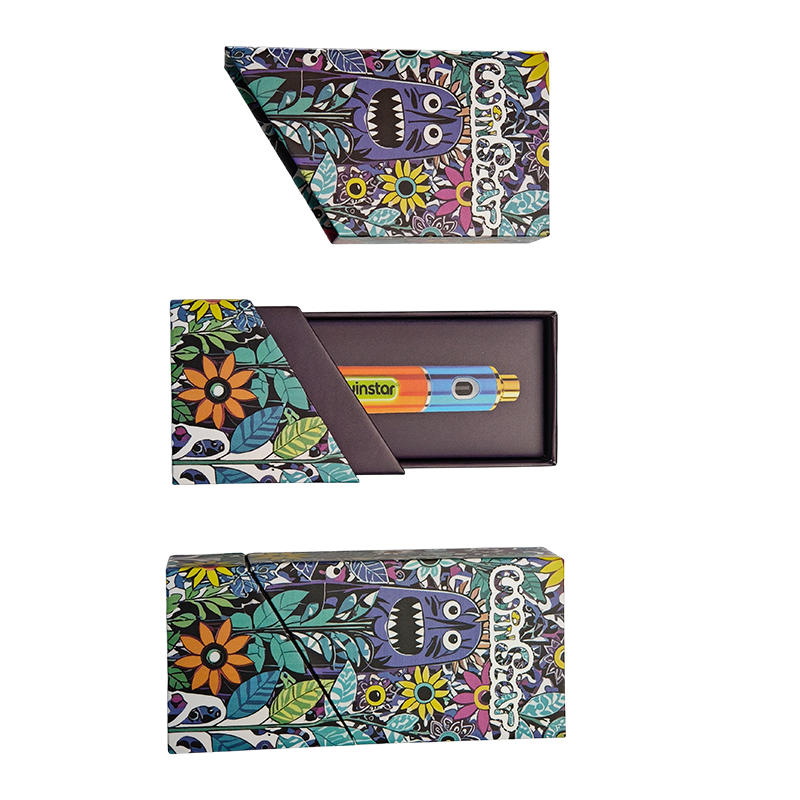
This current 420 Packaging product is a useful example of why component-level compliance matters. The listed rigid drawer construction uses 900–1200 gsm greyboard wrapped with 157–200 gsm coated art paper and can be customized with CMYK/Pantone printing, foil, Spot UV, lamination and several insert options including EVA, paper pulp, cardboard or PET.
That means a single finished package can contain materials from several supplier streams.
For a heavy-metal compliance program, request documentation covering the actual configuration ordered rather than only the base greyboard.
Depending on the build, review:
- wrap paper;
- printing ink;
- foil;
- coating or lamination;
- insert;
- window;
- tamper label.
Pre-Roll Display Kraft Paper Box

The current product page lists customizable paper stocks from 10pt to 28pt, CMYK/PMS printing, gloss or matte coatings, Spot UV, gold or silver foil, embossing and optional PVC window material.
This makes the product a useful example of the difference between:
qualifying a paper substrate
and:
qualifying the complete converted package.
If the final version includes foil, coating and a plastic window, those components should be included in the compliance file.
Concentrate Packaging
420 Packaging’s concentrate category includes glass-jar boxes, rigid paper boxes, drawer structures, PVC-window cartons and magnetic formats.
Concentrate packaging often has more components than a simple folding carton because it may combine:
- a primary jar;
- cap and liner;
- protective insert;
- printed secondary box;
- window;
- foil or other premium finish.
For toxics-in-packaging review, map the configuration ordered rather than assuming every concentrate box uses the same material set.
Heavy Metals vs. PFAS: Keep the Keyword and Compliance Scope Separate
| Topic | Main Substances | Primary Packaging Question |
|---|---|---|
| Toxics in Packaging / Heavy Metals | Lead, cadmium, mercury, hexavalent chromium | Were restricted metals intentionally added, or do incidental levels exceed the applicable combined limit? |
| PFAS Packaging Rules | Per- and polyfluoroalkyl substances | Does the package contain or use intentionally added PFAS under the applicable rule? |
| Food Contact | Depends on material and intended use | Is the material suitable for the intended food-contact condition? |
| Cannabis Product Testing | Cannabinoids, pesticides, metals and other analytes specified by the cannabis program | Does the cannabis product itself meet market testing requirements? |
For edible packaging PFAS specifically, see:
PFAS in Cannabis Edible Packaging: 2026 U.S. Rules, Food-Contact Materials & Supplier QA
This separation matters both for compliance and SEO.
The primary search intent of this article is:
heavy metals in cannabis packaging and toxics-in-packaging compliance.
It should not be optimized around the broader terms:
- cannabis packaging compliance;
- PFAS cannabis packaging;
- food-safe cannabis packaging.
Those terms belong to broader or separate pages.
Common Mistakes to Avoid
| Mistake | Why It Fails | Better Approach |
|---|---|---|
| Checking only the paperboard | Ink, label, insert, foil and adhesive are also packaging components | Build a component-level BOM |
| Assuming food-grade means heavy-metal compliant | Food-contact and toxics-in-packaging requirements answer different questions | Collect separate evidence |
| Reading 100 ppm as 100 ppm per metal | The traditional limit applies to the combined concentration of the four metals | Evaluate the sum under the applicable state requirement |
| Using product COA as packaging evidence | Cannabis testing does not automatically test the package | Maintain packaging-specific compliance documents |
| Testing one component and approving the whole package | The untested component may use another material system | Define test/document scope |
| Reusing old documentation after a supplier change | Material chemistry can change while appearance stays the same | Trigger document review on substitution |
| Calling an XRF screen a complete hexavalent-chromium test | Elemental chromium and chromium(VI) are not automatically the same analytical result | Use the appropriate laboratory method |
Cannabis Packaging Heavy-Metal Compliance Checklist
| Review Item | Approval Question |
|---|---|
| Sales markets | Which toxics-in-packaging states will receive this SKU? |
| Final package | Is the review based on the actual production configuration? |
| Paperboard | Is the exact board or wrap grade documented? |
| Ink | Does the compliance evidence cover the production ink system? |
| Pigments | Have unusual or high-risk colors been reviewed? |
| Foil | Is the exact foil grade included in supplier compliance controls? |
| Coating | Are varnish, UV, lamination or specialty coatings included? |
| Plastic insert | Are resin and color documented? |
| Window | Is PET/PVC/cellulose or other material identified? |
| Label | Are face stock, printing and adhesive included in the BOM? |
| Closure | Are cap, zipper, metal or CR components documented? |
| Certificate | Is there a current Certificate of Compliance or equivalent evidence? |
| Intentional addition | Does the document address intentional use of the restricted metals? |
| Incidental content | Does the evidence address the applicable combined concentration limit? |
| Testing | Is verification needed based on risk or customer requirements? |
| Change control | Will supplier/material changes trigger re-review? |
| Traceability | Can production lots be linked to the approved material version? |
| Retention | Are compliance records stored with the packaging SKU? |
Toxics in Packaging Clearinghouse — Model Legislation
Toxics in Packaging Clearinghouse — Fact Sheet
Toxics in Packaging Clearinghouse — Frequently Asked Questions
TPCH — Guidance on Laboratory Analysis for Toxics in Packaging
California DTSC — Toxics in Packaging
Add material-compliance documentation to the RFQ instead of requesting it after the boxes arrive. Send the target states, package style, colors, print finishes, insert, window and closure requirements with the project brief. 420 Packaging can provide custom paper boxes, pre-roll packaging, vape-cartridge cartons, concentrate packaging and flexible packaging with production-specific material options. For regulated-market projects, request documentation for the actual configuration being ordered and lock material substitutions under change control before mass production.
Frequently Asked Questions
1. Which heavy metals are restricted in U.S. packaging laws?
The traditional Toxics in Packaging model restricts lead, cadmium, mercury and hexavalent chromium. State laws based on that model generally prohibit intentional introduction of these metals and limit their incidental combined concentration, although state-specific requirements and exemptions should always be checked.
2. What is the heavy-metal limit for packaging?
The traditional Model Toxics in Packaging framework limits the combined incidental concentration of lead, cadmium, mercury and hexavalent chromium to 100 ppm by weight. It does not mean that each of the four metals receives a separate 100 ppm allowance.
3. How many U.S. states have toxics-in-packaging laws?
TPCH states that 19 U.S. states have adopted legislation based on the Model Toxics in Packaging Legislation. These include major cannabis markets such as California, New York, Illinois, Maryland, Missouri, Minnesota and Washington.
4. Does the law apply only to the cannabis container itself?
No. Packaging-component definitions can include inks, labels, dyes, pigments, adhesives, coatings, closures, cushioning and other additives. Review the complete packaging system rather than only the largest substrate.
5. Can cannabis packaging contain any lead at all?
Intentional introduction is prohibited under the traditional model. Incidental contamination can be allowed only within the applicable combined concentration limit and subject to state requirements and exemptions. Do not treat the incidental limit as permission to deliberately add lead.
6. Is a cannabis product heavy-metal COA enough to prove the packaging is compliant?
No. Cannabis product testing and packaging-material compliance are separate. A product laboratory report generally does not establish whether the box, pouch, ink, label, insert or closure meets toxics-in-packaging requirements.
7. Does food-grade packaging automatically meet heavy-metal packaging laws?
Do not assume so. Food-contact suitability and toxics-in-packaging compliance are different regulatory questions. Request documentation that specifically addresses the packaging requirements applicable to the intended states.
8. Should printing inks be included in the review?
Yes. California DTSC specifically identifies inks, dyes and pigments as packaging components. A paperboard certificate alone should not automatically be treated as proof for every ink system printed onto the box.
9. Does gold foil need heavy-metal documentation?
It should be included in the package’s supplier-compliance system when used in the final configuration. Foil is a separate converted material, and a change in foil supplier, color or grade should trigger review of whether existing documentation still applies.
10. Is XRF testing enough for cannabis packaging?
XRF can be a useful rapid screening technique for elemental content, but it does not answer every regulatory question. In particular, detecting total chromium does not automatically quantify hexavalent chromium. Use the analytical method appropriate to the applicable law and investigation.
11. Do recycled cannabis packaging materials have a different limit?
Do not assume they do. TPCH states that most states maintain the 100 ppm combined heavy-metal limit even when restricted metals are incidentally present due to post-consumer recycled content, although specific state exemptions should be checked.
12. What is a packaging Certificate of Compliance?
It is a supplier or manufacturer document stating that the package or packaging component meets the applicable toxics-in-packaging requirements. A useful certificate identifies the supplier, covered material or item, compliance statement, applicable requirement, date and authorized representative.
13. How often should cannabis packaging be retested?
There is no universal retest interval for every package. Use a risk-based program. Reconsider testing after supplier changes, material substitutions, new pigments or coatings, major recycled-content changes, incomplete documentation, compliance incidents or customer requirements.
14. What packaging changes should trigger a new heavy-metal review?
Review changes to inks, pigments, foil, coatings, labels, adhesives, plastic colors, recycled-content levels, glass colors, metal finishes, factories and component suppliers. A package can look identical while its material chemistry has changed.