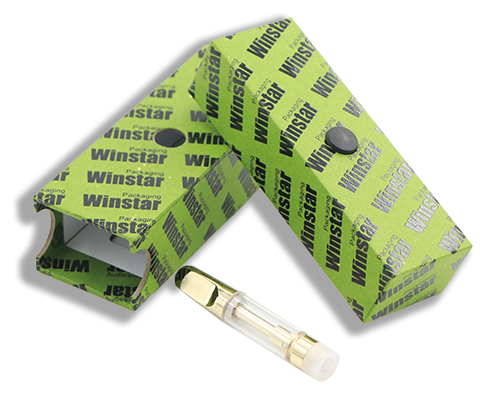

Last updated: September 22, 2026
A cannabis package should not be considered light-protective simply because it looks dark or opaque. Light protection depends on the entire packaging system: the primary container or film, windows, seams, closures, labels, secondary cartons, product position and the wavelengths that actually reach the product. A practical cannabis packaging light-barrier test compares production-intent packages under a controlled light challenge against a dark-stored control. Use the real product, fill weight and package configuration, expose samples for defined times and orientations, then compare color, aroma, oil appearance, product temperature, potency or other product-specific quality markers. For quantitative material comparison, request spectral transmittance data from the packaging supplier or a qualified laboratory rather than treating color, thickness or opacity as a universal UV-protection rating.
Light protection is easy to overlook when cannabis packaging is selected primarily for appearance, child resistance, odor control or shelf impact.
A clear jar may make premium flower easy to inspect at retail. A transparent window may help shoppers see a pre-roll or cartridge. A glossy pouch may photograph well. But every transparent or translucent area creates a potential path for light to reach the product.
That does not automatically make transparent packaging unsuitable. It means the packaging decision should be based on the product, expected shelf time, retail lighting, distribution conditions and validated barrier performance rather than appearance alone.
For a packaging buyer, the useful question is not:
“Is this package UV resistant?”
The better questions are:
- Which wavelengths reach the product?
- How much light reaches it?
- For how long?
- Which part of the product is exposed?
- Does the secondary box remain around the primary container?
- What measurable product change occurs under realistic exposure?
What Does Light-Barrier Cannabis Packaging Mean?
Light-barrier packaging reduces the amount of relevant light reaching the packaged product during storage, distribution and retail display.
That sounds simple, but packaging teams frequently mix together several different concepts:
- visual opacity;
- UV blocking;
- visible-light transmission;
- infrared or heat-related exposure;
- color tint;
- metallization;
- printed coverage;
- secondary-carton shielding.
These are related, but they are not interchangeable.
A package can look dark to the human eye while still transmitting part of the spectrum. A clear material may include additives that reduce certain ultraviolet wavelengths without becoming visibly opaque. A paper carton may block direct light very effectively while it remains around the product, but that protection disappears once the primary container is removed.
Define light protection by the final pack-out and intended use condition, not by material color alone.
UV Protection vs. Visible-Light Protection
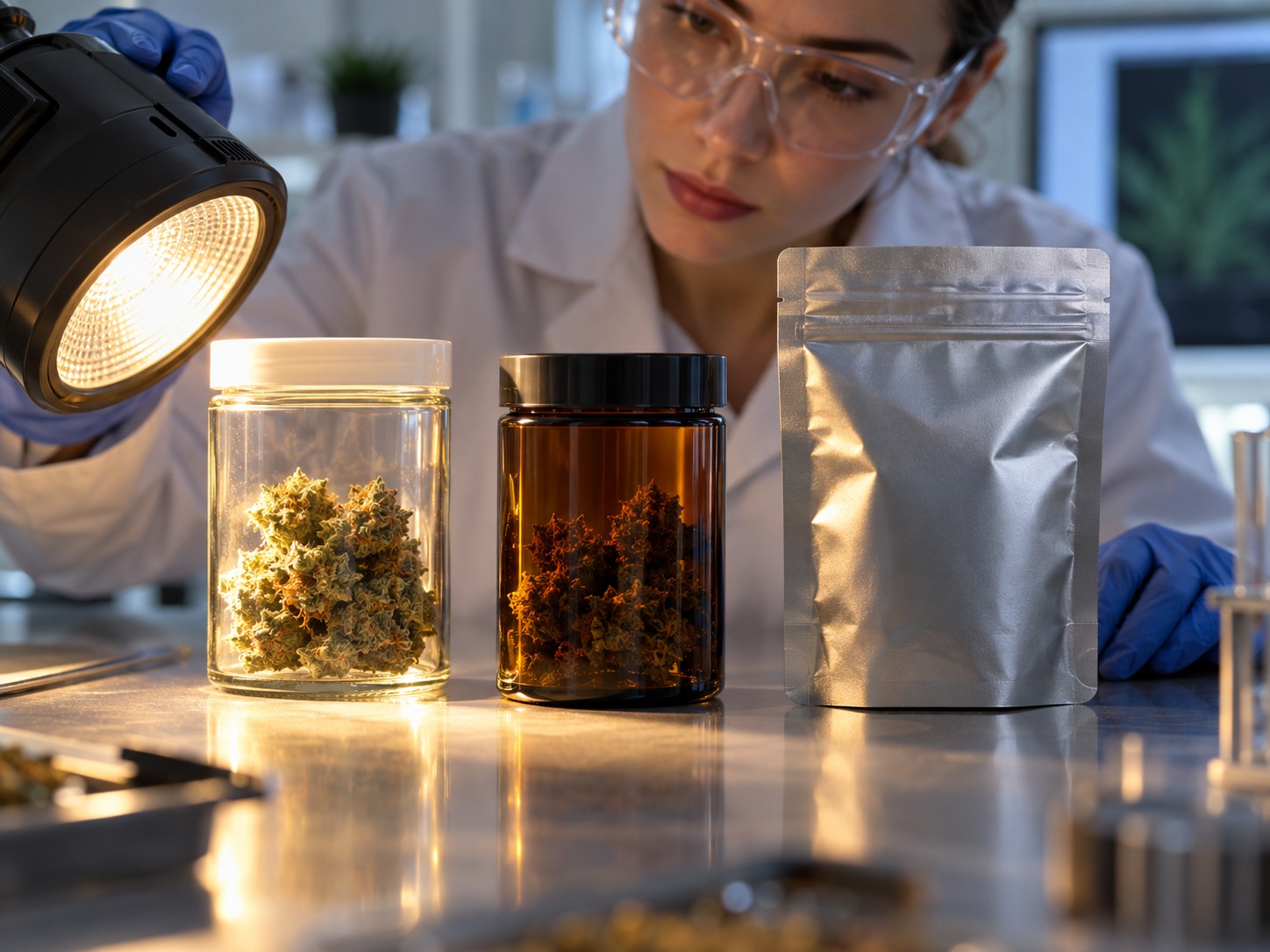
“UV resistant,” “UV blocking,” “light resistant” and “opaque” are often used as though they mean the same thing. They do not.
| Term | What It Generally Describes | What It Does Not Automatically Prove |
|---|---|---|
| Opaque | The product cannot readily be seen through the package | A quantified spectral transmission level |
| Tinted | The material selectively absorbs or changes visible light | Complete UV protection |
| UV blocking | Reduced transmission in specified ultraviolet wavelengths | Blocking of all visible light |
| Metallized | A metallic layer is incorporated into the structure | Performance of seams, windows or closures |
| Light resistant | A general commercial description | A universal test result unless conditions are specified |
If light protection matters to product stability, ask suppliers for more than a visual statement.
A useful technical discussion should identify:
- the exact packaging structure;
- which layer provides light protection;
- whether performance is based on measured transmission;
- the wavelength range measured;
- whether the data applies to an unprinted material or the finished printed structure;
- whether windows, closures or other components change the final result.
This distinction is especially important when comparing a clear jar, amber jar, opaque plastic container, paper carton and metallized pouch. Their protection mechanisms are different.
How Common Cannabis Packaging Formats Handle Light
| Packaging Format | Potential Light Protection | Common Weak Point | Best Validation Method |
|---|---|---|---|
| Clear glass jar | Low without additional treatment or outer package | Full sidewall exposure | Filled jar vs. dark control |
| Tinted glass jar | Depends on tint and wavelength | Assuming color equals complete protection | Spectral data plus filled-product test |
| Opaque plastic jar | Potentially high | Thin sections, lid interface or color variation | Component transmission comparison |
| Metallized flexible pouch | Typically strong across the main panel | Clear window, seal edge or damage | Finished pouch inspection and challenge test |
| Clear-window pouch | Mixed | Window directly exposes product | Window-facing orientation test |
| Paperboard carton | High while product remains enclosed | Open ends, die-cut windows or removal at retail | Complete secondary-pack test |
| Pre-roll tube | Depends strongly on resin and color | Cap, translucent wall or thin molding | Tube and cap tested separately and assembled |
Flexible pouches
Flexible cannabis pouches can provide strong light protection when the structure includes an opaque or metallized barrier layer. However, the final pouch should still be reviewed for clear windows, zipper areas, damaged folds and inconsistent printing.
Brands sourcing flower packaging can compare structures within the custom weed bag category, but the final selection should be tested with the intended product and shelf conditions rather than selected only from material names.
Glass jars
Glass has advantages for product visibility, premium presentation and rigidity. But clear glass places much more responsibility on storage conditions or a secondary carton.
If a transparent jar is central to the brand experience, consider whether a fitted printed carton can provide light shielding during distribution and most of the retail period.
The existing Glass Jar Packaging Guide can be used alongside this test workflow when comparing glass against plastic or flexible packaging.
Pre-roll packages
Pre-rolls may spend weeks or months inside tubes, multi-pack boxes or inner trays. Light exposure can vary dramatically depending on whether the primary tube is opaque, translucent or clear and whether an outer carton remains around it.
For multi-pack products, test the complete pre-roll packaging configuration instead of evaluating the tube or paper box independently.
Seven Ways Light Reaches a Supposedly Protected Product
1. A clear product window
A package may be 95% opaque but still expose the product through a small die-cut or clear-film window.
That does not necessarily make the design unacceptable. It means the window becomes the highest-exposure zone and should be intentionally tested.
2. A translucent zipper or closure
The main pouch panels may block light while the zipper band, cap, liner area or closure uses a different resin or thickness.
Inspect components individually rather than assuming the material specification for the main body applies to every component.
3. Thin corners and molded edges
Rigid plastic containers may not have perfectly uniform wall thickness. Corners, shoulders, molded transitions and closure interfaces can transmit differently from the center of a sidewall.
4. Package damage
A metallized pouch that has been sharply creased, punctured or abraded may no longer behave like an undamaged sample.
Inspect light-protection performance after realistic filling, case packing and transportation—not only on flat material supplied by the converter.
5. Incomplete printed coverage
Heavy printing can change how a package looks, but decorative ink should not automatically be treated as the engineered light-barrier layer unless its performance has been validated.
6. Secondary packaging is removed too early
A transparent concentrate jar inside an opaque paper box may have good distribution protection. But if dispensary staff remove the jar and leave it under retail lighting for an extended period, the actual exposure condition changes.
Map what happens after the shipping case is opened.
7. Retail display orientation
The same package can receive very different exposure depending on whether its front, side, top or window faces the store lighting.
That is why orientation belongs in the test plan.
A Practical Cannabis Packaging Light Exposure Test
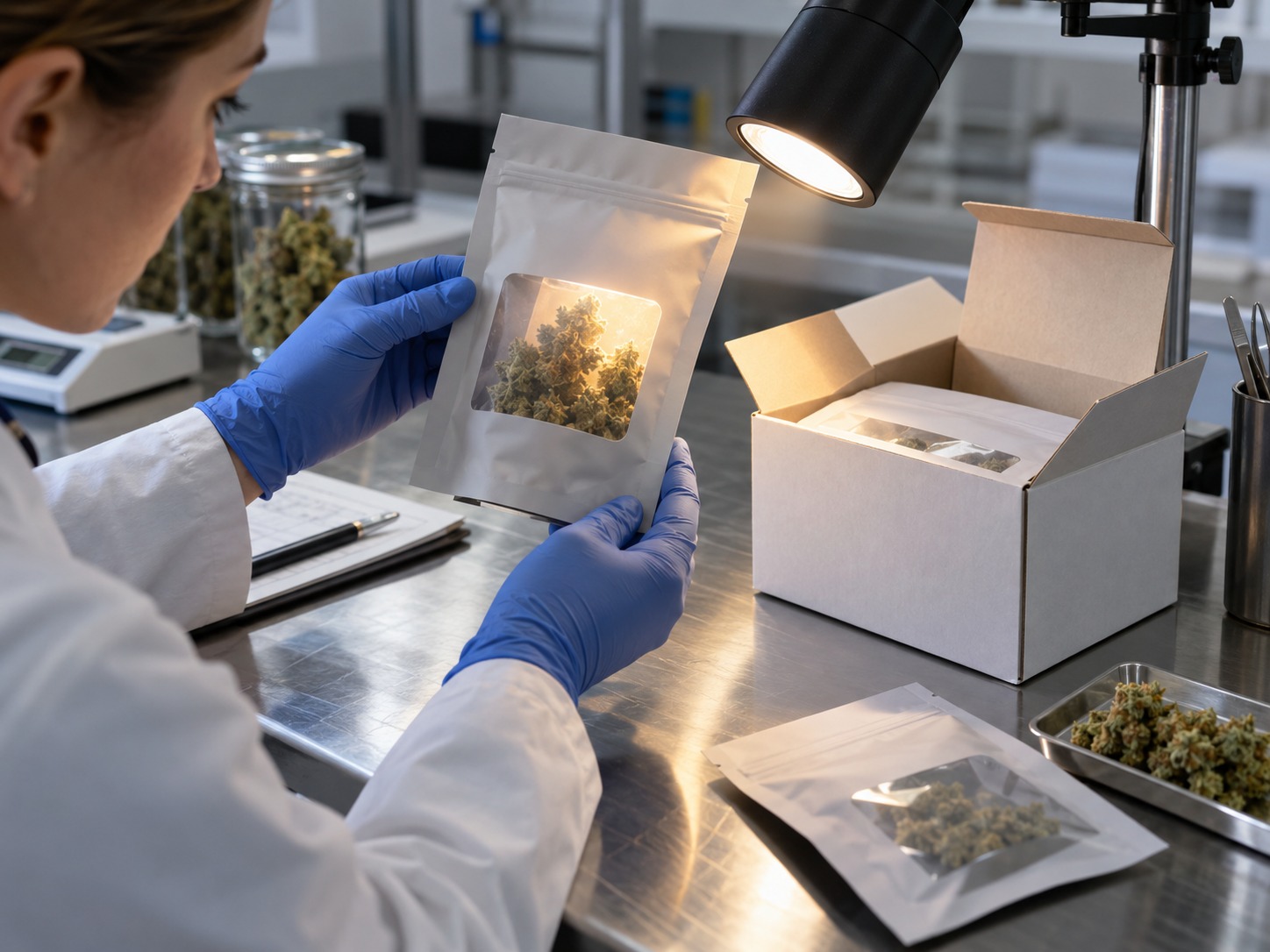
The following workflow is designed as a practical packaging-development screen. It is not a substitute for a formal product shelf-life study.
Step 1: Define the pack-out
Record:
- product type;
- product batch;
- fill weight;
- primary package SKU;
- primary package lot;
- closure type;
- secondary carton;
- insert;
- label;
- humidity-control packet if used;
- intended retail configuration.
Do not test an empty package when the real objective is product protection. Package geometry, headspace and product position can all change the exposure pattern.
Step 2: Build a dark control
Prepare identical filled packages from the same product batch and keep the control group protected from the test light source.
Without a dark control, it becomes difficult to separate normal storage change from light-related change.
Step 3: Use production-intent packaging
Your test sample should use the actual:
- film structure;
- container resin;
- wall thickness;
- color;
- printing;
- window;
- closure;
- label;
- secondary carton.
A white prototype, clear engineering sample or different-color resin can be useful for dimensions but may not represent final light performance.
Step 4: Define the light condition
Document the source rather than writing only “under light.”
Useful records include:
- lamp type;
- distance between lamp and package;
- exposure duration;
- on/off cycle;
- ambient temperature;
- surface or package temperature where relevant;
- package orientation;
- whether sunlight is involved;
- whether a retail fixture or shelf is being simulated.
Do not place one sample beside a window and another under office lighting and treat the results as directly comparable.
Step 5: Separate light from heat
Light-exposure tests can accidentally become heat tests if the lamp significantly warms the package.
If the exposed sample is substantially warmer than the dark control, product change may come from both variables.
Record temperature throughout the test or use a setup that minimizes unwanted thermal differences.
Step 6: Test several orientations
For a pouch, consider:
- front panel facing light;
- back panel facing light;
- window facing light;
- top closure facing light.
For a jar:
- sidewall facing light;
- lid facing light;
- jar inside its carton;
- jar removed from its carton.
Step 7: Inspect at planned intervals
Do not wait until the end to inspect every sample.
Use predefined checkpoints appropriate to your project and record changes without opening every retained package unnecessarily.
Possible observations include:
- flower color change;
- aroma difference;
- visible dryness;
- condensation;
- oil discoloration;
- separation;
- gummy surface change;
- package distortion;
- label fading;
- ink fading;
- film discoloration;
- closure changes.
Step 8: Use laboratory testing when product chemistry matters
Visual inspection can tell you whether something changed. It cannot tell you the chemical significance of that change.
If the goal is to support shelf-life or potency decisions, compare representative exposed and control samples using the validated analytical methods appropriate to the product and your quality program.
A packaging light challenge can identify risk and compare package options. It does not by itself establish a cannabis product's expiration date or shelf life.
Why Package Orientation Changes the Result
A common test mistake is exposing only the largest front panel.
Real packages do not always sit front-facing.
A shipping case may contain pouches lying flat. A jar may rotate inside a display tray. A window may face an overhead lamp. A pre-roll tube may lie horizontally.
Create a simple exposure map before testing.
| Package Area | Expected Exposure | Possible Risk | Test Priority |
|---|---|---|---|
| Main opaque panel | High external light, low internal transmission | Material or print variation | Medium |
| Clear window | Direct | Localized product exposure | High |
| Zipper / top seal | Moderate | Different material construction | Medium |
| Jar sidewall | Direct if transparent | Broad product exposure | High |
| Bottom | Usually lower | Retail shelf reflection | Low to medium |
| Secondary carton | External only while closed | Protection disappears after removal | High for system evaluation |
This approach also helps designers. If a viewing window is required, the team can place it where direct product exposure is minimized while preserving the intended shelf presentation.
What to Check by Cannabis Product Type
Cannabis flower
Flower quality is influenced by multiple storage variables, including light, oxygen, temperature, moisture and time. A light-protection test therefore works best when these other conditions are controlled as consistently as possible.
Record:
- starting appearance;
- product batch;
- water activity if part of your QA program;
- package headspace;
- humidity packet use;
- aroma observations;
- color changes;
- package temperature;
- laboratory results where needed.
If humidity-control packets are part of the finished pack-out, keep them in both control and exposed samples. The Cannabis Humidity Packs in Flower Packaging Guide covers that variable separately.
Pre-rolls
Pre-rolls add another variable because the paper itself can change appearance under long exposure, and the outer tube or box may protect only part of the product.
Inspect:
- paper color;
- tip appearance;
- odor;
- dryness;
- tube transmission;
- outer-carton coverage;
- closure fit after exposure.
Concentrates
Concentrate packaging often uses small clear or tinted jars placed inside paperboard or rigid boxes.
That means the primary and secondary package should be tested as a system.
Compare:
- jar exposed directly;
- same jar inside final secondary carton;
- dark control;
- different jar colors if being evaluated.
Also keep the closure and liner constant so the experiment does not mix light-barrier evaluation with liner compatibility. For that issue, use the Concentrate Jar Liner Compatibility Guide.
Vape cartridges
A cartridge can be partly protected by an outer carton and insert during distribution, then exposed after purchase or display.
For vape cartridge packaging, evaluate both the physical cartridge cavity and whether the printed carton fully covers the oil reservoir in the intended pack-out.
If a window is added, test the window-facing orientation separately.
Edibles
For gummies, chocolates and other edibles, light may interact with heat and product formulation.
Do not assume that a visible change was caused only by light if the exposed package also became warmer. Keep thermal conditions controlled or run separate heat and light studies.
The site's Cannabis Gummy Packaging Heat Test can be used as a separate temperature-focused protocol.
How to Validate Clear Windows
Windows are popular because they reduce uncertainty for shoppers and can make small products more visible.
They also create a deliberate weak point in light shielding.
Before approving a window, answer five questions.
1. What product area sits directly behind it?
A tiny window aimed at an empty headspace is not the same as a window placed directly over flower, oil or an edible.
2. How large is the window?
Evaluate exposed area as well as visual design.
3. Which direction will the package face on shelf?
A window on the front display panel may receive more exposure than one positioned on a side panel.
4. Does the window material have its own barrier specification?
Do not assume the window performs like the opaque body film.
5. Can the secondary carton cover it during distribution?
If the product stays inside a carton until sale, the system may behave differently from a standalone window pouch.
Produce one sample with the proposed window, one with a smaller window and one fully opaque version. Fill all three from the same product batch and expose them together with a dark control. This gives the design team real evidence about the trade-off between product visibility and light protection.
How to Compare Packaging Materials More Objectively
Visual inspection is useful for screening, but human eyesight is not a spectrophotometer.
If a project requires quantified light-barrier performance, request measured transmission data for the actual material construction.
Ask the supplier or laboratory to identify:
- sample structure;
- sample thickness;
- color;
- printed or unprinted condition;
- measurement wavelength range;
- instrument or method;
- percentage transmission or absorption where reported;
- lot or sample identification.
Do not accept a data sheet for a vaguely similar resin or film as proof for a different finished package.
Opacity is still useful—but it answers a narrower question
A simple visual comparison can confirm whether a package is obviously transparent, translucent or visually opaque.
That is useful for design review and for jurisdictions or projects where opacity itself is a requirement.
But visual opacity should not be converted into a made-up UV percentage.
Do not use smartphone lux readings as a laboratory UV test
A phone sensor can be useful for rough consistency checks in a fixture, but it should not be treated as a calibrated spectral-transmission measurement.
If the specification depends on wavelength-specific protection, use suitable instrumentation or supplier laboratory data.
Light Barrier vs. Oxygen Barrier vs. Moisture Barrier
A strong cannabis package frequently needs more than one type of protection.
| Barrier Function | Primary Risk Controlled | Typical Evaluation | Can It Replace a Light Test? |
|---|---|---|---|
| Light barrier | UV and/or visible-light exposure | Spectral transmission and product challenge | — |
| Oxygen barrier | Oxygen ingress | OTR data | No |
| Moisture barrier | Water-vapor transfer | WVTR data | No |
| Odor barrier | Aromatic compound escape | Finished-package odor evaluation | No |
| Seal integrity | Open leak paths | Seal and leak testing | No |
This is why packaging should be selected as a system.
A metallized pouch may provide strong light, oxygen and moisture protection while using a zipper that still needs seal validation. A glass jar may be an excellent physical barrier but remain transparent to significant light. A paper carton may block light but contribute little to the hermetic seal of the primary package.
Production QA for Light-Protective Packaging
Once a package has passed development testing, mass production still needs controls.
Record the material structure
For flexible packaging, keep the approved laminate description and material revision tied to the purchase specification.
If the supplier changes a layer, thickness, metallization, pigment or window film, light performance may change even when the artwork looks identical.
Control color variation in molded packaging
If pigment contributes to opacity, compare production lots against the approved standard.
Significant resin color or wall-thickness changes should trigger review rather than being treated as a purely cosmetic difference.
Inspect windows and unprinted zones
During production, confirm:
- window size;
- window position;
- printing registration;
- missing ink coverage;
- film damage;
- unexpected transparent areas.
Retain samples
Store representative production samples when appropriate to your QA program.
If a later stability complaint appears, retained packaging from the same lot can help determine whether a barrier-material change contributed to the issue.
Requalify meaningful changes
Consider a new validation when changing:
- film structure;
- resin;
- container color;
- wall thickness;
- window size;
- printer;
- coating;
- secondary carton;
- supplier;
- product formulation;
- fill quantity;
- expected shelf environment.
The principle is simple: a packaging specification should describe the features that created the approved performance, not only the package dimensions and artwork.
Questions to Ask Your Packaging Supplier
Instead of asking only, “Is this package UV proof?” send a more specific RFQ.
- What is the exact material structure?
- Which component provides the light barrier?
- Is the package opaque, tinted, metallized or UV-modified?
- Do you have spectral transmission data?
- What wavelength range was tested?
- Does the data apply to the exact material and thickness quoted?
- Does printing contribute to the reported performance?
- Is any part of the zipper, lid or closure more transparent?
- Does a clear window use a different material?
- What production tolerance applies to wall or film thickness?
- Can we receive production-intent samples before mass production?
- Will any material or supplier change require customer approval?
A supplier should also understand the complete packaging application. Tell them whether the product is flower, pre-rolls, concentrates, edibles or vape hardware and whether a secondary carton remains around the primary package.
For broader supplier qualification—including samples, documentation, lead time and change control—see How to Choose a Cannabis Packaging Supplier.
Three Common Light-Barrier Testing Mistakes
Mistake 1: Comparing different products in different packages
If one jar contains one flower batch and another pouch contains a different batch, differences cannot be confidently attributed to packaging.
Use the same product batch wherever practical.
Mistake 2: Exposing one package to more heat
A dark package may absorb more heat than a white package under the same lamp. Record temperature so the study does not accidentally confuse thermal exposure with light exposure.
Mistake 3: Testing the material but ignoring the finished package
Excellent film data does not account for windows, closures, seams, inserts or the fact that part of the product may sit directly behind a transparent component.
Material data and pack-out testing should complement one another.
Light-Barrier Approval Checklist
| Check | Pass Question |
|---|---|
| Final material | Is the production-intent material identical to the approved construction? |
| Window | Has the exposed product area been deliberately evaluated? |
| Closure | Does the closure use material with acceptable light protection? |
| Secondary carton | Was the package tested both with and without the carton where relevant? |
| Orientation | Were realistic shelf and shipping orientations tested? |
| Temperature | Was temperature monitored so heat was not confused with light? |
| Control | Was an identical dark-stored sample retained? |
| Product response | Were product-specific acceptance criteria defined before testing? |
| Supplier data | Does technical data apply to the exact material being purchased? |
| Change control | Will meaningful material changes trigger requalification? |
When requesting cannabis packaging, provide the product type, fill weight, expected shelf life, storage environment, retail display conditions, required child-resistant features, desired visibility, barrier needs and artwork. 420 Packaging can then help narrow the package format, material, window configuration and secondary packaging before you approve production-intent samples.
Frequently Asked Questions
1. Does cannabis packaging need UV protection?
It depends on the product, shelf-life target, storage conditions and amount of expected light exposure. Products that are sensitive to light should be evaluated in the final packaging under representative conditions rather than assuming every cannabis SKU needs the same barrier specification.
2. Is opaque cannabis packaging automatically UV proof?
No. Visual opacity and quantified UV transmission are different properties. An opaque appearance can be useful for light shielding, but wavelength-specific performance should be supported by technical data when it matters to the specification.
3. Are amber cannabis jars better than clear jars for light protection?
A tinted jar can reduce transmission of some wavelengths compared with a clear version, but the exact performance depends on the glass or plastic composition, tint, thickness and wavelength range. Compare supplier transmission data and filled-product samples rather than choosing by color alone.
4. Do metallized weed bags protect cannabis from light?
Metallized flexible structures can provide strong light shielding across the main film panel. The finished pouch should still be checked for windows, zipper materials, seam areas, folds, punctures and other components that may create different exposure conditions.
5. Can a clear cannabis jar be protected by a paper box?
Yes, a closed opaque secondary carton can substantially reduce light reaching a clear primary container while the jar remains inside it. Test the full pack-out and also consider what happens after the jar is removed for display or consumer use.
6. How do you test cannabis packaging for light protection?
Fill production-intent packages with representative product, retain identical dark controls, expose test packs under documented lighting for defined durations and orientations, monitor temperature, then compare product-specific quality markers. Laboratory transmission measurements can be added when quantified material performance is required.
7. Is a smartphone light meter enough to test UV protection?
No. A phone can support rough fixture consistency checks, but it should not be treated as a calibrated wavelength-specific transmission test. Use appropriate laboratory instrumentation or supplier spectral data for quantified UV performance.
8. Does light-barrier packaging replace oxygen and moisture barriers?
No. Light, oxygen and moisture are separate exposure mechanisms. A package may perform well against one and poorly against another. Select the packaging structure around the complete stability needs of the product.
9. Should a cannabis pouch window be avoided?
Not automatically. A window can support product visibility, but its size, location, material and expected light exposure should be evaluated. Test the window-facing orientation against an opaque control before approving production.
10. When should cannabis packaging be retested for light protection?
Retesting should be considered after meaningful changes to the film structure, resin, color, wall thickness, window, coating, supplier, secondary carton, product formulation, fill quantity or expected storage and display conditions.