
Last updated: October 12, 2026
A cannabis packaging case pack should be designed around the finished retail package, actual product weight, distribution route and warehouse conditions—not simply around how many units can be forced into one corrugated carton. A good master carton keeps retail packs from shifting, crushing, scuffing or opening, while remaining practical for receiving, counting and pallet handling. Start by defining the retail-pack dimensions and weight, then choose a case orientation, units per layer and number of layers. Minimize uncontrolled void space, keep heavy loads from bearing directly on fragile features, verify that labels and barcodes remain readable, and test the filled master carton—not an empty box. For formal distribution validation, use a test plan appropriate to the actual shipping system; compression resistance, vibration, drops and full distribution simulation answer different questions and should not be treated as interchangeable.
A cannabis package can pass every retail-level check and still fail before it reaches the dispensary.
A pre-roll box may have the right insert. A concentrate jar may fit its rigid carton perfectly. A vape cartridge box may scan, close and look flawless under retail lighting.
Then twenty-four, fifty or one hundred of those retail packages are loaded into a master carton.
That is where a new set of failure modes begins.
If the carton is too large, retail packs can move, rotate and rub against one another. If it is packed too tightly, compression can bow cartons, distort child-resistant sleeves or transfer pressure into jars and cartridges. If every master carton is packed differently, the warehouse cannot reliably count, stack or investigate damage.
For wholesale cannabis brands, packaging buyers and co-packers, the master carton is not just a freight box. It is the bridge between a packaging design that works on a sample table and a packaging program that survives actual distribution.
What Is a Cannabis Packaging Case Pack?
A case pack is the defined number and arrangement of sellable units placed into a shipping carton or master carton.
For example:
- 24 pre-roll boxes per master carton;
- 48 vape cartridge cartons per case;
- 12 rigid concentrate boxes per shipper;
- 100 flat-packed paper cartons per corrugated case.
The number alone is not a complete specification.
A useful case-pack specification also defines:
- which SKU is inside;
- unit orientation;
- units per layer;
- number of layers;
- separator or divider use;
- gross case weight;
- carton dimensions;
- closure method;
- case label content;
- pallet pattern where applicable.
Without those details, “48 pcs/carton” can describe several very different pack-outs.
Why Retail-Pack Approval Is Not Enough

420 Packaging's existing Cannabis Packaging Sample Checklist covers the broader process of approving fit, closure, labels, codes, finishes and production samples.
The case pack deserves a separate workflow because it introduces interactions that do not exist when one retail pack is tested by itself.
| Retail Pack Passes | Case-Pack Failure That Can Still Happen |
|---|---|
| Box dimensions are correct | Units are loaded too tightly and carton panels bow |
| Print finish looks good | Adjacent cartons rub during vibration and scuff one another |
| Insert holds product securely | Stacking load deforms the retail box and transfers force into the insert |
| Child-resistant closure operates correctly | Compression or side loading distorts the sleeve or locking area |
| Barcode scans correctly | Case abrasion damages the retail-facing barcode panel |
| Jar fits the rigid box | Heavy jar packs concentrate load at the bottom of the master carton |
| Pouch seal is intact | Loose pouches migrate and crease against carton edges during shipment |
The practical lesson is simple: approve the retail pack first, then validate the retail pack inside its real shipping configuration.
The 10 Inputs to Lock Before Designing a Master Carton
Do not ask a supplier to optimize the shipping carton using only the retail box's outside dimensions.
Provide these inputs first.
1. Finished unit dimensions
Measure the production-intent package after folding, gluing, inserts, labels and final closures are complete.
Do not use the flat dieline size.
2. Finished unit weight
Use the actual packed unit, not the empty retail box.
A concentrate jar pack may look small but carry far more mass than a similarly sized pre-roll carton.
3. Maximum production variation
If the retail package can vary slightly in width or height, the master carton needs to accommodate the real production range without becoming unnecessarily loose.
4. Fragile surfaces
Identify:
- windows;
- foil panels;
- soft-touch areas;
- embossed logos;
- child-resistant buttons;
- tear strips;
- peel seals;
- clear display panels.
These features may need to face away from the highest contact zones.
5. Product orientation limits
Some retail packages can travel in any orientation. Others should stay upright because of jars, tincture bottles, inserts or product presentation.
6. Case-count requirement
Warehouse and sales teams may want case quantities that divide conveniently into:
- retailer order quantities;
- display quantities;
- inner packs;
- pallet totals.
7. Receiving workflow
Does the warehouse count every individual unit, scan the master-carton label, or break cases immediately?
8. Shipping method
Parcel delivery, LTL, pallet freight and international ocean shipments create different handling environments.
9. Pallet requirement
If cases are palletized, carton dimensions should be reviewed as part of the pallet system rather than optimized in isolation.
10. Damage tolerance
Define what actually constitutes failure:
- crushed retail carton;
- broken jar;
- bent pre-roll;
- scratched premium finish;
- failed closure;
- unreadable label;
- minor shipper dent with no retail damage.
Do not let the supplier decide the case count only by maximizing the number of units per carton. The “best” count is the one that balances retail-package protection, case weight, warehouse efficiency, pallet use and freight.
How to Calculate Case-Pack Quantity
A case-pack layout usually starts with simple layer math:
Case Pack Quantity = Units per Layer × Number of Layers
But that is only the first calculation.
Example: cartridge cartons
Suppose a finished vape cartridge carton measures approximately:
100 × 55 × 25 mm
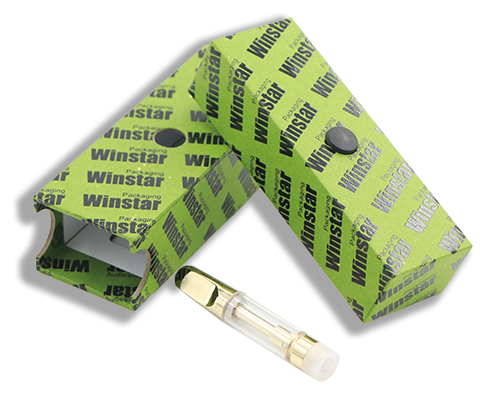
This example size is listed for 420 Packaging's Custom 510 Vape Cartridge Box with Window & Tamper-Evident Peel Seal, although the product is customizable.
A buyer might test three theoretical layouts:
| Layout | Units per Layer | Layers | Total Units | Potential Trade-Off |
|---|---|---|---|---|
| Layout A | 12 | 4 | 48 | Compact count; check top-load and window contact |
| Layout B | 10 | 4 | 40 | More clearance; potentially lower packing density |
| Layout C | 12 | 3 | 36 | Lower stack inside the case; more cases per order |
These numbers are examples, not a production recommendation.
The correct layout must be built from the actual finished unit, corrugated structure, separators and transport plan.
Calculate gross weight too
A useful planning equation is:
Gross Case Weight = (Filled Unit Weight × Case Quantity) + Master Carton + Dividers + Other Packing Materials
A layout that fits geometrically may still be unattractive if it creates an unnecessarily heavy case for warehouse handling.
Choose the Right Pack Orientation
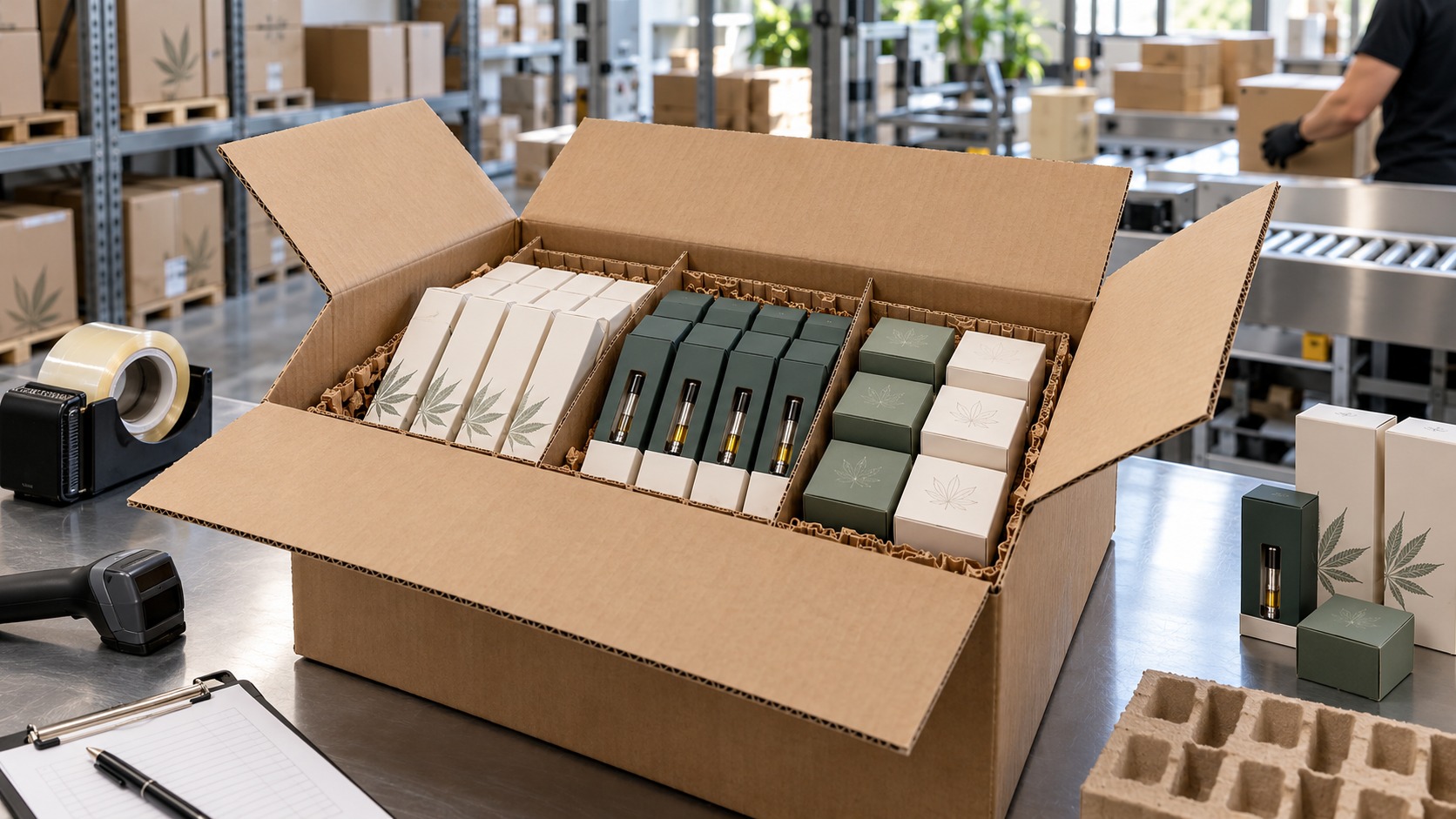
There is often more than one way to place the same retail package inside a shipping carton.
Orientation changes:
- how many units fit;
- which retail surfaces contact one another;
- where compression loads travel;
- whether windows or seals are protected;
- how warehouse staff remove the product.
Face-to-face packing
Efficient for many folding cartons, but premium finishes may rub against each other.
Back-to-front alternating
Can move delicate front panels away from one another, depending on box geometry.
Vertical loading
Can be useful when the package has stronger vertical edges or must stay upright.
Flat loading
May reduce tipping but can place more load on large display panels.
Alternating orientation
Can improve space utilization for irregular packages, but makes warehouse presentation less predictable.
If one case layout performs poorly, do not immediately add more corrugated material. Rotate the retail package and test another orientation. Sometimes the damage path comes from where the retail box carries load, not from the strength of the master carton itself.
How Much Empty Space Is Too Much?
Empty space is not automatically bad.
Uncontrolled empty space is the problem.
If retail packs can build momentum before hitting another package or the master-carton wall, the carton becomes a small impact chamber.
Signs of excessive uncontrolled void
- units rotate during normal handling;
- packages arrive in a different orientation than they were packed;
- corners become selectively crushed;
- printed faces show random rubbing patterns;
- carton walls bow inward because the contents do not support them;
- warehouse staff hear or feel movement when the case is handled.
Do not solve every void problem with loose filler
Extra paper or other dunnage can stabilize some shipments, but a better production solution may be:
- a different case count;
- a new orientation;
- a corrugated divider;
- an inner pack;
- a layer pad;
- a better-fitting master carton.
The goal is repeatable positioning, not random material added until the carton feels full.
Compression and Stacking Risk
Master cartons are exposed to vertical load in warehouses, trucks and pallets.
The effect on retail packaging depends on how the case, internal packs and product share that load.
A retail package can fail even if the shipper does not collapse
A master carton may still look usable while:
- top-layer retail cartons bow;
- rigid boxes develop corner dents;
- child-resistant sleeves become harder to open;
- pouch zipper areas crease;
- jar inserts compress;
- window cartons deform around the cutout.
For formal compression evaluation, ASTM's current ASTM D642-25 covers compressive resistance testing of shipping containers, components and unit loads. ASTM notes that compression resistance is used to evaluate a shipping container's ability to survive compressive forces encountered in storage and distribution.
Do not copy a compression load from another brand
The appropriate target depends on factors such as:
- case gross weight;
- stack height;
- warehouse duration;
- pallet pattern;
- corrugated construction;
- humidity exposure;
- whether the product itself shares load;
- distribution route.
Use your actual logistics assumptions when establishing a laboratory test plan.
Prevent Scuffing and Print Transfer Inside the Case
High case-pack efficiency creates more surface contact.
That makes print and finish compatibility part of shipping design.
Common case-pack scuff patterns
| Pattern | Likely Cause | What to Review |
|---|---|---|
| Front panel rubs against adjacent front panel | Face-to-face layout | Orientation or separator |
| Top row has matte polishing | Vertical case pressure plus vibration | Layer pad and finish resistance |
| Black ink transfers to light carton | Printed surfaces in repeated contact | Ink/coating cure and rub resistance |
| Foil scratches at one edge | Localized contact point | Orientation and structural protrusion |
| Window area dents | Adjacent carton corner loads the window | Pack direction and divider use |
420 Packaging's Cannabis Packaging Rub Test covers print and finish abrasion in more detail. Use that guide when the main failure is coating, ink or foil durability; use the current guide when the question is how the case-pack arrangement creates the contact.
Case-Pack Risks by Cannabis Product Type
| Product Format | Main Case-Pack Risk | What to Check |
|---|---|---|
| Pre-roll boxes | Crushed tips, rattling, retail-box deformation | Orientation, insert support, layer load, divider retention |
| Concentrate jar boxes | High unit weight, glass damage, insert compression | Gross case weight, bottom support, jar movement, layer count |
| Vape cartridge cartons | Window damage, hardware rattle, thin-carton bowing | Face orientation, insert fit, case pressure, divider use |
| Flower pouches | Creased zippers, folded seals, uncontrolled migration | Pouch fill profile, carton headspace, orientation, seal protection |
| Gummy pouches or cartons | Heat plus stacking interaction, pouch blocking, carton staining | Temperature route, orientation, compression and recovery |
| Tincture boxes | Bottle weight, leakage, dropper damage | Upright control, dividers, bottom support and leak containment |
Pre-roll programs
420 Packaging's Pre-Roll Packaging Crush Protection Guide goes deeper into cone clearance, insert retention and transit damage at the individual pack level.
This article deliberately keeps the keyword scope broader: how multiple finished cannabis packages should be organized in the master carton.
Master-Carton Labels and Receiving Accuracy
A mechanically strong case pack can still create warehouse problems if the outer carton does not clearly identify its contents.
Before production, define which fields the receiving operation actually needs.
Common master-carton fields
- brand or customer;
- product / packaging SKU;
- artwork revision where relevant;
- color or variant;
- quantity inside the case;
- lot or production reference;
- purchase-order number;
- carton number, such as 4 of 28;
- gross or net weight where required;
- dimensions where useful;
- destination or warehouse code;
- machine-readable barcode when part of the receiving workflow.
Do not let two different counts look the same
If one SKU ships 24/case and another 36/case, make that difference obvious.
A case label that shows only the product name forces the warehouse to open cartons to verify quantity.
Protect the label from normal handling
Place the label where stretch wrap, carton tape, pallet edges or strapping will not make it unreadable.
If the operation depends on scanning, test the final label after the actual case is closed and palletized.
Palletization and Warehouse Handling
The master carton should also work as part of a larger unit load.
A case that looks efficient by itself can create poor pallet utilization or unstable stacking.
Review these factors together
- cases per pallet layer;
- number of layers;
- case orientation;
- pallet overhang;
- column versus interlocked stacking strategy;
- stretch-wrap containment;
- corner protection where used;
- total load height;
- gross pallet weight;
- whether cases are repeatedly broken down and restacked.
Avoid uncontrolled pallet overhang
When cartons extend beyond the pallet edge, lower cartons can lose support and become more vulnerable to handling impact.
Do not optimize only for maximum case count
A slightly different master-carton dimension may improve pallet utilization enough to reduce total freight or handling complexity.
That trade-off should be evaluated before the retail packaging order is locked.
A Practical Case-Pack Validation Protocol
The following workflow is useful for development and supplier qualification.
Step 1: Freeze the retail package
Use production-intent:
- cartons or pouches;
- inserts;
- closures;
- labels;
- finishes;
- filled product or a safe representative substitute.
Step 2: Record the case configuration
Document:
- master-carton internal dimensions;
- corrugated specification supplied by the carton vendor;
- retail units per layer;
- layers;
- total quantity;
- divider / layer-pad design;
- case gross weight;
- closure tape pattern.
Step 3: Photograph the pack-out
Take photographs:
- after the first layer;
- half full;
- fully packed before closing;
- after closure;
- after testing.
This makes later damage mapping far more useful.
Step 4: Check movement before formal testing
With safe handling practices, verify whether units move excessively inside the closed case.
If a carton obviously contains large uncontrolled movement, correct the pack-out before paying for a more advanced test.
Step 5: Expose the pack to relevant hazards
Depending on the distribution route, evaluation may include:
- compression;
- vibration;
- drops or impacts;
- temperature and humidity conditioning;
- parcel handling;
- pallet handling.
Step 6: Open the case methodically
Do not dump all packages onto the inspection table.
Inspect by position:
- top layer;
- middle;
- bottom;
- corners;
- center.
Damage location often reveals the load path.
Step 7: Check function, not just appearance
After distribution exposure, confirm that:
- child-resistant features still work as intended;
- pouch closures still engage;
- jars are intact;
- cartridges remain retained;
- tamper features are not falsely triggered;
- QR codes and barcodes remain usable;
- required information remains readable.
ASTM and ISTA: Which Test Answers Which Question?
Do not describe every drop, vibration or compression screen as the same type of test.
| Reference | Main Purpose | Useful When | What It Does Not Mean |
|---|---|---|---|
| ASTM D642-25 | Compression resistance of shipping containers, components and unit loads | You need to evaluate compressive strength or compare case designs | It is not a complete distribution simulation by itself |
| ASTM D4169 | Laboratory performance evaluation using sequences of distribution hazards | You need a broader shipping-container system test plan | It does not replace your product-specific damage criteria |
| ISTA 2A | Partial simulation for individual packaged products up to 150 lb / 68 kg | You need a packaged-product test with conditioning / compression / vibration / shock elements as applicable to the procedure | It is not automatically the correct protocol for every distribution system |
| ISTA 3A | General simulation for individual packages moving through parcel delivery systems | The filled shipping package is distributed as an individual parcel | It should not automatically be applied to palletized freight just because it is well known |
ISTA's current procedure library describes its 2-Series as partial simulation tests and lists ISTA 2A for individual packaged products weighing 150 lb (68 kg) or less. ISTA 3A is specifically designed around individual packaged products shipped through parcel-delivery systems.
ASTM D4169 describes a broader laboratory framework that subjects shipping units to anticipated distribution hazards, while ASTM D642 focuses specifically on compressive resistance.
A laboratory can expose a package to a defined protocol, but the shipper still needs to determine what product damage and package degradation are acceptable. Decide in advance whether a crushed retail corner, scuffed foil logo, difficult child-resistant lock or broken secondary carton is a failure for your program.
Pre-Shipment Case-Pack QA
Once the development pack-out passes, production still needs a repeatable packing check.
| Check | What to Verify |
|---|---|
| Retail SKU | Correct product and artwork revision |
| Case quantity | Matches purchase order and case-pack specification |
| Orientation | Units face the defined direction |
| Layer count | No missing or extra layer |
| Dividers | Correct material, position and quantity |
| Void | No unexpected empty space caused by shortage or wrong orientation |
| Retail packaging | No crushing, unintentional opening or severe friction before shipment |
| Master carton | No major damage, wet board, open seam or weak closure |
| Gross weight | Reasonable against the approved pack-out reference |
| Case label | SKU, quantity, lot and PO data are correct |
| Pallet | Pattern, containment and labels match the shipping plan |
Use carton weight as a useful error screen
Once a standard case pack is established, gross weight can help flag:
- missing units;
- extra units;
- wrong product packed;
- missing dividers;
- unexpected packing-material changes.
It should support—not replace—quantity and SKU verification.
Retain one packed reference case when practical
A retained retail sample is useful. A documented master-carton pack-out is even more useful when a later complaint concerns:
- case quantity;
- orientation;
- friction damage;
- carton size;
- divider placement.
420 Packaging Formats to Validate in a Case Pack
Child-Resistant Kraft Paper Pre-Roll Packaging Box
This current 420 Packaging format uses an outer sleeve, sliding inner tray and locking tab. The product page lists kraft paperboard, customizable pre-roll capacity, CMYK/Pantone printing, optional finishes and flat-packed supply.
Case-pack validation should focus on:
- whether stacked cases distort the push-and-slide area;
- whether flat-packed units or assembled units are being shipped;
- whether dividers stay aligned after vibration;
- whether kraft faces rub or polish against adjacent packs;
- whether the child-resistant structure still operates after shipping.
Custom 510 Vape Cartridge Box with Window & Tamper-Evident Peel Seal
The current product specification lists an example external size of 100 × 55 × 25 mm, customizable 300–400 gsm SBS/C1S or kraft board, paperboard / molded pulp / EVA insert options and packaging quantities of 100–200 pieces per carton on the product page.
For a production program, do not automatically adopt the listed carton quantity. Validate the actual SKU because final dimensions, insert, window, board, product weight and finish can change the correct case pack.
Case-pack checks should include:
- window protection;
- cartridge retention;
- peel-seal protection;
- carton bowing;
- barcode-panel access;
- scuffing of premium finishes.
5g Concentrate Violet Glass Packaging Box
This rigid paperboard box is customized around a 5g violet glass jar and supports paper, foam, EVA or molded insert options. The current product page lists an MOQ of 1,000 pieces and customized dimensions based on jar diameter, height and insert structure.
Compared with a lightweight carton, jar packaging makes case gross weight and layer compression much more important.
Validate:
- jar movement after vibration;
- insert compression;
- bottom-layer loading;
- rigid-box corner damage;
- case gross weight;
- pallet stack height.
Case-Pack Failure Diagnosis Table
| What You Find After Shipping | First Areas to Investigate |
|---|---|
| Only top-layer retail boxes crushed | Case top load, pallet stacking, headspace and layer pad |
| Only bottom layer damaged | Case weight, bottom support, internal load path |
| Corner units damaged | Master-carton corner impact, excess void, pallet overhang |
| Center units scuffed | Retail-to-retail contact, vibration and surface finish |
| All units bowed in the same direction | Overtight case dimensions or case-panel compression |
| Random unit rotation | Excessive void or missing internal control |
| Cases arrive intact but jars break | Retail insert, internal impact and product load path |
| Child-resistant function becomes difficult | Retail-pack deformation under case compression |
| Outer case collapses in warehouse stack | Corrugated design, stack load, humidity and pallet pattern |
What to Send Your Packaging Supplier
If you want the supplier to engineer the master carton instead of guessing, include:
- final retail-package dimensions;
- filled unit weight;
- SKU count;
- order quantity per SKU;
- target units per case if your warehouse has a preference;
- shipping mode;
- destination;
- whether the shipment is parcel, loose case or palletized;
- maximum preferred case weight;
- fragile retail surfaces;
- required upright orientation;
- pallet dimensions where predetermined;
- label fields and barcode requirement;
- distribution test requirement;
- damage acceptance criteria.
420 Packaging's Cannabis Packaging Supplier Guide covers the broader RFQ, documentation, sample and change-control process. Use the case-pack specification as a separate logistics attachment rather than burying it inside general packaging notes.
ASTM D4169 — Standard Practice for Performance Testing of Shipping Containers and Systems
International Safe Transit Association — Test Procedure Library
When requesting custom cannabis packaging, send the product dimensions, filled weight, retail package format, order quantity, target market, preferred case count and shipping route at the same time. That makes it easier to evaluate the retail box, insert, master-carton arrangement and shipping efficiency as one packaging system instead of solving freight problems after the retail box is already in production.
Frequently Asked Questions
1. What does case pack mean in cannabis packaging?
Case pack means the defined number and arrangement of retail-ready units inside a master shipping carton. A complete case-pack specification should also define unit orientation, layers, separators, gross weight, carton dimensions and outer case labeling.
2. How many cannabis packages should go in one master carton?
There is no universal count. The best quantity depends on finished package size, filled unit weight, fragility, case dimensions, warehouse preferences, pallet configuration and shipping method. Compare several layouts before locking the count.
3. Should I use the smallest possible shipping carton?
Not automatically. Excess void can cause movement, but an overly tight case can crush or bow retail packages. The goal is controlled clearance and repeatable positioning rather than simply minimizing carton volume.
4. Why do cannabis retail boxes get scuffed inside an undamaged master carton?
Retail packs can rub against one another during vibration even when the master carton remains intact. Review pack orientation, surface finish, divider use, case compression and the contact points between adjacent units.
5. What is the difference between a compression test and a distribution test?
A compression test focuses on resistance to applied compressive load. A broader distribution test may combine hazards such as conditioning, vibration, compression, impacts or drops according to the selected protocol. One test should not be presented as proving every distribution risk.
6. What is ASTM D642 used for?
ASTM D642 covers compression testing of shipping containers, components and unit loads. It can be used to evaluate or compare resistance to external compressive loads encountered during storage and distribution.
7. Is ISTA 3A right for every cannabis packaging shipment?
No. ISTA 3A is designed for individual packaged products moving through a parcel-delivery system. Palletized or other distribution systems may require a different protocol. Select a test based on the actual shipping route.
8. Should master-carton testing use empty retail boxes?
For meaningful pack-out validation, use the final filled package or a safe representative substitute with equivalent dimensions, weight and relevant physical behavior. Empty packaging may not reproduce the compression, movement and load paths of the production shipment.
9. What information should go on a cannabis packaging master carton?
Common fields include SKU, variant, case quantity, lot or production reference, purchase-order number, carton number and receiving barcode. Exact requirements depend on the brand, warehouse and applicable supply-chain procedures.
10. When should a cannabis case pack be revalidated?
Recheck the case pack after meaningful changes to retail-package dimensions, material, insert, filled product weight, case quantity, master-carton design, divider, shipping route or pallet configuration. A change that looks small at the retail level can alter the distribution load path.