
Last updated: October 14, 2026
A cannabis package is production-efficient when workers or equipment can repeatedly feed, orient, fill, close, label, inspect and case-pack it without unnecessary handling or a high reject rate. The fastest-looking package is not always the best one: a pouch that saves material can become slow if operators struggle to open it, a child-resistant box can create a bottleneck if every lock needs manual correction, and a premium carton can lose money if labels cannot be applied consistently. Before mass production, run the finished package through the real work sequence, time each step separately, record defects and rework, and calculate labor per 1,000 units. Evaluate manual and automated handling independently. A package should be approved not only because it looks good and fits the product, but because it can be packed repeatedly at the volume your operation actually needs.
Packaging buyers spend a lot of time comparing unit prices.
They spend much less time asking how many seconds each package adds to the production line.
That difference can be expensive.
Imagine two cannabis cartons. Package A costs a few cents less, but every worker has to open the carton by hand, straighten an insert, load the product, correct a locking tab and then reposition the box before applying the label. Package B costs slightly more but arrives pre-glued, opens predictably and presents the label panel in the same orientation every time.
On a small sample order, the difference barely matters.
At 10,000, 50,000 or 100,000 units, it can determine whether a launch stays on schedule.
For brands, co-packers and manufacturers, packaging should therefore be treated as part of the production system—not as an object that appears after production has already been designed.
What Is Cannabis Packaging Line Efficiency?
Packaging line efficiency is not simply the maximum speed of a filling machine.
It is the ability of the complete packaging process to move units from empty packaging to finished, inspected and case-packed product with predictable labor and low rework.
That process may include:
- bringing empty packaging to the workstation;
- opening or erecting the package;
- orienting the package;
- weighing or counting product;
- filling;
- installing an insert or accessory;
- closing a cap, zipper, drawer or locking structure;
- applying tamper evidence;
- applying labels or variable data;
- checking net contents;
- scanning codes;
- visual inspection;
- loading retail units into master cartons.
If one step is significantly slower than every other step, that station controls the output of the line.
This is why buying packaging by unit price alone can give a misleading picture of total cost.
Why Packaging Unit Price Can Hide Labor Cost
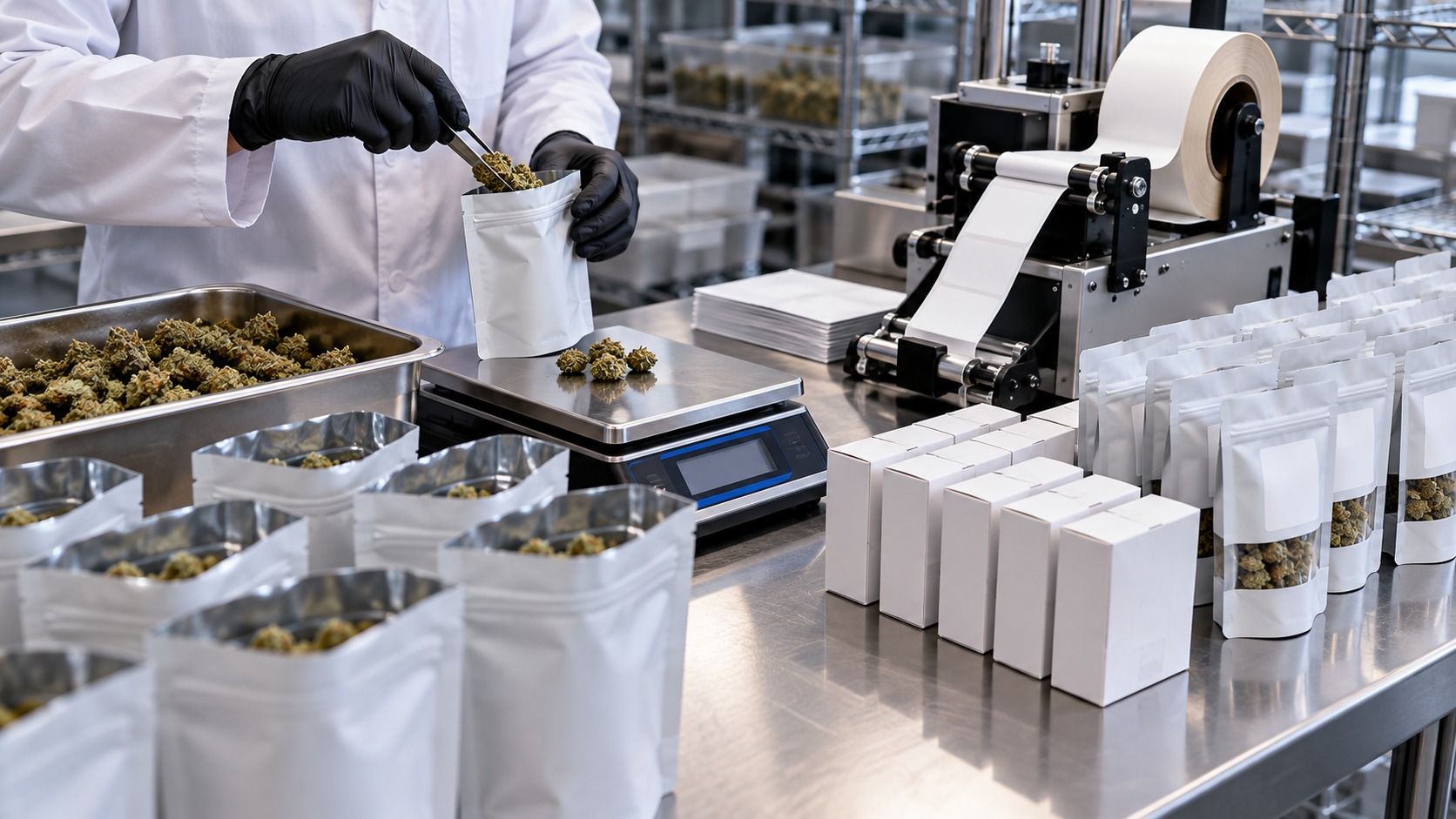
A packaging quote normally shows the price of the empty package.
It rarely shows the cost of assembling it.
Consider a simple example.
| Package | Empty Package Cost | Average Added Handling Time | Added Labor Hours per 10,000 Units |
|---|---|---|---|
| Package A | Lower | 5 seconds | 13.9 hours |
| Package B | Higher | 15 seconds | 41.7 hours |
| Difference | Depends on quote | 10 seconds | 27.8 hours |
The math is simple:
Labor Hours = Units × Seconds per Unit ÷ 3,600
If a packaging choice adds only 10 seconds of work, 10,000 units require almost 28 additional labor hours.
At 100,000 units, the same difference becomes approximately 278 hours.
When comparing two custom packages, add assembly time to the quotation. A package that costs slightly more per unit can still produce a lower total packed cost if it removes folding, alignment, relabeling or rework.
Map the Entire Pack-Out Before Choosing the Package
Do not begin line-efficiency analysis at the filler.
Start with the first time an operator touches the empty package and end when the finished retail pack enters the master carton.
| Stage | Question to Ask | Common Failure |
|---|---|---|
| Empty-pack handling | How does packaging arrive at the line? | Flat cartons require unexpected manual erection |
| Feeding | Can packages be separated one at a time? | Static, nesting or irregular shapes cause double-feeds |
| Orientation | Does the package naturally present the correct side? | Workers rotate every unit before filling |
| Filling | Is the opening large and accessible enough? | Product spills or contaminates closure surfaces |
| Insert loading | Does the product enter without force? | Insert bends or product needs repeated alignment |
| Closing | Can workers confirm closure visually or mechanically? | Partially locked units appear closed |
| Labeling | Is there a flat, repeatable label panel? | Labels bridge seams or drift around tapered surfaces |
| Inspection | Can defects be seen without reopening the package? | QC must destroy or reopen completed units |
| Case packing | Does the retail pack load consistently into the shipper? | Orientation changes from case to case |
420 Packaging's existing Cannabis Packaging Sample Checklist includes a short filling-line trial as one part of sample approval. This guide focuses specifically on production efficiency: how to break that trial into stations, quantify labor and diagnose the step that limits throughput.
Can the Package Be Fed and Oriented Reliably?
Before a package can be filled, it has to reach the filling position in the correct orientation.
That sounds obvious until a distinctive shape reaches an automated or semi-automated line.
Ask how empty packaging behaves in bulk
Ten samples placed neatly on a desk do not show whether 500 empty packages:
- nest inside one another;
- stick together;
- fall over;
- rotate randomly;
- require individual opening;
- create static;
- need protective films removed;
- have no reliable orientation feature.
Stable geometry helps automation
Round jars, straight-sided cartons and consistent pouches are generally easier for equipment to locate than shapes with large dimensional variation.
Distinctive packaging can still be automated. It simply needs to be tested with the intended equipment rather than assuming every package feeds the same way.
Automation suppliers such as Canapa Solutions currently show cannabis lines that include weighing, jar filling, bagging, capping, labeling, cartoning, tray forming and case packing. This illustrates why packaging compatibility should be evaluated across several stations, not only at the filler.
Design the Opening Around the Filling Process
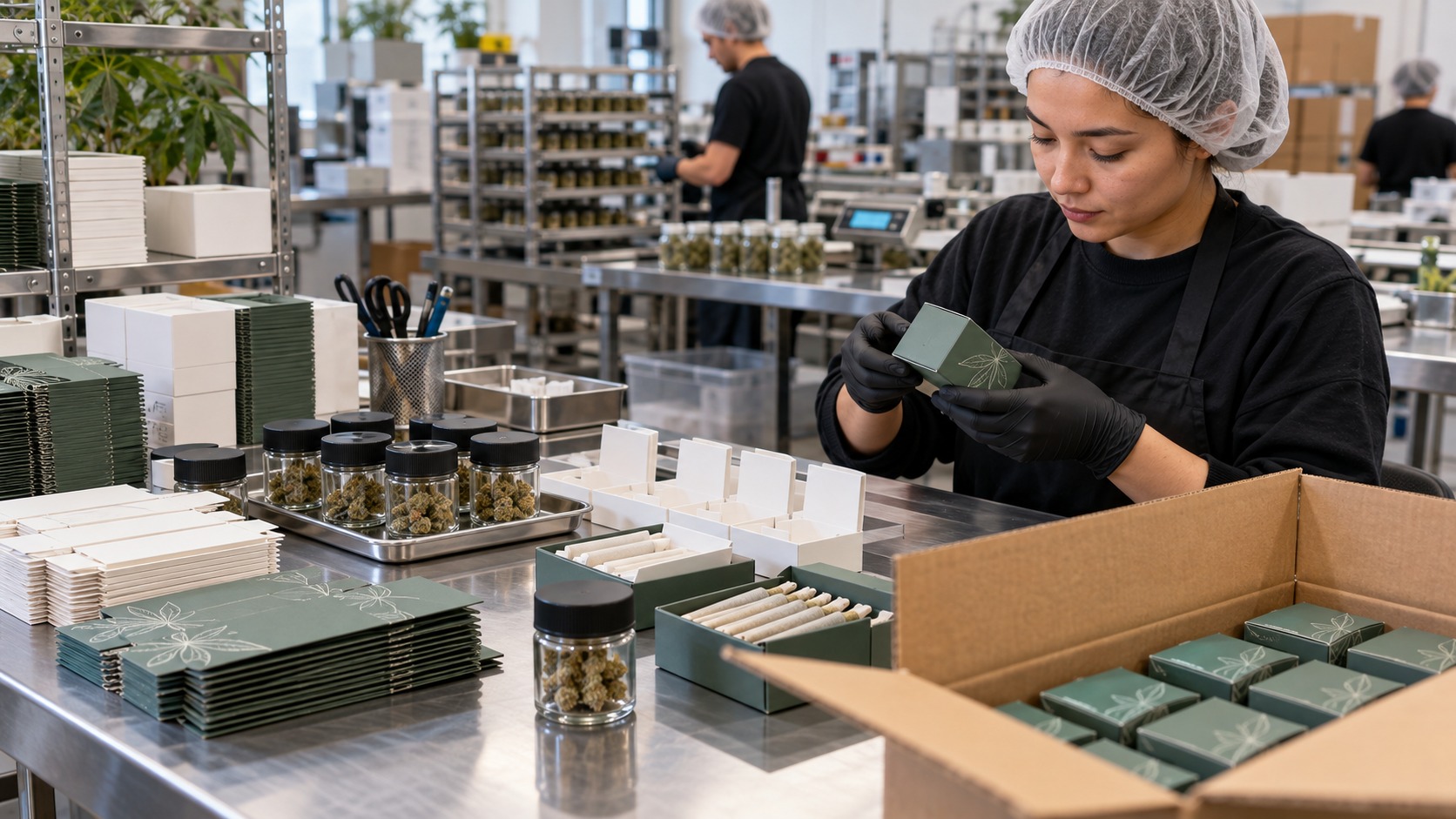
One of the easiest ways to slow a packaging line is to make the opening difficult to access.
Flower pouches
The pouch needs to open wide enough for the actual filling method.
Possible problems include:
- zipper closes again while filling;
- gusset does not fully open;
- funnel contacts the zipper;
- flower lands in the heat-seal area;
- workers must hold the pouch open with one hand;
- high fills distort the pouch before sealing.
If flower packaging is being heat sealed, use the separate Cannabis Flower Pouch Seal Test for seal-land contamination and sealing-process QA.
The line-efficiency question is different: how easily can the package be opened, filled and handed to the next station without creating contamination or rework?
Jars
Check:
- mouth diameter;
- funnel or chute clearance;
- container stability;
- whether jars need orientation;
- fill-height visibility;
- cap placement;
- thread-start consistency.
Pre-roll packaging
The packaging process may need to count, orient and place several pre-rolls into dividers or trays.
A beautiful multipack can become slow if each pre-roll must be individually corrected into a narrow slot.
When Inserts Become a Production Bottleneck
Inserts protect products and improve presentation, but they can also add several manual actions.
Common insert-related delays
- insert must be folded before use;
- insert arrives separate from the carton;
- insert can be installed backward;
- insert shifts while product is loaded;
- cavity fit is so tight that workers must force the product in;
- the product must be rotated before insertion;
- small accessory slots require manual correction.
Measure loading time, not just fit
A product that fits after careful handling may still be unsuitable for a high-volume line.
During the pilot trial, record:
- average loading time;
- slowest loading time;
- insert damage rate;
- product misalignment rate;
- number of times operators use two hands;
- number of units requiring rework.
Give the insert and product to someone who did not design the package. Do not explain the correct orientation. If the person frequently loads the product backward or hesitates before inserting it, the production line may need a clearer poka-yoke feature, fixture or visual work instruction.
Child-Resistant Closures and Line Speed
Child-resistant functionality should never be weakened merely to improve speed.
But the packaging team should still understand how the selected structure affects assembly.
Questions for a child-resistant paper box
- Does the lock engage automatically during normal closing?
- Can an operator tell when it is fully engaged?
- Does the inner tray need perfect alignment?
- Can paper dust or dimensional variation interfere with the lock?
- Does closing require one hand or two?
- Can a fixture improve repeatability without changing the tested structure?
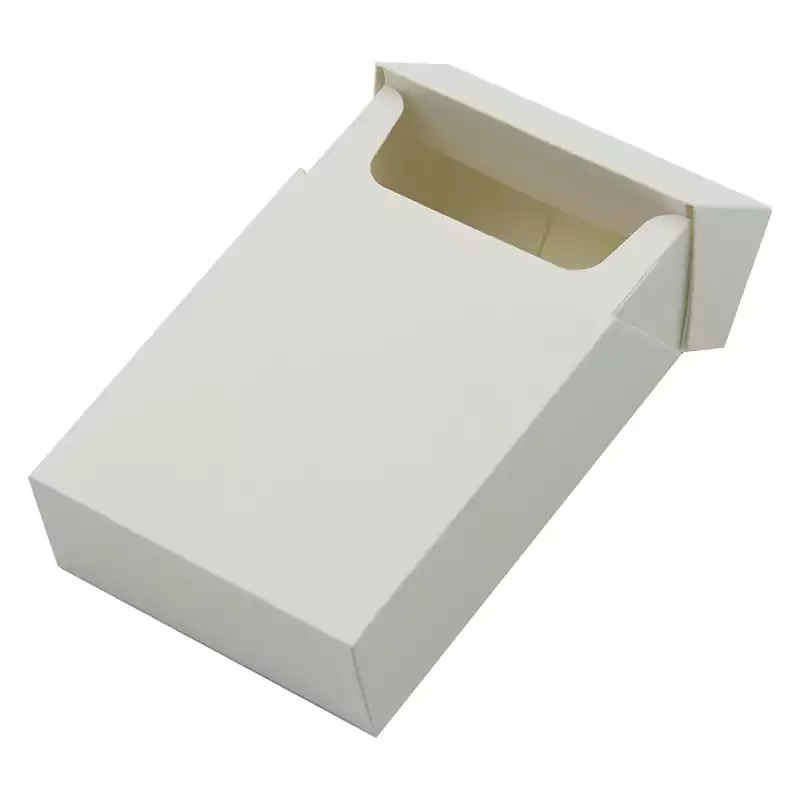
420 Packaging's Child-Resistant Kraft Paper Pre-Roll Packaging Box uses an outer sleeve, inner sliding tray and push-and-slide locking tab. The official product page notes that it is supplied flat and uses simple manual folding and locking.
That means a buyer should evaluate two different operations:
- initial carton assembly;
- finished-product loading and lock engagement.
A sample that opens correctly does not tell you how many finished units workers can assemble per hour.
Design Packaging for Reliable Label Application
Labeling can become a bottleneck even when filling is fast.
Good label panels are predictable
For pressure-sensitive labels, check whether the intended panel is:
- flat or predictably curved;
- large enough;
- free of major seams;
- free of locking tabs;
- away from tear strips;
- consistent in orientation;
- accessible to the labeling head or operator.
Orientation matters
If a compliance label must align to printed artwork, the packaging line needs a way to present every container consistently.
A round jar without an orientation mark may be easy to label with a generic wrap label, but more difficult when the label must align with direct printing or a molded feature.
Do not solve a mechanical problem with operator eyesight
If the specification requires every label to land within a narrow position, investigate:
- guide rails;
- registration marks;
- container fixtures;
- vision inspection;
- package redesign.
For adhesive failures after application, use the site's Cannabis Packaging Labels Peeling Guide. That article covers label adhesion; this one covers label application as a production step.
Heat Sealing and Tamper-Evident Steps
A cannabis package may pass through more than one closing operation.
For example:
fill pouch → close zipper → heat seal → inspect → label → case pack
or:
load cartridge → close carton → apply tamper-evident seal → label → inspect
Each added step creates a potential bottleneck.
Track first-pass yield
Do not measure only how quickly a station operates.
Also record the percentage of units that pass the station correctly the first time.
A useful calculation is:
First-Pass Yield = Good Units After First Attempt ÷ Total Units Processed × 100%
A fast station with frequent rework may produce less finished output than a slightly slower but stable process.
Make defects visible before the next station
Whenever possible, inspect:
- seal continuity;
- closure engagement;
- tamper label presence;
- lot-code presence;
- orientation;
before the unit receives more labor and material.
Run a 50-Unit Packaging Line Trial
A practical pre-production trial does not require thousands of units.
For many projects, 50 production-intent samples are enough to reveal obvious labor and handling problems before a large order is released.
Step 1: Use the actual work sequence
Do not allow the packaging designer to create a special shortcut during the trial.
Use the process intended for production.
Step 2: Use several operators
One experienced person can learn around a bad design.
Use more than one operator when practical.
Step 3: Time stations separately
| Station | Record |
|---|---|
| Package preparation | Seconds per unit and assembly errors |
| Filling | Cycle time, spills, contamination |
| Insert / product loading | Cycle time and misalignment |
| Closure | Cycle time and incomplete closures |
| Labeling | Cycle time, crooked labels, reapplication |
| Code / scan | Failed scans or missing variable data |
| Final inspection | Defects detected and rework time |
| Case packing | Units per case and loading time |
Step 4: Do not stop the clock when something fails
Rework is part of the real process.
If a worker needs 8 seconds to fix a tab, reapply a label or reopen a pouch, include that time.
Step 5: Record the bottleneck
The slowest station with persistent work-in-process building in front of it deserves the first improvement effort.
Calculate Packaging Labor per 1,000 Units
Once average seconds per unit are known, convert the result into labor.
Hours per 1,000 Units = Average Seconds per Unit × 1,000 ÷ 3,600
| Packaging Time | Labor Hours per 1,000 Units | Labor Hours per 10,000 Units |
|---|---|---|
| 10 seconds/unit | 2.8 hours | 27.8 hours |
| 20 seconds/unit | 5.6 hours | 55.6 hours |
| 30 seconds/unit | 8.3 hours | 83.3 hours |
| 45 seconds/unit | 12.5 hours | 125 hours |
| 60 seconds/unit | 16.7 hours | 166.7 hours |
You can then estimate direct labor:
Packaging Labor Cost = Labor Hours × Loaded Hourly Labor Cost
This calculation is intentionally simple. It does not include equipment depreciation, supervision, floor space, downtime or overhead, but it is much more useful than comparing empty-package prices alone.
Diagnose the Bottleneck Instead of Blaming the Whole Package
| Observed Problem | Likely Area to Investigate First |
|---|---|
| Workers wait for empty packages | Feeding, erection or material presentation |
| Product spills during filling | Opening size, funnel geometry, package stability |
| Product repeatedly loads backward | Insert orientation and poka-yoke design |
| Child-resistant boxes need hand correction | Lock alignment, folding consistency, closure tolerance |
| Labels are consistently crooked | Package orientation, label panel geometry, fixture |
| Heat seal rejects are high | Seal land, pouch handling and sealing process |
| Finished units accumulate before QC | Inspection method or scan process |
| Master carton packing is slow | Retail-pack orientation, case layout and divider design |
A bottleneck table prevents a common mistake: redesigning the entire package when only one interaction is causing the slowdown.
Manual vs. Semi-Automated vs. Automated Packaging
Not every cannabis company needs a fully automated line.
The package should work with the production scale that actually exists.
| Production Model | Packaging Priority | Typical Risks |
|---|---|---|
| Manual | Easy opening, folding, loading and visual verification | Labor, operator variation and repetitive handling |
| Semi-automated | Consistent dimensions plus operator-friendly transfer between stations | Machine/manual handoff becomes the bottleneck |
| Automated | Feeding, orientation, dimensional repeatability and machine-compatible surfaces | Small packaging variation creates repeated stoppages |
Calyx Containers' automation overview separates common production steps into dispensing/filling, capping/sealing, labeling/variable data and tamper evidence. That breakdown is useful for packaging buyers because each step can impose a different geometry requirement on the package.
Canapa also documents automated systems covering rigid jars, pouches, cartons, trays and end-of-line case packing. The point is not that every brand should automate. It is that packaging ordered today should not create an unnecessary barrier if volume increases later.
Why SKU Changeover Time Matters
A line that runs one SKU all day has a different packaging requirement from a line switching strains, flavors or potency variants every hour.
Changeovers can involve:
- new packaging material;
- new label roll;
- different variable data;
- different insert;
- new case label;
- different product weight;
- machine guide adjustment;
- cleaning or line clearance;
- new inspection criteria.
Use common structures when practical
If several SKUs can share:
- the same external carton;
- the same insert;
- the same label size;
- the same equipment settings;
changeovers may become easier.
That does not mean every SKU should look identical. Color, artwork and variable data can still differentiate products while the physical package architecture remains stable.
Track changeover minutes separately
A package that runs efficiently once set up may still be costly if every changeover takes a long time.
A useful KPI is:
Changeover Cost per Batch = Changeover Time × Line Labor Cost
For short runs, changeover efficiency can matter as much as raw line speed.
Line-Efficiency Risks by Cannabis Product Type
| Product Type | Common Production Bottleneck | Packaging Feature to Review |
|---|---|---|
| Flower pouch | Opening, filling and contaminated seal land | Pouch mouth, gusset, zipper and seal zone |
| Flower jar | Container feeding, filling, capping | Jar stability, mouth, thread and cap |
| Pre-roll multipack | Counting and individual placement | Divider geometry and loading direction |
| Single pre-roll tube | Tube orientation and cap application | Tube geometry and closure |
| Vape cartridge carton | Insert loading, carton erection and label orientation | Carton structure, insert and flat label panels |
| Concentrate jar box | Jar insertion and rigid insert fit | Cavity tolerance and loading clearance |
| Edible pouch | Counting, zipper closure and heat seal | Opening width, closure and seal zone |
420 Packaging Formats to Evaluate on Your Line
Child-Resistant Kraft Paper Pre-Roll Packaging Box
This current 420 Packaging format uses a kraft paperboard outer sleeve, sliding inner tray and locking tab. Capacity is customizable by pre-roll size and count, and the official page lists CMYK/Pantone customization and optional finishes.
The product page also notes that the box is supplied flat with manual folding and locking. That makes it particularly important to measure:
- initial carton assembly time;
- divider installation where used;
- pre-roll loading time;
- lock-engagement first-pass yield;
- whether operators can immediately identify correct orientation.
Custom 510 Vape Cartridge Box with Window & Tamper-Evident Peel Seal
The current 420 Packaging specification lists a customizable straight-tuck-end carton, example external size of 100 × 55 × 25 mm, 300–400 gsm SBS/C1S or kraft board, paperboard/molded-pulp/EVA insert options and a standard peel-corner tamper-evident feature.
The product page states that the carton ships flat and pre-glued for pack-out.
For line approval, test:
- carton erection speed;
- insert loading;
- cartridge insertion;
- tuck closure;
- tamper-seal application;
- label-panel orientation;
- finished window alignment.
420 Smell Proof Bags with Zipper
420 Packaging currently offers resealable zipper pouches that can also be heat sealed above the zipper. Flexible packaging reduces empty-package storage volume but should still be evaluated on the actual filling process.
Test:
- how quickly the pouch opens;
- whether the bottom gusset expands consistently;
- compatibility with funnels or automated pouch opening;
- zipper contamination during filling;
- heat-seal presentation;
- finished pouch discharge and case packing.
How to Compare Two Packaging Designs Before Ordering
| Metric | Design A | Design B |
|---|---|---|
| Empty package unit cost | Record quote | Record quote |
| Assembly seconds | Measure | Measure |
| Fill seconds | Measure | Measure |
| Closure seconds | Measure | Measure |
| Label seconds | Measure | Measure |
| First-pass yield | Measure | Measure |
| Rework seconds | Measure | Measure |
| Case-pack seconds | Measure | Measure |
| Operator comments | Record recurring difficulty | Record recurring difficulty |
| Automation compatibility | Review | Review |
This makes the packaging decision much more useful than comparing appearance and unit price alone.
Production-Line Approval Checklist
| Check | Approval Question |
|---|---|
| Packaging supply | Does packaging arrive in a form that matches the planned production method? |
| Orientation | Can operators or equipment identify the correct direction reliably? |
| Opening | Can the package be opened without unnecessary handling? |
| Filling | Does the opening work with the intended funnel, filler or loading method? |
| Insert | Can the product be loaded quickly without forcing or repeated alignment? |
| Closure | Can workers confirm the package is fully closed? |
| Child resistance | Does the approved CR configuration remain unchanged by production fixtures or shortcuts? |
| Tamper evidence | Can the feature be applied consistently and inspected before the next station? |
| Labeling | Is the label panel accessible and repeatable? |
| Variable data | Can lot, batch or date information be applied and verified at line speed? |
| Inspection | Can major defects be identified without destructive reopening? |
| Case packing | Can finished units be loaded in the correct orientation efficiently? |
| Labor | Has actual seconds per unit been converted into cost at forecast volume? |
| Changeover | Has SKU-switch time been measured? |
What to Send Your Packaging Supplier
When production efficiency matters, include more than dimensions and artwork in the RFQ.
- product type and filled weight;
- forecast production volume;
- expected units per hour or shift;
- manual, semi-automated or automated process;
- existing filling equipment;
- funnel or filling-head dimensions where relevant;
- labeling method;
- tamper-evident process;
- child-resistant requirement;
- insert-loading method;
- case-pack quantity;
- number of SKUs;
- expected changeover frequency;
- known line bottlenecks;
- request for production-intent samples.
For broader supplier qualification, use How to Choose a Cannabis Packaging Supplier. The supplier article covers documentation, quality, quotations and change control; the current guide focuses specifically on production-line compatibility.
Canapa Solutions — Cannabis Packaging Automation Systems
Calyx Containers — Packaging Automation Overview
Viking Masek — Cannabis Pre-Roll Pouch Packaging Line Walkthrough
Send the product dimensions, production volume, package format, filling method, child-resistant requirements, label workflow and expected case pack before finalizing a custom structure. Evaluating the package against the real work sequence can help reduce unnecessary folding, difficult loading, closure rework and labeling problems before they are multiplied across a production order.
View Cannabis Packaging Options
Frequently Asked Questions
1. What is cannabis packaging line efficiency?
It is the ability to prepare, fill, close, label, inspect and case-pack cannabis packaging at a predictable rate with low rework. It includes labor and handling around the package, not only the speed of the filling machine.
2. How can packaging slow a cannabis production line?
Common causes include difficult pouch opening, cartons that require excessive folding, tight inserts, unclear orientation, closures that need manual correction, poor label panels and packaging that cannot be fed consistently into equipment.
3. How should I test cannabis packaging before a large production order?
Run production-intent samples through the actual pack-out sequence. Time package preparation, filling, loading, closure, labeling, inspection and case packing separately. Record first-pass yield, rework and recurring operator difficulties.
4. How many units should be used in a packaging line trial?
There is no universal number for every operation. A small run of around 50 production-intent units can be useful for exposing obvious repetitive problems, but higher-risk or automated programs may require larger engineering trials using the actual equipment.
5. How do I calculate packaging labor per 1,000 units?
Multiply the average packaging seconds per unit by 1,000, then divide by 3,600. For example, 30 seconds per unit equals about 8.3 labor hours per 1,000 units before considering supervision, downtime or other overhead.
6. Is automated cannabis packaging always cheaper than hand packing?
No. The best production method depends on volume, SKU variety, labor cost, equipment investment, changeover frequency and package design. Lower-volume or frequently changing products may still benefit from manual or semi-automated workflows.
7. Can child-resistant packaging be modified to run faster on equipment?
Do not modify a child-resistant structure in a way that changes the approved or tested configuration without appropriate review. Fixtures and handling improvements may help production, but the safety function and supporting documentation must remain applicable to the package being sold.
8. Why does packaging work manually but jam on an automated line?
Automated equipment depends on repeatable dimensions, orientation and feeding behavior. A worker can compensate for slight variation by sight and touch, while a feeder, guide or labeler may stop when the same variation occurs repeatedly.
9. Why should packaging changeover time be measured?
Brands with many strains or product variants may spend significant production time replacing packaging, labels, inserts, data and machine settings. For small batches, changeover labor can materially affect packed cost even when the line runs quickly after setup.
10. When should packaging be requalified on the filling line?
Recheck the line after meaningful changes to package dimensions, material, insert, closure, label size, product hardware, filled weight, sealing process or production equipment. A change that looks minor in artwork can still alter feeding, filling or closing behavior.