
Last updated: November 19, 2026
Yes. Printing ink on the outside of a cannabis edible package can still create a migration concern. Substances can transfer through a packaging material, move from the printed face to the food-contact face while film is wound or sheets are stacked (set-off), or travel through the package headspace. The risk depends on the actual ink formulation, packaging layers, food-contact surface, curing conditions, storage time, temperature and food characteristics. A package described as "food-grade" or printed with "low-migration ink" is not automatically qualified for every gummy, chocolate or infused edible. Before approving mass production, obtain the exact layer structure and ink/coating information, document the intended food-contact conditions, assess set-off during printing and storage, and obtain appropriate supplier compliance evidence or migration testing where needed. Keep the chemical migration review separate from child-resistance, seal-strength and PFAS checks.
A cannabis gummy pouch arrives from the printer with sharp artwork, a clean zipper and a strong heat seal.
The production team fills it, closes it and places the finished package on a shelf.
Everything looks fine.
But one question may remain unanswered:
What separates the printed ink from the gummies?
If the answer is simply "the ink is on the outside," the packaging review is incomplete.
Printed flexible films can transfer substances through more than one pathway. A material that prevents moisture loss is not automatically an effective barrier against every ink component. A paperboard carton may be separated from the edible by an inner wrapper, but the safety assessment must account for that actual wrapper rather than the carton alone.
The FDA has specifically examined photoinitiators used in UV-cured inks on the exterior of food packaging because certain substances may migrate under relevant conditions. The issue is not limited to inks printed directly against food.
FDA: Hazard Identification of Printing Ink Substances Used on the Exterior of Food Packaging
For a cannabis edible brand purchasing custom packaging, the practical job is to identify the material touching the product, map the printed layers and evaluate the complete structure under the intended conditions of use.
What Is Ink Migration in Edible Packaging?
Ink migration is the transfer of chemical substances associated with printing inks or related coatings from packaging toward food or the food-contact surface.
These substances may include components associated with:
- colorants and pigments;
- binders and resins;
- solvents and residual volatiles;
- photoinitiators used in some UV-curing systems;
- additives or formulation impurities;
- degradation or reaction products.
Not every substance will migrate from every printed structure. The composition of the ink and the physical properties of the packaging determine which transfer pathways are possible.
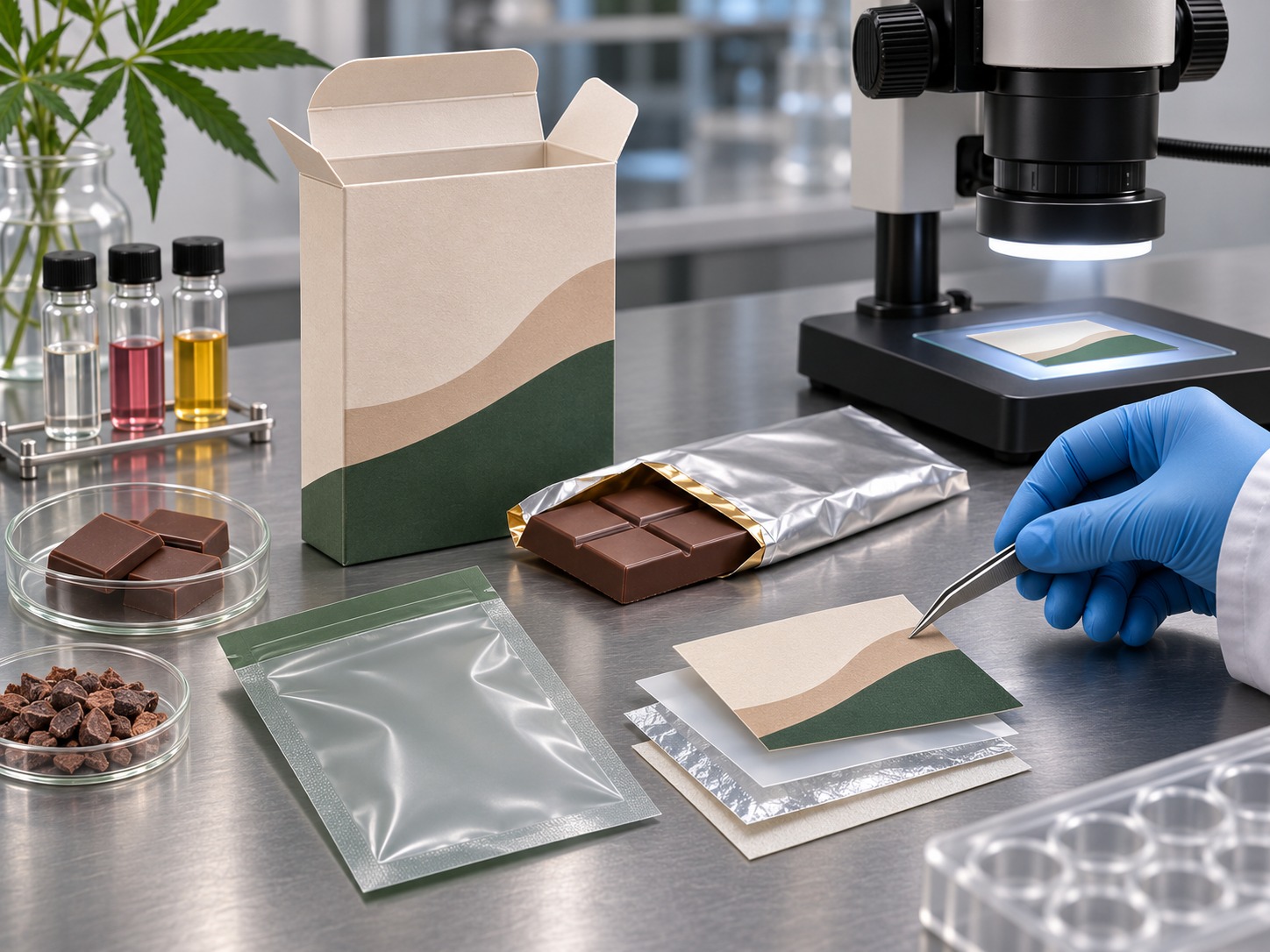
For example, a printed outer paperboard carton surrounding an individually wrapped chocolate bar presents a different contact arrangement from a printed stand-up pouch that directly contains loose gummies.
The critical variable is not the marketing description of the package. It is the actual route between the printing layer and the edible product.
Four Ways Substances Can Reach the Product
1. Migration through the packaging material
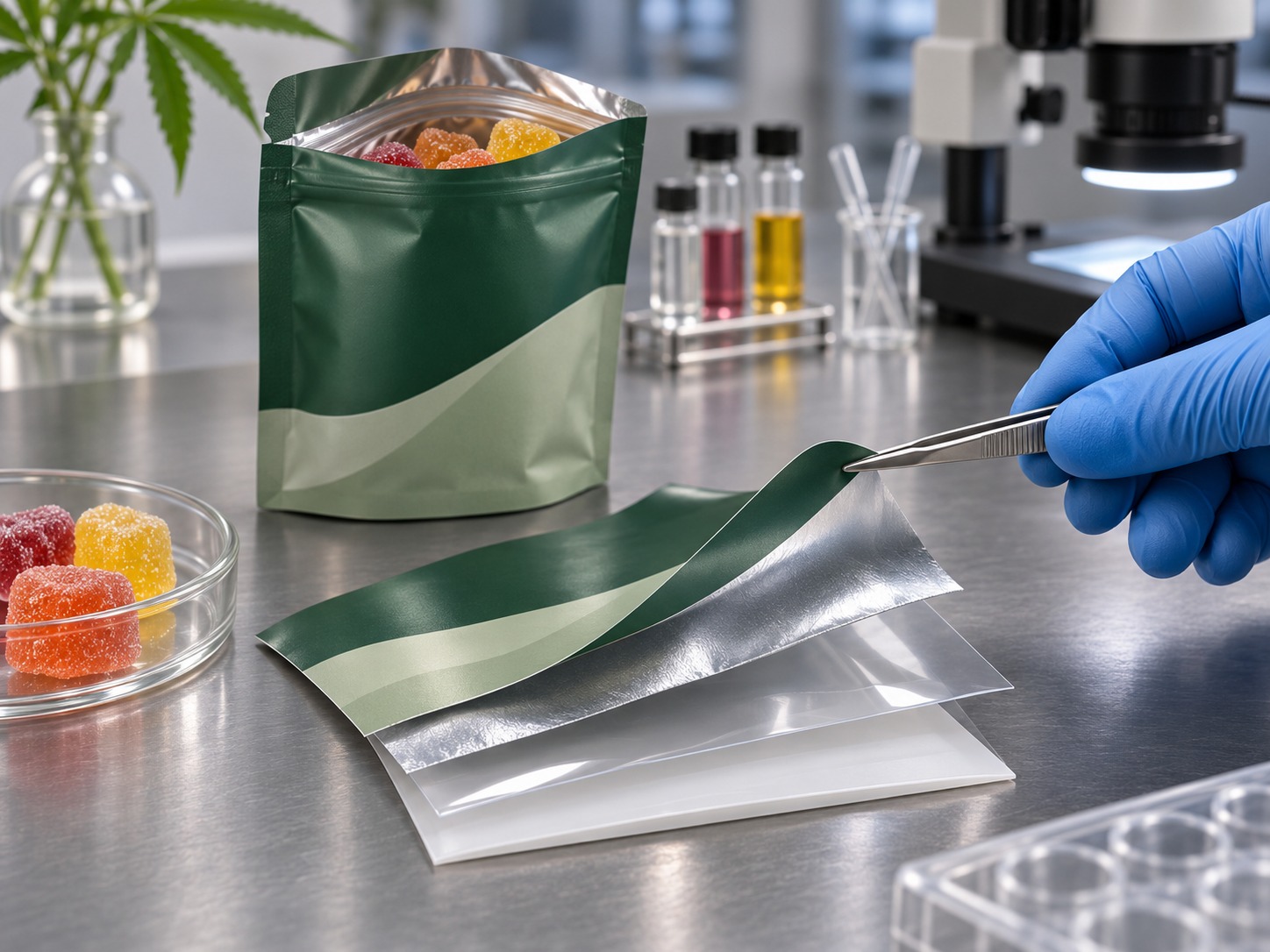
In a direct-contact pouch, printing may be applied to the exterior of a multilayer film. Depending on the structure and substances involved, ink components may pass through intervening material toward the inner food-contact layer.
For example, a printed film could contain:
- an outer PET or OPP printing layer;
- printing ink;
- lamination adhesive;
- an intermediate barrier layer;
- an inner PE or CPP sealant layer.
Each actual layer and its arrangement affects the migration assessment.
2. Set-off during winding or stacking
Printed film is wound into rolls. Printed paperboard sheets are stacked.
During these operations, a printed surface may contact the reverse face of another section of the material.
Ink-related substances can then transfer to the surface that will eventually face the product.
This can happen before the package is filled.
3. Transfer through the package headspace
Some volatile substances can enter the gas phase and move inside the package.
This matters when a printed material and the edible share an enclosed space, even without direct physical contact.
4. Direct contact
If printing is exposed on a surface that touches the edible, the food-contact assessment must explicitly cover that intended use.
Examples to investigate include:
- printing on the inner surface of a wrapper;
- printed paper that directly touches chocolate;
- decorative ink on a food-contact tray;
- an incorrectly oriented printed film.
| Transfer Route | Where It Can Occur | What to Verify |
|---|---|---|
| Through-material migration | Printed pouch or film | Complete laminate, substance properties and conditions of use |
| Set-off | Wound film, stacked cartons, nested trays | Reverse-face contact, drying/curing and storage controls |
| Gas-phase transfer | Enclosed wrapper or carton | Volatile components, barriers and headspace exposure |
| Direct transfer | Printed food-contact face | Specific suitability of the ink/coating for the actual contact use |
How Packaging Structure Changes the Risk
Consider four packaging configurations for the same edible product.
| Packaging Configuration | Contact Arrangement | Main Qualification Question |
|---|---|---|
| Printed multilayer stand-up pouch | Edible touches the inner polymer layer | Do the ink, adhesive and layer structure support the intended food-contact conditions? |
| Printed paperboard box with individually wrapped edibles | Primary wrapper separates edible from carton | Is the wrapper a suitable barrier, and has set-off been controlled? |
| Printed paperboard tray directly holding chocolate | Chocolate contacts the paperboard surface | Are the board, coatings and printing system appropriate for direct contact? |
| Printed outer carton around a sealed jar | Jar and closure separate product from carton | Is the jar/closure system an adequate barrier under the intended use? |
A packaging brand can reduce an uncertain exposure pathway by changing the architecture rather than only changing ink.
For example, a correctly specified primary wrapper can separate a chocolate bar from a highly decorated outer carton. But the wrapper needs its own material and compliance review.
What Are Low-Migration Printing Inks?
Low-migration inks are formulated for packaging applications where transfer of ink components must be controlled.
The term refers to an intended performance characteristic, not a universal legal certificate.
A low-migration ink may be appropriate for certain indirect food-contact packaging applications when used with its specified:
- substrate;
- printing process;
- ink deposit or coverage;
- drying or curing conditions;
- intervening packaging layers;
- intended storage conditions.
Replacing conventional ink with a low-migration product does not eliminate the need to examine the rest of the package.
Low migration is not the same as low odor
A printed package may have little noticeable smell while still requiring a migration assessment.
Likewise, an unusual smell can indicate a production or material issue without identifying which chemical substances are present.
Odor inspection is useful for finding suspicious packaging lots. It does not substitute for an appropriate chemical evaluation.
Low migration is not the same as food-contact approved
Ask the ink supplier to specify which applications its recommendation covers.
An ink suitable for printing on the outside of a multilayer pouch with an effective barrier should not automatically be assumed suitable for direct contact with a chocolate bar.
What Does U.S. Food-Contact Regulation Require?
U.S. food-contact compliance is tied to the substance and its intended use, not simply to a broad marketing label such as "FDA approved packaging."
The FDA identifies several possible regulatory pathways for substances used in food-contact materials, including:
- applicable regulations in 21 CFR Parts 174–179;
- qualifying GRAS status;
- prior sanctions;
- Threshold of Regulation exemptions;
- effective Food Contact Notifications (FCNs).
The suitability of a particular authorization depends on details such as substance identity, manufacturer and conditions of use.
For an FCN, FDA states that its effectiveness is specific to the identified manufacturer, substance and conditions of use.
FDA: Determining the Regulatory Status of Components of a Food Contact Material
Does FDA approve individual printing inks?
Do not treat a supplier statement saying "FDA-approved ink" as a complete answer.
U.S. food-contact rules concern the applicable substances and uses. A blanket approval of a commercial printing-ink product is not a substitute for evaluating migration and regulatory status.
Ink manufacturer Siegwerk explains this distinction in its North American regulatory guidance, including the need to examine migration, set-off and functional barriers.
Siegwerk: Regulations in North America
Food-contact material compliance and cannabis product legality are separate matters. An FDA-related food-contact authorization does not constitute FDA approval of a THC edible or establish compliance with a state's cannabis packaging regulations. Brands must separately assess the applicable licensed-market requirements, including child resistance, tamper evidence, labeling and material restrictions.
Ink Migration in Cannabis Gummy Pouches
A stand-up gummy pouch is a useful example because the package may combine several material systems:
- printed outer film;
- lamination adhesive;
- barrier film or metallized layer;
- inner sealant;
- zipper;
- heat seal.
Before approval, request a cross-section or written laminate construction showing the order of those layers.
Five questions for the printed gummy pouch
- Which side of the film is printed?
- Does printing contact the inner food-contact face during winding or conversion?
- Which specific layer is intended to act as the functional barrier, if any?
- What temperature and storage duration are included in the supplier's use assessment?
- Does the evidence cover the finished pouch structure, including the actual inks and adhesives?
What about sticky, acidic or oil-containing gummies?
Food composition changes how contact materials should be assessed.
A gummy containing organic acids may present different contact conditions from a fatty chocolate bar. An edible with a sticky surface can maintain prolonged contact with the pouch's inner layer.
Tell the packaging supplier what type of product will contact the material.
For a formal migration study, an appropriately qualified laboratory should select relevant food simulants, exposure conditions and analytical methods based on the actual use.
Do not substitute a generic pouch test performed for a different food and storage condition without reviewing its scope.
Printed Chocolate Wrappers and Cartons
Chocolate creates a different packaging problem because it is a fat-containing food.
A chocolate package may contain:
- primary wrap;
- inner tray;
- outer paperboard carton.
The package should be evaluated from the chocolate outward.
Example: Individually wrapped chocolate inside a rigid carton
Start with the wrapper.
Record its:
- food-contact face;
- film or foil structure;
- sealing system;
- printing location;
- intended storage temperature.
Then review the outer carton.
If the printed carton is physically separated from the chocolate by an appropriate and continuous wrapper, the exposure assessment differs from a carton in direct contact with the chocolate.
However, the wrapper must remain intact during actual packing and handling.
Example: Chocolate directly against a printed paper tray
The review changes immediately.
Now the paperboard, printing, coating and any transferred ink substances may be relevant to direct-contact suitability.
Changing the package from wrapped to unwrapped chocolate is therefore a material-use change, even if the outside artwork does not change.
Printed Paperboard and Direct Food Contact
Paperboard is widely used for premium cannabis edible cartons, but paperboard is not automatically an effective barrier to all small chemical molecules.
Relevant variables include:
- fiber and coating composition;
- board thickness;
- printed ink system;
- storage conditions;
- direct or indirect contact;
- additional film or wrapper layers.
For a child-resistant paperboard box intended to hold wrapped gummies, the food-contact wrapper may be the component requiring the most direct food-contact evidence.
For a box intended to hold loose gummies, the entire packaging proposal needs a different assessment.
Ask the supplier to state whether the proposed paperboard structure is intended for direct contact, indirect contact or secondary packaging only.
Does heavier paperboard stop ink migration?
No universal thickness establishes a barrier for every substance.
A thicker carton can improve stiffness or crush resistance without proving chemical migration control.
Likewise, a glossy or matte finish is not automatically a functional barrier.
Only use a barrier claim when it is supported for the materials and conditions involved.
How to Evaluate Functional Barriers
A functional barrier is an intervening material that sufficiently limits migration under the applicable conditions.
It is not the same thing as a moisture barrier or odor barrier.
| Claim | What It Addresses | What It Does Not Prove by Itself |
|---|---|---|
| Moisture barrier | Water vapor transfer | Control of every ink component |
| Oxygen barrier | Oxygen transmission | Control of every organic migrating substance |
| Odor barrier | Specified volatile-compound transfer or leakage | Full chemical migration compliance |
| Functional migration barrier | Relevant chemical transfer under stated conditions | Performance outside its qualified conditions |
The word "metallized" is not enough to establish a functional barrier. A metallized film and a continuous aluminum foil structure can have very different construction and performance characteristics.
For a migration-sensitive packaging project, ask exactly which layer provides the claimed protection and what evidence supports it.
How Set-Off Happens During Printing and Storage
Set-off can occur before the packaging becomes a bag or a box.
Flexible-film example
A printer produces several thousand meters of film and winds the material into a roll.
The printed face contacts the opposite face of the film as the roll builds.
Under unfavorable conditions, ink-related substances may transfer to the future inner surface of the package.
The final pouch can look perfectly clean while the contact surface carries transferred substances that are not visually obvious.
Paperboard example
Printed cartons are stacked after printing.
The decorated face of one sheet touches the reverse face of the next sheet.
Insufficient drying or inappropriate storage conditions can increase the likelihood of transfer.
Production controls to request
- documented ink drying or curing settings;
- approved ink/coating system;
- winding or stacking conditions;
- material-specific set-off controls;
- release criteria for printed rolls or sheets;
- identification of nonconforming production lots.
An ordinary visual rub test can reveal visible transfer or smearing, but it does not detect every invisible chemical-transfer pathway.
For surface scuffing and ink durability, see the separate Cannabis Packaging Rub Test Guide.
UV Inks, Photoinitiators and Curing
UV-curable ink systems use light-driven reactions to form a cured ink film.
Some UV systems use photoinitiators, which produce reactive species when exposed to the intended curing light.
The FDA has identified photoinitiators in printing inks used on the exterior of food packaging as substances warranting investigation for certain intended uses and possible migration.
FDA: Printing Ink Photoinitiator Research
What should a cannabis brand ask the printer?
Ask whether the selected ink and curing system are suitable for the exact package structure and intended edible-contact conditions.
Also request the established production controls for:
- curing energy and equipment settings;
- ink coverage;
- approved substrates;
- post-print handling;
- material or ink substitutions.
A visually dry, glossy surface is not proof that all relevant curing and migration requirements have been satisfied.
What about Spot UV on an outer carton?
Spot UV can be an appropriate decorative finish on a secondary carton. The answer depends on whether the carton is separated from food by a suitable primary package and whether the printing system is used under its qualified conditions.
Do not transfer conclusions from a sealed-wrapper chocolate box to a carton designed to hold unwrapped food.
When Is Migration Testing Needed?
A packaging brand should not assume every artwork variation requires a complete new laboratory program.
It should also not assume that a supplier's one-page "food-safe" statement covers every use.
A useful decision process begins with available evidence.
| Situation | Practical Next Step |
|---|---|
| Supplier has full, relevant documentation for the exact construction and intended use | Review scope, retain evidence and check for material changes |
| Supplier has a migration report for another food or temperature | Ask a qualified specialist whether the evidence covers the intended use |
| Printed film is newly laminated or the ink system changes | Reassess migration and set-off risk; determine whether further testing is needed |
| Artwork changes but ink family, coverage and conditions remain within the qualified range | Confirm whether existing qualification remains applicable |
| Direct-contact paperboard has no food-contact documentation | Hold approval until suitable supporting evidence is provided |
| Customer or applicable rule requires independent migration testing | Commission testing to the appropriate specification |
What a laboratory report should identify
At minimum, the reviewer should be able to establish:
- tested packaging material and revision;
- food-contact side;
- sample preparation;
- food or simulant used;
- time and temperature;
- analytical target substances or screening scope;
- method detection and quantification information where relevant;
- results and applicable evaluation criteria;
- testing laboratory and report date.
A number printed on a report is not useful without the context showing what it represents.
Choosing Realistic Test Conditions
Migration depends on exposure conditions.
For a cannabis edible, document at least three operational phases:
- time between packaging manufacture and filling;
- time and temperature during finished-product storage and distribution;
- intended retail shelf life.
Example: Shelf-stable gummies
Record the expected storage condition and maximum intended shelf life. If the product may experience warmer distribution conditions, include that fact in the laboratory brief.
Example: Chocolate bars
Document intended temperature control, the primary wrapper construction and the possibility of fatty food contacting the wrapper over time.
Example: Printed cartons stored before filling
Examine whether printing, stacking and storage expose the future food-contact surface to set-off before the final edible is inserted.
There is no single universal migration limit that can be applied to every substance, packaging structure and cannabis edible. The applicable assessment depends on the chemistry, intended use, regulatory basis and testing approach. Have the qualified supplier, laboratory or food-contact specialist determine the appropriate criteria rather than adopting an arbitrary number from a generic packaging checklist.
A Practical Set-Off Screening Exercise
The following in-house screen can help flag visibly problematic printing or handling. It is not a standardized chemical migration test.
- Collect three production-representative printed samples from different positions in the print run.
- Confirm which face will contact the food or face another layer in production.
- Place the printed and reverse surfaces together in the same orientation experienced during stacking or winding.
- Apply only the pressure, duration and temperature conditions documented for the production process.
- Separate the surfaces and inspect for visible ink transfer, tack, blocking or coating damage.
- Record photographs, lot identification and print conditions.
- Escalate any visible transfer and investigate chemical migration separately where required.
A clean screen means no visible defect was found under those conditions. It does not prove the absence of invisible migration.
What to Request From Your Packaging Supplier
Include the intended edible-contact application in the RFQ before the supplier selects inks, film or coatings.
Request the following information:
| Requested Document or Detail | What It Resolves |
|---|---|
| Complete material construction | Identifies the layers between print and edible |
| Food-contact surface identification | Confirms which material touches the food |
| Ink and coating application statement | Clarifies approved printing uses and limitations |
| Food-contact compliance declaration | Connects the actual material to applicable regulatory status |
| Barrier evidence, where claimed | Supports the particular functional-barrier conclusion |
| Migration report, when applicable | Documents testing for relevant conditions |
| Printing and set-off controls | Addresses transfer during production and storage |
| Material and ink revision control | Prevents unreviewed substitutions |
| Production-lot traceability | Links delivered packaging to qualified materials |
Five supplier answers that need clarification
"Our film is food-grade." Ask which layer contacts food and what conditions the declaration covers.
"We use low-migration ink." Ask for the ink manufacturer's applicable use statement and the qualified packaging structure.
"The ink does not touch the food." Ask how through-material migration and set-off have been addressed.
"We have an SDS." A safety data sheet is not, by itself, a finished-package migration assessment.
"We have never received a complaint." The absence of consumer complaints does not establish compliance with a chemical migration requirement.
Production Approval Workflow
Step 1: Define the edible product
Record whether the package will hold gummies, chocolate, hard candy or another product, and whether the product contains fatty or acidic ingredients relevant to contact-material selection.
Step 2: Identify primary and secondary packaging
Distinguish what actually touches the edible from the branded outer carton.
Step 3: Map printing and coating surfaces
Specify the printed face, laminating layers, reverse side and potential set-off contact points.
Step 4: Record the intended storage conditions
Document storage time, temperature and the product's planned shelf life.
Step 5: Collect supplier documentation
Match each declaration or test report to the actual material and revision ordered.
Step 6: Determine the qualification gap
Identify which substances, contact conditions or components remain unsupported by the available evidence.
Step 7: Arrange appropriate testing if needed
Use a qualified laboratory and an agreed test brief rather than asking for a generic "food safety test."
Step 8: Approve production-intent samples
Use the intended film, ink, adhesive, coatings and finished package construction.
Step 9: Validate package performance separately
Confirm child resistance, tamper evidence, closure, seal integrity and product fit using the requirements appropriate to the intended market.
Step 10: Lock the material specification
Require documented approval before changing the ink, adhesive, coating, laminate or production source.
Step 11: Verify incoming production lots
Check material and revision identifiers against the approved documents.
Step 12: Retain the evidence
Keep the material specification, supplier declarations, reports, artwork revision and signed final sample together with the packaging SKU.
For the broader packaging sample approval process, read Cannabis Packaging Sample Checklist Before Production.
Material Changes That Trigger Requalification
A repeat order may look identical while the chemical exposure conditions have changed.
| Change | Why It Requires Review |
|---|---|
| Ink supplier or formulation | Different migrating substances or curing requirements |
| UV curing system or settings | Changes the conditions affecting the cured printed film |
| Adhesive formulation | May alter the substances present in the laminate |
| Barrier layer or thickness | Can change the migration pathway |
| Inner sealant material | Changes the direct food-contact surface |
| Printing side or printing process | May create direct contact or set-off exposure |
| Product changes from wrapped to unwrapped | Changes which surfaces contact the edible |
| Storage time or temperature | Changes intended exposure conditions |
| Different edible formulation | May change food-contact and migration assumptions |
Changing the printed logo alone is not necessarily equivalent to changing the ink chemistry. But if the new artwork uses a different ink system, new specialty color, higher coverage or additional UV coating, review whether the existing qualification still applies.
420 Packaging Products to Evaluate
1. Hemp Zipper CBD Edible Bags / Gummies Bags
420 Packaging lists this flexible packaging format with customizable structures including PET, OPP or MOPP combined with VMPET and CPP or PE, as well as gravure printing and multiple pouch configurations.
For a gummy packaging project, request the exact structure selected for the finished order rather than treating every available material option as equivalent.
Ask for:
- the selected layer sequence;
- identification of the direct food-contact surface;
- ink and lamination adhesive information;
- applicable food-contact documentation;
- migration and set-off evidence appropriate to the intended use.
2. Child Proof Chocolate Bar Packaging
This customizable 420 Packaging paperboard format is listed with coated/art paper and greyboard, CMYK or Pantone printing, and optional matte or glossy lamination, varnish, hot foil and Spot UV.
The food-contact review depends on how the chocolate is packed.
For individually wrapped chocolate, assess the primary wrapper first, then determine whether the decorative carton introduces any additional relevant exposure.
For an unwrapped product, do not assume the printed board or decorative finish is suitable for direct food contact without specific supporting evidence.
3. Wholesale Child Resistant Edible Packaging
420 Packaging offers a rigid paper sliding-box format for gummies, chocolate and other edible products. Its product description identifies coated paper and greyboard construction with cardboard or PVC insert options.
That creates a useful design decision:
If the edible is individually wrapped, the insert can primarily support product fit and separation. If the edible might contact the tray directly, the exact tray material and intended food-contact conditions require a separate assessment.
Selecting cardboard instead of PVC, or vice versa, also changes the material specification. Neither option should be accepted for direct food contact based only on its name.
Related Packaging Checks That Should Stay Separate
Ink migration should be one part of a complete edible packaging approval, not a replacement for other tests.
| Existing 420 Packaging Topic | Question It Answers |
|---|---|
| PFAS in Cannabis Edible Packaging | What PFAS-related restrictions and supplier evidence apply? |
| Cannabis Gummy Packaging Heat Test | How do heat, clumping and physical package performance change? |
| Cannabis Flower Pouch Seal Test | How should physical pouch-seal failures be investigated? |
| Cannabis Packaging Color Consistency | Do printed colors match the intended brand target? |
| Cannabis Packaging Sample Checklist | Is the entire package ready for production? |
A pouch could pass a heat-seal test and still lack appropriate food-contact evidence. A carton could match its Pantone target and still require a review of the inks, coatings and inner wrapper.
Cannabis Edible Packaging Ink Migration Checklist
| Review Item | Acceptance Question |
|---|---|
| Edible type | Is the intended gummy, chocolate or other product identified? |
| Contact surface | Which exact material touches the edible? |
| Package architecture | Are primary wrapper, tray and outer carton distinguished? |
| Printing side | Is ink location documented? |
| Laminate | Is the complete layer sequence recorded? |
| Ink system | Is the intended food-packaging application supported? |
| Adhesives | Are lamination and other relevant adhesives included? |
| Coatings | Are UV, varnish and other finishes evaluated? |
| Set-off | Are winding and stacking transfer pathways controlled? |
| Barrier | Is the claimed functional barrier supported for relevant substances? |
| Time and temperature | Does evidence match actual storage and distribution conditions? |
| Regulatory status | Is the applicable food-contact basis documented? |
| Laboratory report | If needed, does it match material, contact conditions and scope? |
| Child resistance | Has packaging safety been validated separately? |
| Production samples | Are samples representative of actual production materials? |
| Change control | Will ink, film, adhesive and supplier substitutions trigger review? |
| Traceability | Can delivered lots be linked to approved material revisions? |
FDA — Determining the Regulatory Status of Components of a Food Contact Material
FDA — Hazard Identification of Printing Ink Substances Used on the Exterior of Food Packaging
FDA — Understanding How the FDA Regulates Food-Contact Substances
Siegwerk — North American Printing Ink Regulations
Before ordering printed gummy pouches or chocolate cartons, define the complete package structure and food-contact conditions. Send the product format, target package dimensions, direct-contact requirements, expected storage conditions, printing finishes and child-resistant needs with your packaging RFQ.
420 Packaging can help compare custom pouch, paperboard carton, insert and secondary-box configurations. Request material-specific documentation for the production version being purchased and arrange any required compliance review or testing before mass production.
Frequently Asked Questions
1. Can printing ink migrate through cannabis edible packaging?
Yes. Depending on the materials and conditions, ink-related substances can move through packaging layers, transfer through set-off during winding or stacking, or travel through the headspace. Printing on the outside does not automatically eliminate migration risk.
2. What is low-migration ink?
Low-migration ink is formulated for packaging applications where transfer of ink components must be controlled. Its suitability depends on the actual substrate, printing process, package construction, curing conditions and intended food-contact use. The description alone does not certify every finished package.
3. Does food-grade packaging guarantee that printing ink is safe?
No. The food-contact suitability of a base film or paperboard does not automatically cover every ink, coating, adhesive and finished printing configuration. Request documentation tied to the actual material structure and conditions of use.
4. What is ink set-off in packaging?
Set-off occurs when substances from the printed surface transfer to another surface during winding, stacking or nesting. In food packaging, the receiving surface may later become the food-contact side of the finished package.
5. Can ink migrate from the outside of a gummy pouch?
It can, depending on the laminate and ink system. Brands should verify the full layer sequence, direct-contact surface, functional-barrier claims, printing configuration and relevant migration or compliance evidence.
6. Are UV inks safe for cannabis edible packaging?
Suitability depends on the specific ink system, intended use, curing controls and package structure. FDA research has examined photoinitiators in UV-cured printing inks because some substances may migrate from the exterior of food packaging under certain conditions.
7. Does a metallized pouch automatically block ink migration?
No. The word metallized does not establish a functional barrier against every ink component. Request evidence for the exact structure, substances and intended contact conditions. A metallized film should not automatically be treated as equivalent to a continuous aluminum foil barrier.
8. Is a printed paperboard chocolate box safe if the chocolate has an inner wrapper?
The inner wrapper can change the exposure pathway, but its actual material and barrier performance still need to be evaluated. The suitability of the full packaging arrangement depends on the wrapper, printed carton, storage conditions and intended use.
9. Can a packaging safety data sheet replace migration testing?
No. A safety data sheet provides information about a chemical product, but it is not automatically evidence that the finished package meets the migration requirements for a particular edible and storage condition.
10. How should cannabis brands choose migration test conditions?
Document the actual edible type, direct-contact layer, anticipated temperature, storage duration and shelf life. A qualified laboratory or food-contact specialist should select the appropriate test methods, food simulants and evaluation criteria for that intended use.
11. Does a successful heat-seal test prove the pouch is food-contact compliant?
No. A heat-seal test evaluates physical sealing performance. It does not independently establish chemical migration compliance for printing inks, adhesives or packaging layers. Both issues need separate review.
12. Which packaging changes require a new ink migration review?
Changes to ink formulation, adhesive, laminate layers, inner sealant, functional barrier, print orientation, curing process, food-contact arrangement, storage conditions or edible formulation should trigger a review of whether existing documentation remains applicable.